Chemistry 2.12 - Potable water and dissolved salts
Explain how water treatment removes suspended solids and microorganisms, and how distillation separates water from dissolved salts. Use evaporation evidence to distinguish drinking water from water suitable for chemical analysis.
Potable, pure and dissolved
Potable water is water that is safe to drink. It does not have to be chemically pure water.
Chemically pure water
Chemically pure water contains only the compound water, , and no other substance.
At the macroscopic level, potable tap water may look colourless and clear. Appearance alone cannot show whether substances are dissolved in it. A clear sample can contain small amounts of dissolved salts and still be safe to drink.
At the particle level, a dissolved salt has separated into particles that are spread among the water molecules. These particles are too small to settle and they pass through ordinary filter paper with the water. The solution is therefore a mixture even though no solid grains can be seen.
This is different from an insoluble, suspended solid, such as fine mud. Its particles do not dissolve. Larger suspended particles can settle under gravity, while smaller ones can be trapped by a filter.
| Material in water | Particle behaviour | Useful treatment idea |
|---|---|---|
| Larger suspended insoluble solids | Can settle when water is left still | Sedimentation |
| Smaller suspended insoluble solids | Remain suspended but can be trapped | Filtration |
| Dissolved salts | Particles are dispersed through the water | Distillation is needed to separate the water from them |
| Harmful microorganisms | May remain after physical particle removal | Chlorination |
Treating waste and ground water
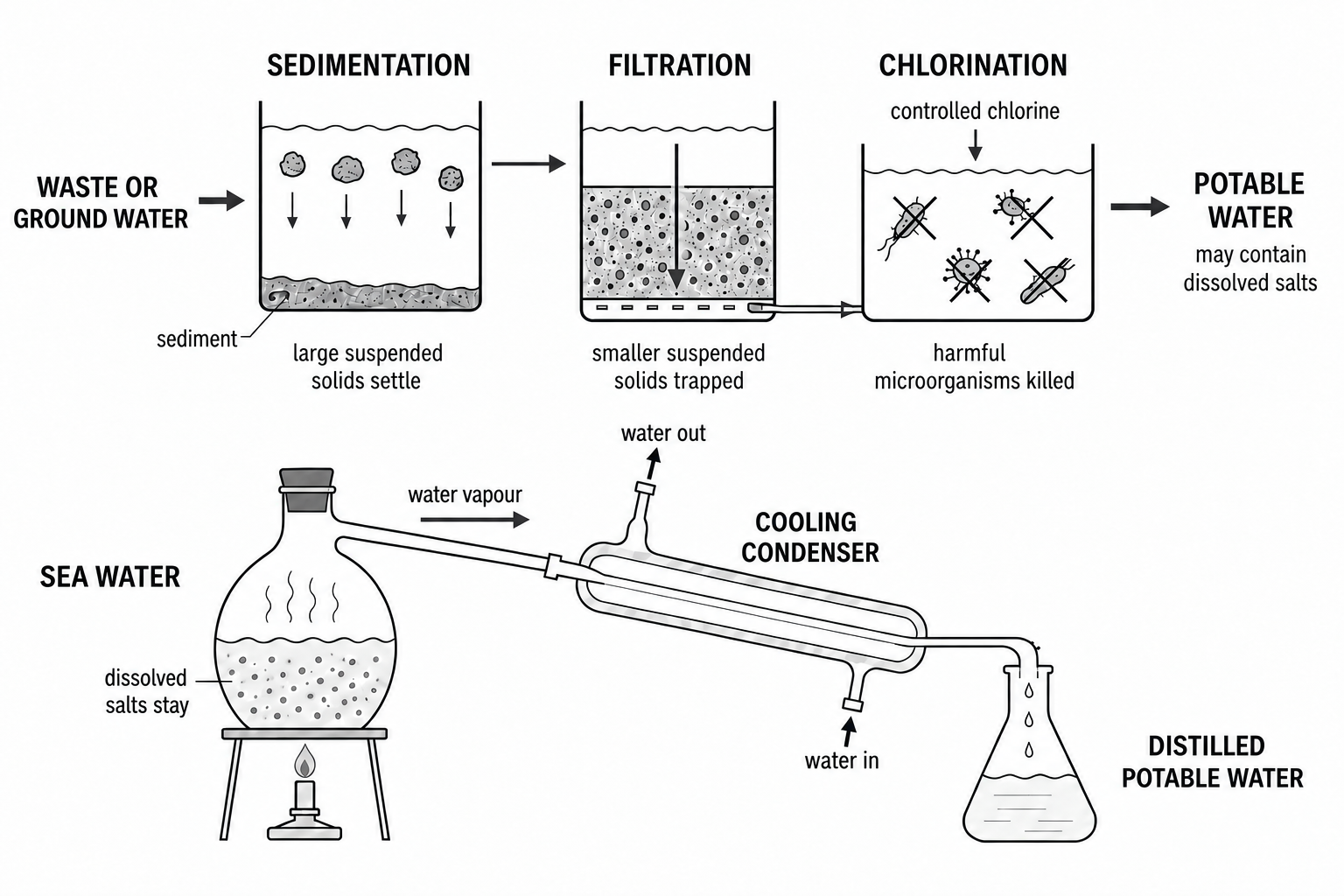
Waste water and ground water can contain suspended solids, dissolved substances and harmful microorganisms. Sedimentation, filtration and chlorination address suspended solids and microorganisms. Real treatment is selected for the contaminants present: these three stages alone do not remove every harmful dissolved chemical. Treated water must meet drinking-water standards before being called potable.
- Sedimentation: the water is held still, or its flow is slowed, in a settling tank. Larger or heavier suspended insoluble particles fall under gravity and collect as sediment. Clearer water can then be taken from above the sediment. This stage is needed to remove much of the solid load before finer treatment.
- Filtration: the water passes through fine filter material, such as layers of sand. Smaller suspended insoluble particles are trapped in the gaps. Water and substances dissolved in it pass through, so filtration does not remove dissolved salts.
- Chlorination: a carefully controlled amount of chlorine is mixed with the filtered water. Chlorine kills or inactivates harmful microorganisms that could cause disease. This is needed because water that merely looks clear is not necessarily microbiologically safe.
The order matters. Removing suspended matter first allows the final disinfection stage to act on much clearer water. After chlorination, the water can be potable while still containing acceptable dissolved substances: safe to drink does not mean pure .
The three roles can be summarised as sedimentation settles larger suspended solids → filtration traps smaller suspended solids → chlorination kills or inactivates harmful microorganisms.
Distilling sea water
Sea water is a solution of water with dissolved salts. The dissolved salt particles pass through an ordinary filter, so filtration cannot turn sea water into potable fresh water. Distillation separates the water by making it change state and collecting it elsewhere.
- Heat the sea water. Water boils or evaporates to form water vapour.
- The dissolved salts do not evaporate with the water under these conditions. They remain in the heated vessel, producing a more concentrated salt solution and eventually a residue if enough water is removed.
- Lead the water vapour into a cooler condenser. Energy is transferred from the vapour to the surroundings, so the vapour condenses to liquid water.
- Collect the condensed liquid, called the distillate, in a separate receiver. The water has followed an evaporation-condensation route; the salt has not.
No new substance is made. Evaporation and condensation are physical changes, and the separation works because water is volatile at a much lower temperature than the dissolved salts. Heating large quantities of water requires substantial energy, which is a limitation of using distillation on a large scale.
[DIAGRAM: asset_name: Chemistry 2.12 - Potable water and dissolved salts - diagram 01; asset_slug: chemistry_2_12_potable_water_and_dissolved_salts__diagram_01; recommended_method: image_gen; description: A clean monochrome two-route process diagram on white. The upper route begins with waste or ground water and uses left-to-right arrows through sedimentation, where large suspended insoluble particles settle downward as sediment; filtration, where smaller suspended insoluble particles are trapped while water and dissolved salts pass; and chlorination, where harmful microorganisms are killed or inactivated, ending at potable water that may still contain dissolved salts. The lower route begins with sea water in a heated flask; only water vapour follows an arrow into a cooling condenser and then into a receiver as distilled potable water, while dissolved salts remain in the heated flask. Use exact labels, visible arrowheads, #6A6B6E linework and light neutral-grey fills; exclude reverse osmosis, screening, biological sewage treatment, ion tests, colour, decorative frames and any arrow carrying salt into the distillate.]
Continue this lesson.
You’re previewing NovaLearn without an account. Create a free account to read the rest.
Create free account