Chemistry 4.11-4.12 - Life-cycle assessments
A product affects the environment before, during and after its use. Compare the same service across all four life-cycle stages, calculate totals and percentage changes, and use environmental trade-offs to reach a qualified conclusion.
The four stages of a life-cycle assessment
A life-cycle assessment (LCA) considers the environmental effects of a product from obtaining its raw materials to the point when the product is no longer useful. Looking at the whole route helps prevent a change that reduces an impact in one stage from quietly increasing it in another.
Pearson specifies four stages:
| Stage | What is considered | Examples of environmental data |
|---|---|---|
| 1. obtaining raw materials | mining or collecting resources and processing them into usable materials | amount of ore or other resource used, land disturbance, energy, water, waste and emissions |
| 2. manufacturing the product | shaping, joining and packaging the materials into the product | energy and water use, material losses, factory emissions and waste |
| 3. using the product | impacts while the product performs its job, including energy, water or maintenance it needs | electricity or fuel used, washing water, replacement parts, emissions and useful lifetime |
| 4. disposing of the product | what happens when it is no longer useful | reuse or recycling, transport, landfill, waste treatment, energy used and recovered material |
[DIAGRAM: asset_slug: che_e_life_cycle_stages; description: Four life-cycle stages, separate final-waste branch and recycling return; inputs and emissions at each stage.]
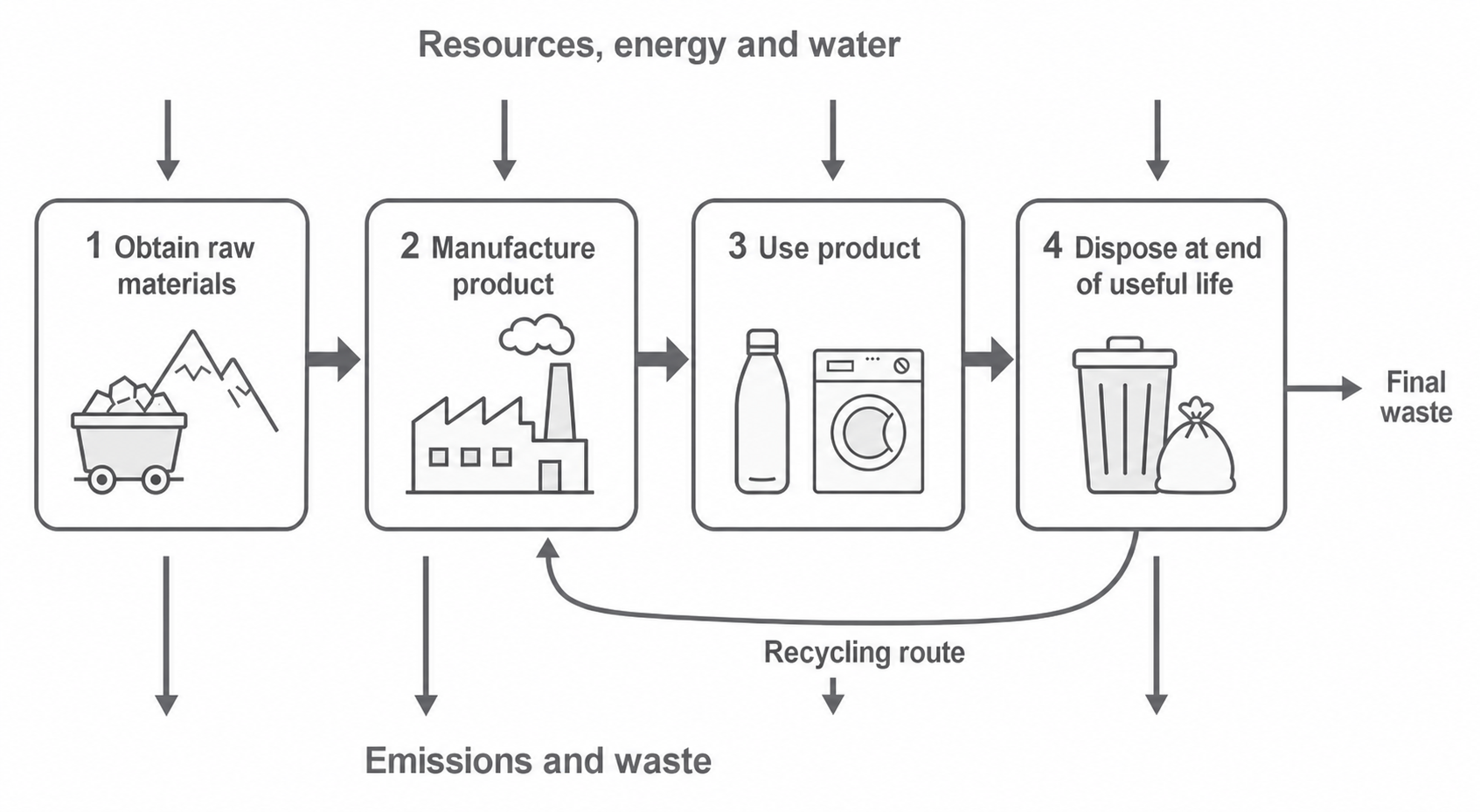
Each stage can have inputs, such as raw materials, energy and water, and outputs, such as a useful product, emissions and waste. Transport can contribute to the relevant stages, but it does not replace any of the four Pearson stages.
The word “cycle” does not mean that every product forms a perfectly closed loop. Some recovered metal can return to manufacture, while some material may be lost, contaminated or sent to final waste. An LCA records the disposal route that is actually assumed.
LCA evidence can include energy use, water use, mass of raw material, mass of waste and greenhouse gas emissions. A table may express climate impact in , meaning grams of carbon dioxide equivalent. That is one impact indicator, not a complete score for the environment.
Evaluating life-cycle data
Before comparing totals, make sure the products are doing the same job. Comparing one single-use container with one reusable container is unfair if the reusable one performs the job many times. The number of uses, product capacity and stages included must be clear.
A reliable evaluation follows this route:
- Check that both options provide the same service and use the same system boundary.
- For each impact indicator, convert to the same unit and total all included life-cycle stages.
- Compare the values using an absolute difference or percentage where useful.
- Identify which stage causes the largest difference and any trade-off between indicators.
- Check assumptions and missing data, such as product lifetime, number of reuses, recycled content, disposal route, energy source and transport.
- Give a qualified conclusion that says what the data support and what they do not establish.
Do not add unlike quantities directly. For example, + litres of water has no meaningful unit. Compare greenhouse gas emissions with greenhouse gas emissions, and water use with water use, before judging the trade-off.
Worked example: containers for 100 drinks
The following values are invented for method practice, not claims about real products. Both columns cover containers for the same 100 drinks and use the same boundary.
| Life-cycle measure | 100 single-use metal cans | 1 reusable metal bottle used 100 times |
|---|---|---|
| raw materials and manufacture / | 9500 | 2100 |
| use / | 0 | 1400 |
| disposal / | 500 | 200 |
| total water use over all four stages / L | 24 | 38 |
Continue this lesson.
You’re previewing NovaLearn without an account. Create a free account to read the rest.
Create free account