Physics 10.12 - 10.13 - Resistance and current
Changing resistance changes the current at a fixed potential difference. Learn how a variable resistor controls the conducting path, then use voltage and current to calculate resistance and predict charge flow.
How resistance controls current
Pearson supplies an equation sheet for the 2025–2027 GCSE Combined Science Physics exams. Practise selecting equations, understanding their quantities, converting units and rearranging them. The independent calculations here include the equation support they need.
Resistance describes how strongly a component opposes the flow of charge. Its symbol is and its unit is the ohm, .
The effect of changing resistance must be stated with the potential difference controlled:
- at the same potential difference, increasing resistance decreases current;
- at the same potential difference, decreasing resistance increases current.
A smaller current means that less charge passes a point each second. The charge has not disappeared and the current has not been used up; the rate of charge flow around the circuit has changed.
A variable resistor lets the resistance be adjusted. It can be placed in series with a component so that changing its setting changes the current in that branch. A sliding variable resistor must connect through one fixed end and the sliding contact (wiper). Using only its two fixed ends would include the whole wire whatever the slider position. Moving the wiper then changes the effective length of resistance wire in the circuit: a greater effective length gives a greater resistance.
Current is still charge per second; for a steady current, , where is charge in coulombs and is time in seconds. Thus a current change also changes the charge passing in a fixed time.
[DIAGRAM: asset_slug: combined_phy_e_variable_resistor; description: A fixed end and sliding wiper select the active resistance track; the second fixed end is unused.]
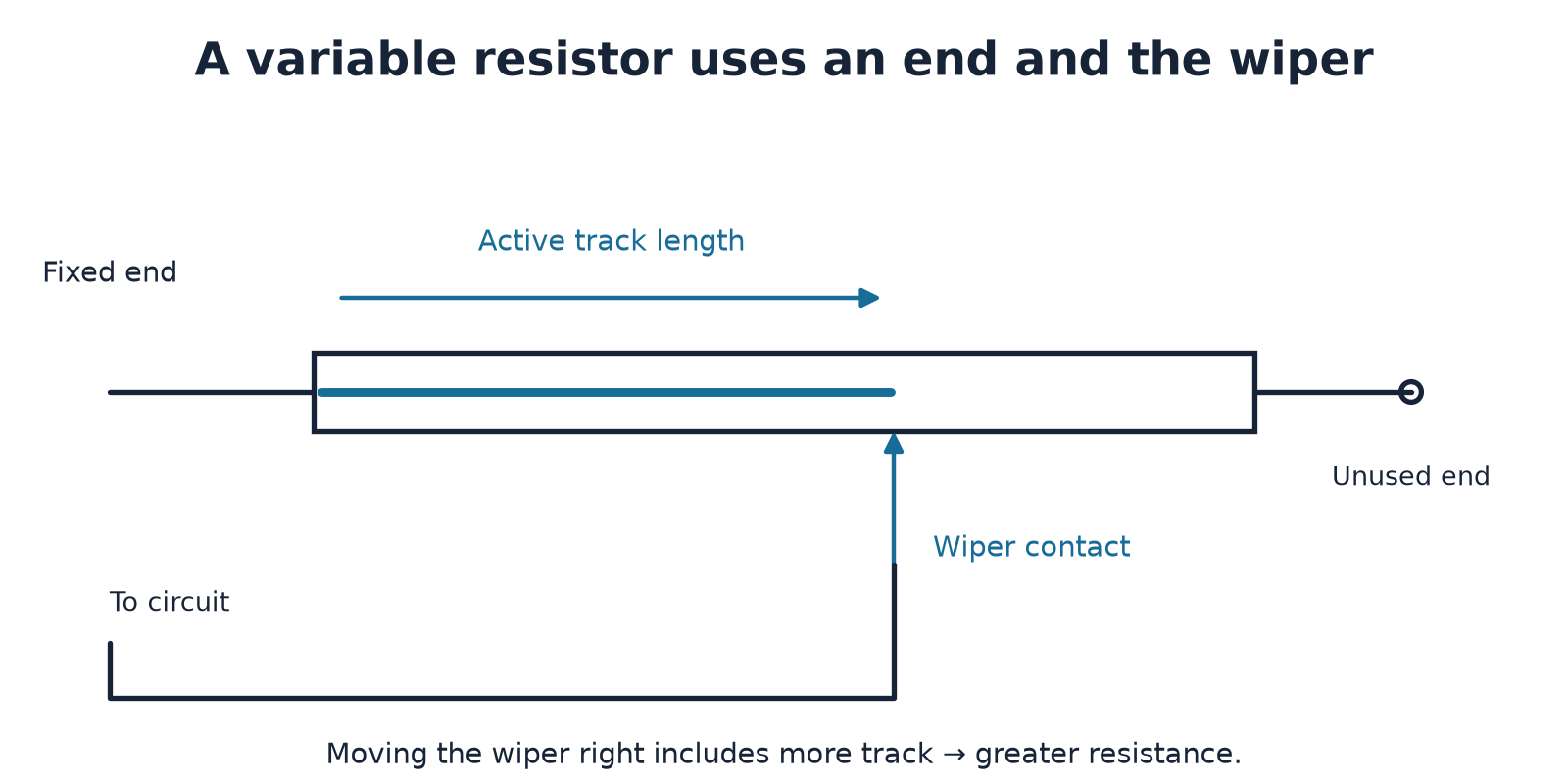
At fixed potential difference, the causal chain is:
move the contact → change the resistance → change the current
Increasing the variable resistor's resistance makes the current smaller; decreasing its resistance makes the current larger. This is control of current, not consumption of current.
Potential difference, current and resistance
Potential difference, current and resistance are linked. Use values for the same component or the same selected section of a circuit.
Continue this lesson.
You’re previewing NovaLearn without an account. Create a free account to read the rest.
Create free account