Chemistry 0.5 - 0.6 - Hazards and practical risk
Use container symbols to recognise hazards, then connect each practical risk to a precaution that reduces the chance or seriousness of harm.
Hazards, risks and safe working
A label starts the safety reasoning; it does not finish it.
Hazard, risk and control
A hazard is something with the potential to cause harm. Risk combines how likely that harm is in a particular procedure with how serious it could be. A control or precaution is a specific change that reduces the likelihood, exposure or severity.
Real GB CLP pictograms have a red diamond border. The monochrome chart below preserves the shapes used for recognition in this lesson.
[DIAGRAM: asset_name: Chemistry 0.1-0.6 - Formulae, equations and lab hazards - diagram 01; asset_slug: chemistry_0_1_0_6_formulae_equations_and_lab_hazards__diagram_01; recommended_method: image_gen; description: A white-background 3-by-3 monochrome chart of the nine current GB CLP hazard pictograms, with exact label-symbol pairings: Explosive/exploding bomb, Flammable/flame, Oxidising/flame over circle, Corrosive/liquid damaging hand and metal, Acute toxicity/skull and crossbones, Environmental hazard/dead tree and fish, Harmful or irritant/exclamation mark, Serious health hazard/torso with chest starburst, and Gas under pressure/horizontal cylinder; no risk ranking or chemical-specific claims.]
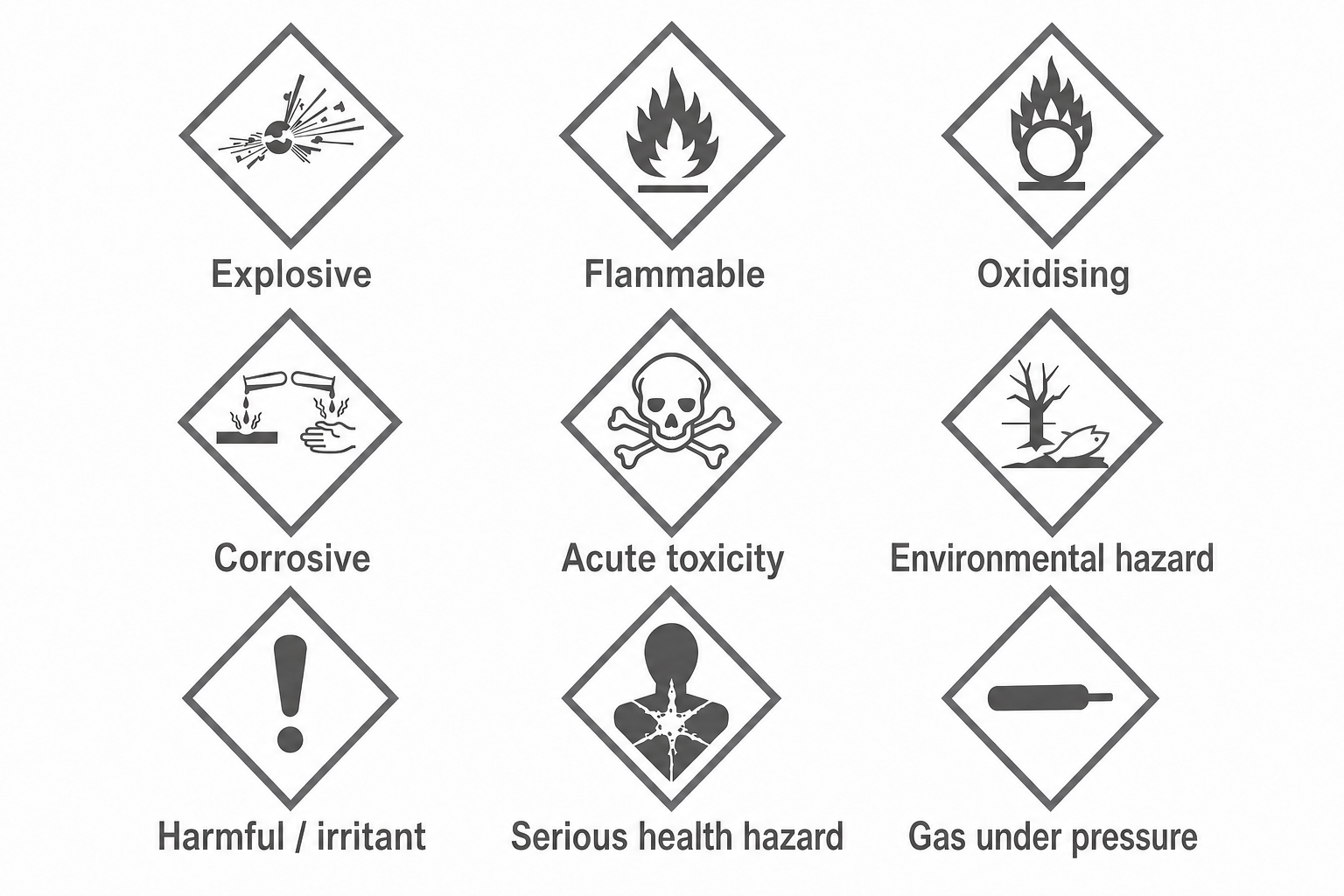
| Pictogram | Danger it signals | A linked safe-working response |
|---|---|---|
| Explosive | May explode after heat, impact or friction. | Keep away from heat/impact and use only the instructed small quantity behind suitable protection. |
| Flammable | Can catch fire readily. | Remove naked flames and other ignition sources; use a suitable water bath or electric heating method when instructed. |
| Oxidising | Can cause or intensify fire. | Keep away from fuels and other combustible materials. |
| Corrosive | Can cause severe skin burns or eye damage and may attack metals. | Prevent splashes with small controlled transfers and eye protection; follow immediate rinse/spill instructions. |
| Acute toxicity | Small exposure may cause severe or fatal poisoning. | Prevent inhalation, swallowing and skin exposure; use containment or a fume cupboard when instructed. |
| Environmental hazard | Can damage aquatic organisms or ecosystems. | Do not pour it down the sink unless instructed; use the specified waste container. |
| Harmful / irritant | May cause irritation or less severe acute harm. | Avoid skin/eye contact and inhalation; use ventilation and the specified protection. |
| Serious health hazard | May cause serious long-term effects such as organ damage, cancer or respiratory sensitisation. | Minimise exposure using substitution, containment and local extraction where specified. |
| Gas under pressure | The container may burst if heated; refrigerated gas may cause cold burns. | Keep cylinders secure and away from heat; use only the specified regulator and handling procedure. |
One substance may have several pictograms. Read the full label, hazard statements, precautionary statements and laboratory instructions: the icon alone does not reveal the concentration, quantity, exposure route or exact control needed.
How to evaluate a procedure
For each step, ask:
Continue this lesson.
You’re previewing NovaLearn without an account. Create a free account to read the rest.
Create free account