Physics 10.37 - 10.42 - Mains safety and appliance power
Live and neutral complete an appliance’s operating circuit; earth and protective devices deal with faults. Follow a live-to-case fault through disconnection, then connect power ratings to the rate at which energy stores change.
Equation support is provided for GCSE Combined Science Physics examinations in 2025–2027. Practise choosing, interpreting and rearranging the supplied relationships; these activities do not assume unaided equation memorisation.
Live, neutral and earth
Think of a metal-cased kettle connected to the UK mains. Its working components need two conductors, live and neutral, to make a complete circuit. A third conductor, earth, is a safety connection to the metal case rather than part of the normal operating circuit.
Potential difference
Potential difference is measured between two points. It tells us how much energy is transferred per unit charge between those points, so it is not meaningful to give a wire a potential difference without a reference point.
| Wire | Function in the appliance | Current in normal operation |
|---|---|---|
| Live | Connects the appliance to the alternating mains potential and supplies energy electrically to the appliance. | Carries the operating current. |
| Neutral | Completes the circuit back to the supply and is kept close to earth potential. | Carries the operating current. |
| Earth | Connects an exposed metal case to earth so a fault current has a low-resistance route. | Normally carries no current. |
Neutral is not a no-current wire. In normal operation, the same current passes through live, the appliance and neutral. The important safety difference is their potential relative to earth.
| Pair of wires | Normal potential difference |
|---|---|
| live to neutral | about |
| live to earth | about |
| neutral to earth | about |
The large potential difference from live to earth means that touching live while also connected to earth can drive a dangerous current through the body. A direct low-resistance connection between live and earth can also produce a very large current, causing heating, damage or fire.
How the safety system works
In normal use, the live current passes through the appliance and returns through neutral. The earth wire is connected to the metal case but carries no current.
Now suppose damaged insulation lets the live wire touch the metal case:
- The case is connected to live and could give a user an electric shock.
- The earth wire provides a low-resistance path from the case to earth.
- The approximately p.d. drives a large fault current through that path.
- The large current makes the fuse melt or makes the circuit breaker open.
- The live supply is disconnected, so the case does not remain live.
[DIAGRAM: asset_slug: phy_f_mains_fault; description: Live fuse and appliance circuit inside an earthed metal case; dashed fault connection explicitly joins live to case, giving a low-resistance earth path.]
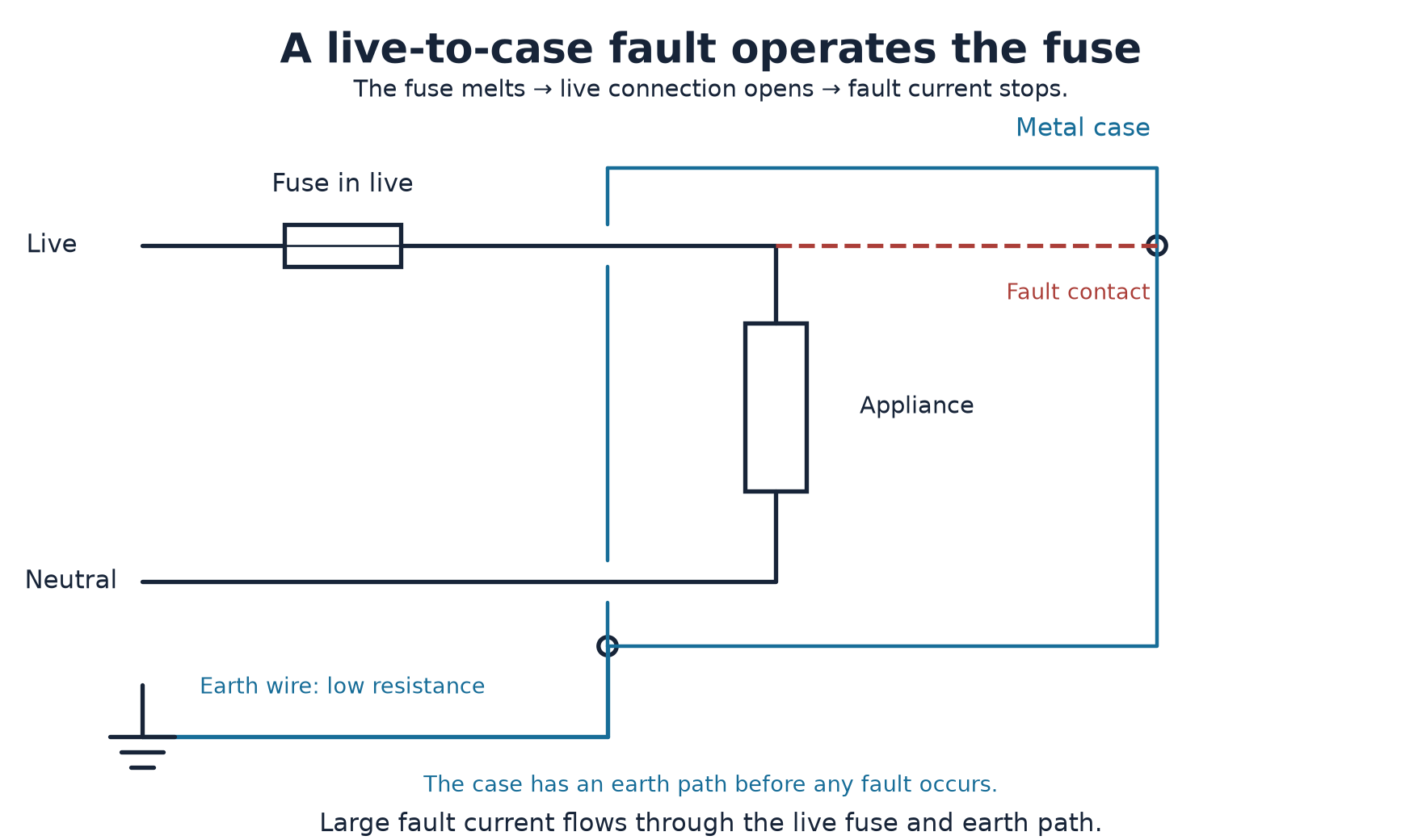
The dashed line marks the added fault contact. The case is already connected to earth before the fault occurs. The diagram shows the intact fuse at the moment of the fault; the caption describes the next event, when it melts and opens the live connection. Because the supply is a.c., fault-current direction alternates, but the path still passes through the live fuse and earth connection.
A fuse contains a thin wire connected in series. If the current exceeds its rating, the wire heats enough to melt and breaks the circuit; the fuse must then be replaced. A circuit breaker also opens the circuit when the current is too large, but it can usually be reset after the fault has been removed.
The earth wire does not absorb current and does not switch the appliance off by itself. It makes a large fault current possible so that the protective device acts quickly. This is why a live-earth connection is dangerous: protection must disconnect it rapidly.
Continue this lesson.
You’re previewing NovaLearn without an account. Create a free account to read the rest.
Create free account