Chemistry 2.1 - 2.4 - States and particle changes
Use the particle model to explain solids, liquids, gases and changes of state. Melting and boiling data then let you predict which state a substance has under stated conditions.
Particles in the three states
The particle model represents matter as tiny particles. The circles in a particle diagram are not magnified photographs, and the gaps are not filled with another material. The model helps connect what a sample does on the large scale with the arrangement, movement and relative energy of its particles.
| State | Arrangement | Movement | Relative particle energy | Observable behaviour |
|---|---|---|---|---|
| Solid | Particles are very close together in a regular arrangement. | They vibrate about fixed positions but do not move through the solid. | Lowest in this comparison. | A solid keeps a fixed shape and volume. |
| Liquid | Particles are still close together, but the arrangement is irregular. | They move randomly and slide around one another. | Higher than in the solid state but lower than in the gas state. | A liquid flows, takes the shape of its container and keeps a nearly fixed volume. |
| Gas | Particles are far apart with no regular arrangement. | They move rapidly and randomly in all directions. | Highest in this comparison. | A gas flows and spreads to fill its container. |
This compares the same substance as it is heated through its states at a fixed pressure. The relative-energy ranking includes energy associated with particle attractions; it is not a claim that every gas has faster particles than every liquid at any temperature. The table shows the usual regular model of a solid; some solids have disordered structures.
The particles in a liquid are mostly close together; a liquid is not a half-way diagram with gas-sized gaps. A solid's particles are not motionless. Temperature can change how energetically particles move, but a state change does not make each particle grow, shrink or turn from a solid particle into a liquid particle.
[DIAGRAM: asset_name: Chemistry 2.1-2.6 - States, purity and melting data - diagram 01; asset_slug: chemistry_2_1_2_6_states_purity_and_melting_data__diagram_01; recommended_method: image_gen; description: Three equal side-by-side monochrome particle-model panels on white, titled SOLID, LIQUID and GAS. Show exactly 12 identical same-size grey circles in each panel: solid closely packed in a regular lattice with tiny double-headed vibration marks around fixed positions; liquid closely packed but irregular with short varied movement arrows allowing particles to slide around one another; gas widely spaced throughout the whole container with longer random-direction movement arrows. Beneath each panel print the exact phrases 'close, regular - vibrate in fixed positions - lowest relative energy', 'close, irregular - move around each other - middle relative energy', and 'far apart, irregular - rapid random motion - highest relative energy'. Use #6A6B6E linework and text, visible arrowheads, no interconversion arrows, no particle size changes, no extra particles, no colour-dependent meaning and no decorative frame.]
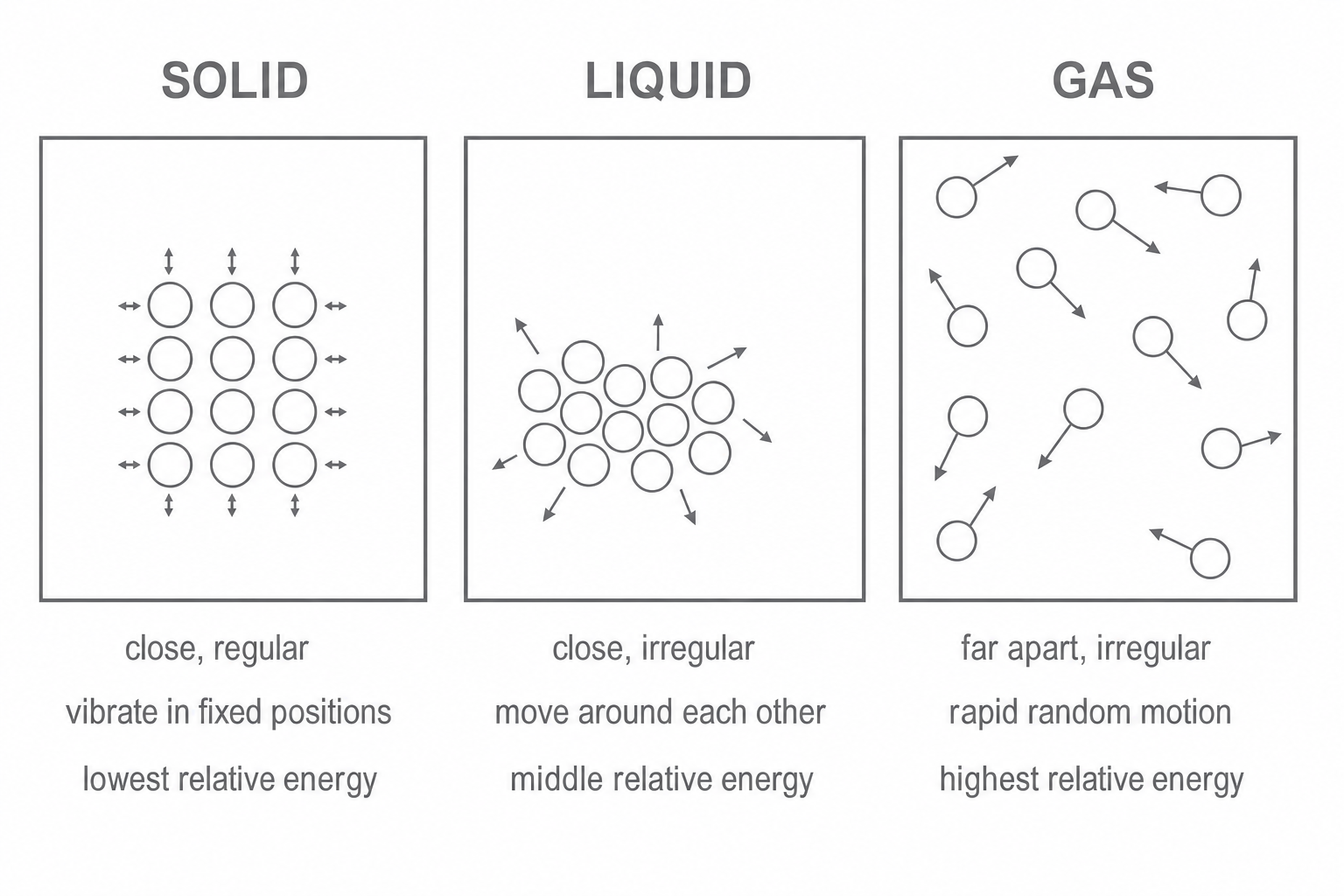
The diagram deliberately keeps the particle identity, size and number constant. Only their arrangement, movement and relative energy differ.
Physical changes of state
A change of state is a physical change. The chemical identity of the substance stays the same: no new substance is formed. For example, solid water, liquid water and water vapour all consist of water particles. By contrast, a chemical reaction changes the substances present and forms one or more new substances.
Do not use reversible as the only test. State changes form reversible pairs when heating or cooling conditions are reversed, but the decisive distinction is whether the chemical substance has changed.
Continue this lesson.
You’re previewing NovaLearn without an account. Create a free account to read the rest.
Create free account