Chemistry 3.15, 3.17 - Preparing copper sulfate crystals
Make pure, dry hydrated copper sulfate crystals from an insoluble base and an acid. Explain why excess copper oxide, filtration, gentle concentration and cooling each matter.
Why add an insoluble reactant in excess?
A soluble salt initially forms a solution, so making crystals has two stages: obtain a solution containing only the intended salt and water, then remove enough water for crystallisation.
Copper(II) oxide is an insoluble black base. Sulfuric acid reacts with it to make soluble copper(II) sulfate and water:
Add copper(II) oxide in small portions while stirring and warming gently. At first it is used up and a blue solution forms. When a little black solid persists after sufficient stirring and time to react, the base is in excess: all the acid has reacted. Filtering removes the excess solid as the residue. The filtrate contains dissolved copper(II) sulfate and water, because no acid remains and the unreacted insoluble base has been removed.
Filtering cannot remove a dissolved impurity. This method succeeds because the excess reactant is insoluble; an excess of a soluble alkali would pass through the paper.
Pure, dry and hydrated
Pure means containing only the intended salt. Dry means having no liquid solution clinging to the crystals. A hydrated crystal contains water in its crystal structure, so it can be both hydrated and surface-dry.
Core practical: hydrated copper sulfate crystals
The purpose is to prepare pure, dry, hydrated copper(II) sulfate crystals from copper(II) oxide and dilute sulfuric acid. The process joins a reaction to three separation techniques: filtration, partial evaporation and crystallisation.
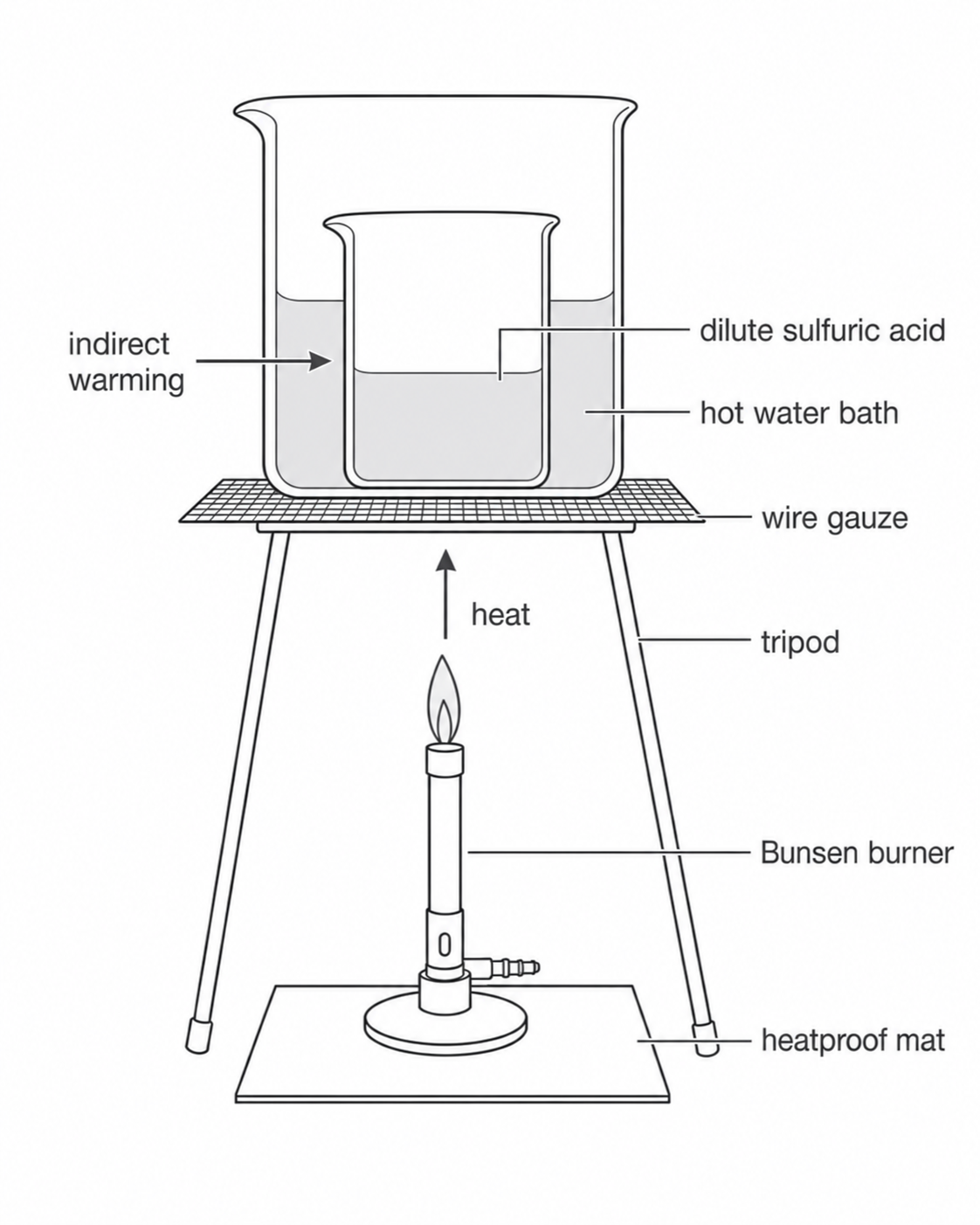
Use dilute sulfuric acid, copper(II) oxide powder, a spatula and glass rod, two beakers, a water bath, measuring cylinder, filter funnel and paper, conical flask, evaporating basin, Bunsen burner, tripod, gauze, heatproof mat, watch glass and filter paper. A water bath is a larger beaker of hot water surrounding the beaker of acid. It warms the acid indirectly and evenly, reducing local overheating and spitting.
[DIAGRAM: asset_name: Chemistry 3.15-3.18 - Preparing soluble salts and titration - diagram 01; asset_slug: chemistry_3_15_3_18_preparing_soluble_salts_and_titration__diagram_01; recommended_method: image_gen; description: A clean monochrome laboratory diagram of the required water-bath arrangement: a small beaker labelled dilute sulfuric acid standing inside a larger beaker labelled hot water bath, the outer beaker supported on gauze and a tripod over a Bunsen burner on a heatproof mat; one upward heat arrow from the flame to the water bath and one inward heat-transfer arrow from hot water to the acid beaker; show the acid heated indirectly, with no flame touching the acid beaker, no copper oxide added yet, no thermometer, no decorative objects and no colour-dependent meaning.]
Ordered method and evidence
- Measure a fixed volume of dilute sulfuric acid into the small beaker. Warm it gently in the water bath; do not boil it.
- Remove the acid beaker from the bath. Add copper(II) oxide one small spatula portion at a time, stirring after each addition. The black solid disappears as it reacts and a blue copper(II) sulfate solution forms.
- Continue until a little black solid remains even after warming and stirring. This is excess copper(II) oxide: visible evidence that the sulfuric acid has been used up.
- Filter the warm mixture. Excess black copper(II) oxide is the residue on the filter paper. The blue copper(II) sulfate solution is the filtrate; do not mistake the residue for the product.
- Transfer the filtrate to an evaporating basin supported on gauze and a tripod over a Bunsen burner on a heatproof mat. Under teacher supervision, heat gently until the solution is near its crystallisation point, shown by the first small crystals at the edge or by a drop forming crystals when cooled. Do not boil it to dryness.
- Remove the heat and leave the concentrated solution to cool undisturbed. As water leaves the solution and solubility falls on cooling, copper ions, sulfate ions and water become arranged in hydrated crystals, commonly written .
- Pour off the remaining solution. Move the crystals to a watch glass, blot their surfaces gently with filter paper and allow them to air-dry. Strong heating is not used to dry them because it can drive water from the hydrated crystal structure or decompose the salt.
Continue this lesson.
You’re previewing NovaLearn without an account. Create a free account to read the rest.
Create free account