Physics 5.7 - 5.8, 5.10 - 5.12 - The electromagnetic spectrum
Radio waves, warmth and visible light belong to one continuous family of transverse waves. Connect spectrum order, wavelength and frequency, and explain how a detector receives energy even when the wave is invisible.
Electromagnetic waves as one family
Radio waves, microwaves, infrared, visible light, ultraviolet, X-rays and gamma rays are all electromagnetic waves. The group names do not describe different substances. They describe different ranges of frequency and wavelength within one family.
Transverse wave
In a transverse wave, the oscillations are perpendicular to the direction in which the wave and its energy travel.
All electromagnetic waves are transverse. They can travel through a vacuum, so they do not need particles of matter to carry them. In a vacuum, every electromagnetic wave travels at the same speed:
, exactly, or approximately for GCSE calculations.
The word vacuum matters. It means a region with no matter. The claim is not that every electromagnetic wave has this speed inside glass, water or another substance.
Electromagnetic waves transfer energy from a source to an observer, where an observer can be a person or a detector:
- a lamp is a source of visible light; a light sensor receives some of the transferred energy;
- a warm object is a source of infrared; an infrared detector receives energy from it;
- a transmitter is a source of radio waves; a receiver detects energy carried to it.
Matter does not have to travel from source to detector. The electromagnetic wave propagates and carries the energy.
[DIAGRAM: asset_slug: phy_c_spectrum_verified; description: All seven regions and all seven visible colours in correct order; decreasing wavelength and increasing frequency arrows; continuous spectrum labelled, visible expansion not to scale.]
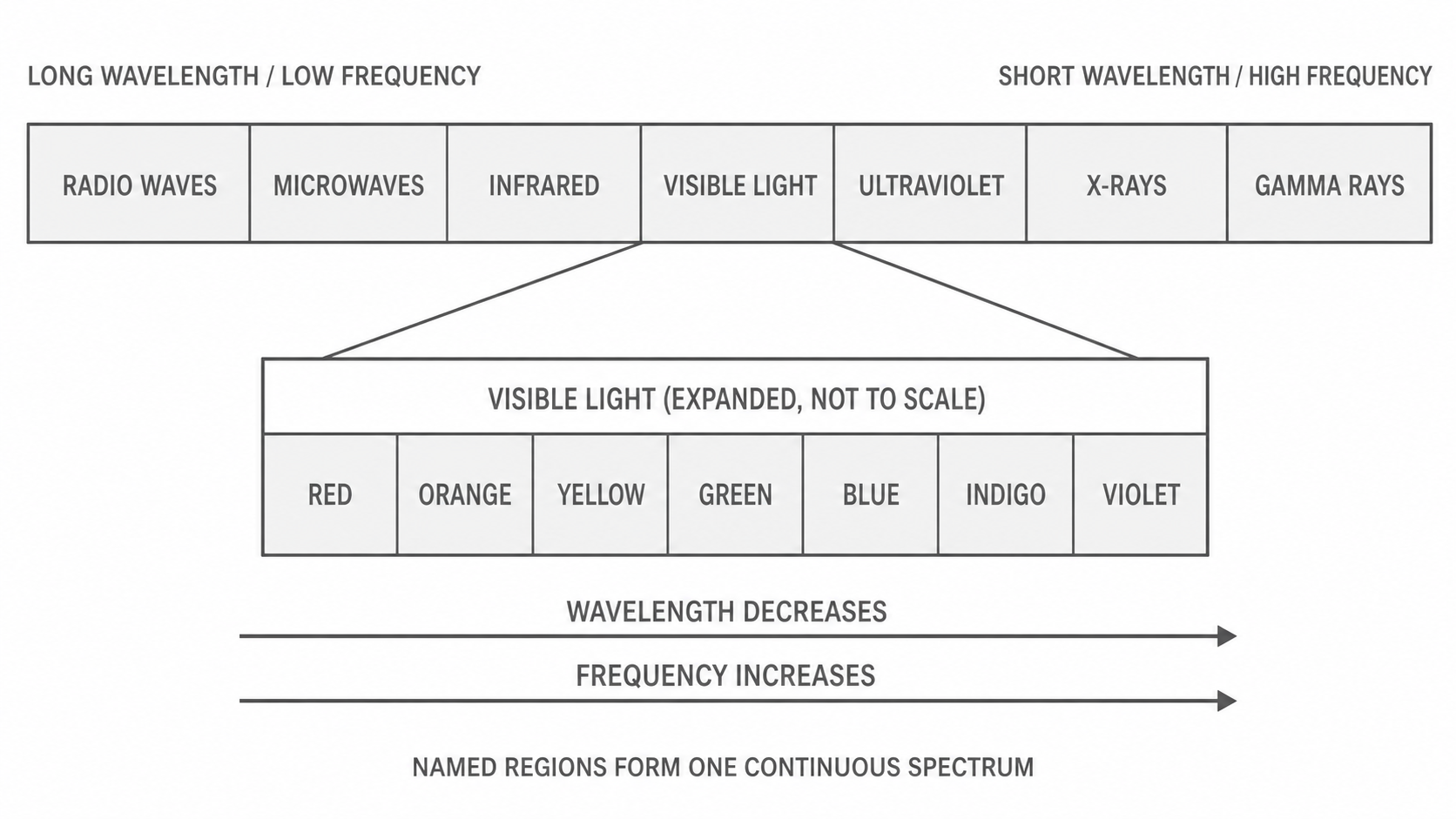
The continuous electromagnetic spectrum
The full family forms a continuous spectrum. There is no physical gap when one named group gives way to the next; the names mark useful ranges along a continuous spread of frequencies and wavelengths.
Read the main groups in this order:
From longest wavelength / lowest frequency to shortest wavelength / highest frequency:
Radio waves → microwaves → infrared → visible light → ultraviolet → X-rays → gamma rays.
Across this sequence, wavelength decreases while frequency increases. Reversing the order reverses both trends.
Visible light is itself continuous. From longest visible wavelength and lowest visible frequency to shortest visible wavelength and highest visible frequency, the usual colour order is:
red → orange → yellow → green → blue → indigo → violet
Human eyes detect only this limited visible range of electromagnetic frequencies. A typical wavelength range is about , with violet near the shorter-wavelength end and red near the longer-wavelength end. Those approximate limits are useful for a sense-check, but the required idea is that vision covers only a small part of the full electromagnetic spectrum.
Continue this lesson.
You’re previewing NovaLearn without an account. Create a free account to read the rest.
Create free account