Chemistry 1.1 - 1.6 - Atomic models and structure
Follow how discoveries changed the atomic model, then use particle locations, charges and masses to explain the structure of a neutral atom.
From Dalton's atom to electrons
A scientific model is a representation used to explain observations and make predictions. It is not a permanent fact or a perfectly scaled picture. When new evidence cannot be explained by an existing model, scientists test a revised model against the evidence.
In the early 1800s, John Dalton pictured atoms as tiny, solid spheres. Atoms of different elements could be different, but each atom was indivisible: it had no smaller internal parts in the model. This explained chemical reactions in terms of whole atoms rearranging, but it could not survive evidence of particles inside atoms.
In 1897, J. J. Thomson's cathode-ray experiments provided evidence for tiny negatively charged particles, later called electrons. Because electrons came from atoms, atoms could not be indivisible solid spheres. Thomson replaced Dalton's model with the plum pudding model:
- positive charge was spread throughout a sphere;
- negative electrons were embedded within that positive material;
- the equal positive and negative charge made the whole atom neutral.
There was no nucleus in the plum pudding model. Its positive material was spread out, and it should not be drawn as a cluster of positive protons.
| Model | Main claim | Evidence that forced a change |
|---|---|---|
| Dalton's solid sphere | An atom is a tiny indivisible sphere with no internal structure | Discovery of the electron showed that atoms contain smaller particles |
| Thomson's plum pudding | Negative electrons are embedded in spread-out positive charge | Later scattering results could not be explained by diffuse positive charge |
Scattering reveals the nucleus
A model earns its place by explaining observations. Ernest Rutherford worked with Hans Geiger and Ernest Marsden on an experiment in which positively charged alpha particles were directed at very thin gold foil. A surrounding detector showed the direction in which each detected alpha particle travelled after reaching the foil.
The plum pudding model made a prediction. If positive charge was spread through each atom, an alpha particle would meet no tiny region with enough concentrated positive charge to turn it sharply. The particles should therefore pass through, perhaps with only small changes in direction.
The results contained two very different patterns:
- Most alpha particles passed straight through or changed direction only slightly. This supported the inference that most of an atom is empty space.
- A small fraction were deflected through large angles, and very few came almost straight back. A positive alpha particle could be turned so strongly only by approaching a concentrated positive charge. Because these events were rare, that charge had to occupy a very small region.
Rutherford's nuclear model therefore placed a tiny, dense, positively charged nucleus at the centre, with electrons around it. Positive charge and most of the mass were no longer spread throughout the atom.
The word most matters. The straight paths did not mean the foil contained holes: the alpha particles passed through atoms. The rare large deflections revealed what the common straight paths could not reveal on their own.
The present GCSE model
Rutherford's nuclear model was another step, not the final picture. Two later developments completed the model needed here.
- In 1913, Niels Bohr proposed that electrons occupy particular energy levels around the nucleus. At GCSE, these levels are represented as shells.
- In 1932, James Chadwick provided evidence for the neutron, an uncharged particle in the nucleus.
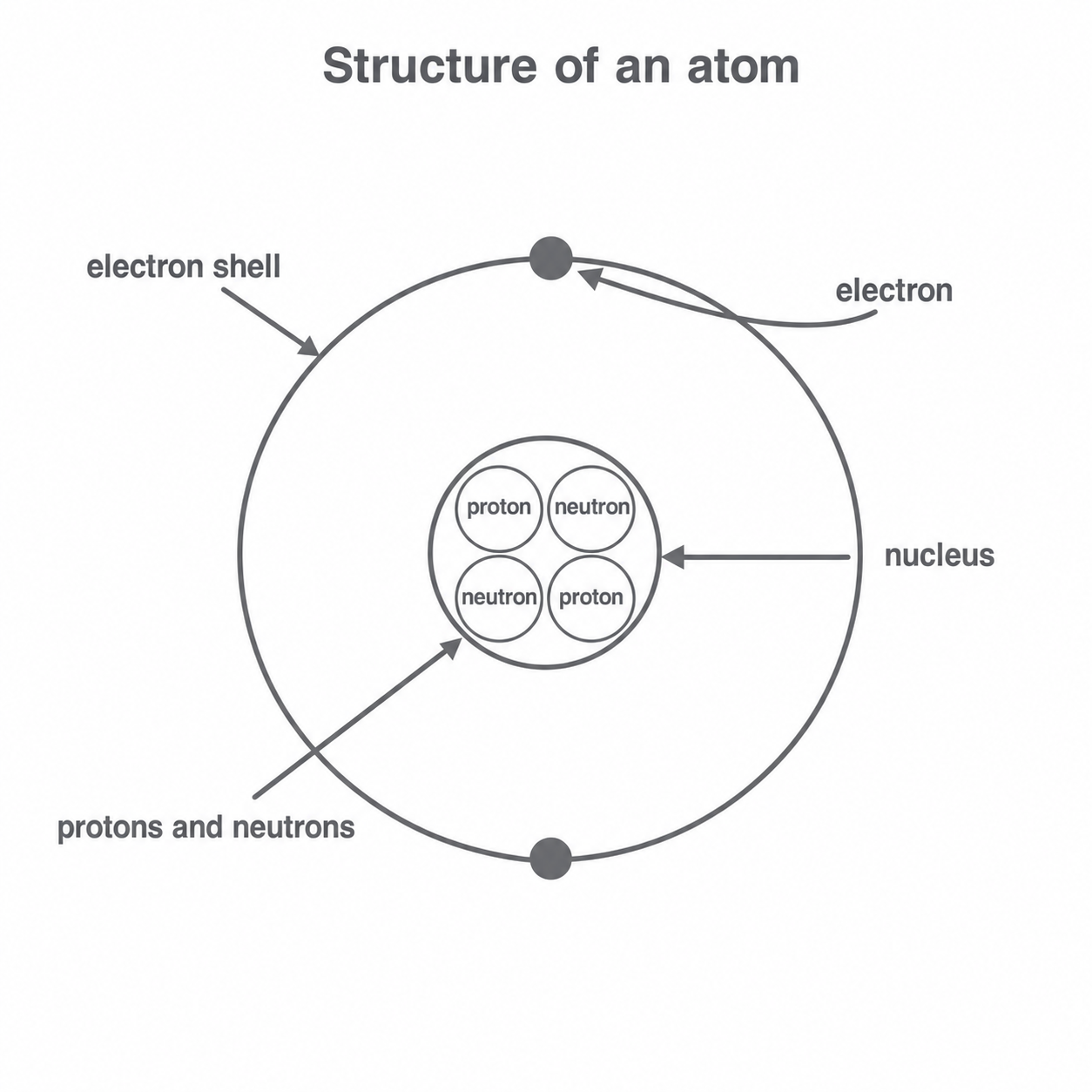
The present GCSE model describes an atom as a central nucleus containing protons and neutrons, surrounded by electrons in shells. The locations are as important as the names:
| Region | Particles in the model | Overall role in the model |
|---|---|---|
| Nucleus | Protons and neutrons | Tiny central region containing positive charge and nearly all the mass |
| Shells around the nucleus | Electrons | Occupy the much larger region that determines the atom's overall size |
A shell line in a diagram is not a rigid material layer, and an electron is not a tiny planet on a known circular track. The shell picture is a useful GCSE representation of electron energy levels. It also cannot be drawn to true scale while keeping both nucleus and electrons visible.
The evidence-led sequence is:
Dalton solid sphere → electron discovered → Thomson plum pudding → alpha scattering → Rutherford nucleus → Bohr shells → Chadwick neutron
[DIAGRAM: asset_name: Neutral atom structure; asset_slug: chemistry_atomic_structure_repaired; description: Two protons and two neutrons in the central nucleus, with two electrons in one surrounding shell. Not to scale.]
Continue this lesson.
You’re previewing NovaLearn without an account. Create a free account to read the rest.
Create free account