Chemistry 1.18 - 1.20 - Electron shells and table position
Build electron-shell diagrams for the first twenty elements, connect their configurations to periods and groups, and explain the broad division between metals and non-metals.
Electronic configurations of the first 20 elements
An electron-shell diagram is a model of occupied energy levels. The shell circles help us count and organise electrons; they are not literal tracks showing where an electron travels.
For a neutral atom among the first 20 elements:
- Use the atomic number to find the total number of electrons.
- Put up to 2 electrons in the first, innermost shell.
- Put up to 8 of the remaining electrons in the second shell.
- For the first 20 elements, put up to 8 in the third shell. Potassium and calcium then begin a fourth shell.
- Write the shell populations from inner to outer, separated by full stops: for example, .
The rule here is a prediction rule limited to the first 20 elements. It must not be turned into the false claim that the third shell can never hold more than eight electrons; electron filling becomes more complex after calcium.
Worked example: phosphorus
Phosphorus has atomic number 15, so a neutral phosphorus atom has 15 electrons.
- First shell: place 2 electrons; remain.
- Second shell: place 8 electrons; remain.
- Third shell: place the remaining 5 electrons.
- Electronic configuration: .
To draw it, sketch a nucleus and three concentric electron-shell lines. Place exactly 2 electron dots on the first shell, 8 on the second and 5 on the third. The check matches the atomic number, so no electron has been lost or added.
[DIAGRAM: asset_name: Sodium and calcium electron shells; asset_slug: chemistry_first_twenty_shells_repaired; description: Sodium has shells 2.8.1; calcium has shells 2.8.8.2. Exactly 11 and 20 electron marks are shown, respectively.]
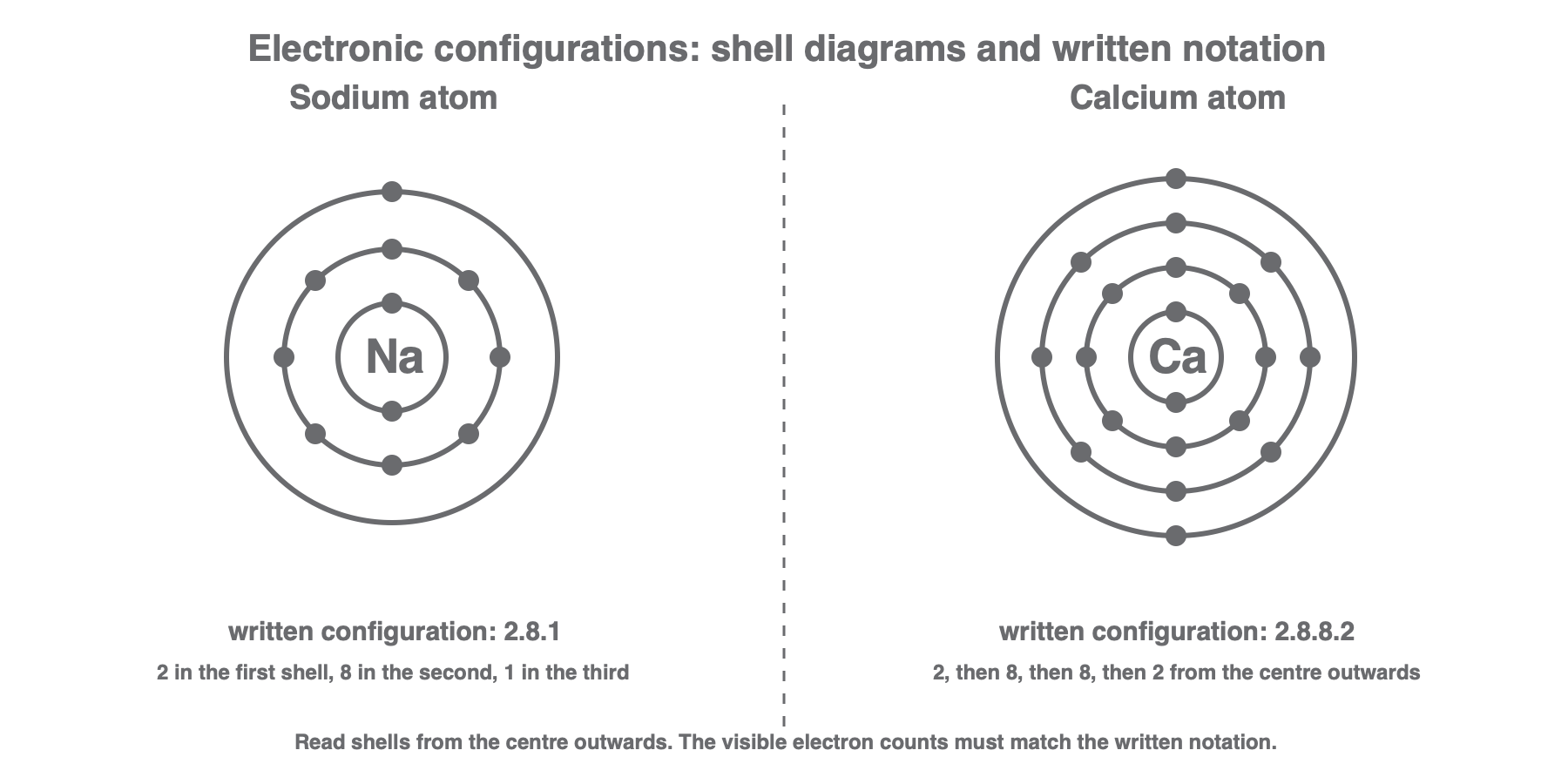
The complete first-20 pattern is shown below. These configurations can be predicted from atomic number rather than memorised as unrelated facts.
| Z | Element | Configuration | Z | Element | Configuration |
|---|---|---|---|---|---|
| 1 | Hydrogen, H | 11 | Sodium, Na | ||
| 2 | Helium, He | 12 | Magnesium, Mg | ||
| 3 | Lithium, Li | 13 | Aluminium, Al | ||
| 4 | Beryllium, Be | 14 | Silicon, Si | ||
| 5 | Boron, B | 15 | Phosphorus, P | ||
| 6 | Carbon, C | 16 | Sulfur, S | ||
| 7 | Nitrogen, N | 17 | Chlorine, Cl | ||
| 8 | Oxygen, O | 18 | Argon, Ar | ||
| 9 | Fluorine, F | 19 | Potassium, K | ||
| 10 | Neon, Ne | 20 | Calcium, Ca |
How configuration reveals position
Electronic configuration explains the layout of the main groups:
Continue this lesson.
You’re previewing NovaLearn without an account. Create a free account to read the rest.
Create free account