Chemistry 7.6-7.8 - Catalysts and enzymes
Explain how catalysts speed reactions while remaining unchanged overall. Use gas and recovery evidence to test those claims, and connect biological catalysts to alcoholic-drink production.
What a catalyst changes and what it preserves
Consider two flasks containing equal volumes of the same hydrogen peroxide solution at the same temperature. A small amount of manganese(IV) oxide is added to one flask. Oxygen bubbles form much faster in that flask, so the macroscopic observation is a faster rate of gas production when the added substance is present.
The reaction itself is:
The equation is balanced: there are four hydrogen atoms and four oxygen atoms on each side. Manganese(IV) oxide is not included among the overall reactants or products because it is regenerated during the process.
Catalyst
A catalyst is a substance that speeds up the rate of a reaction without altering the products. At the end of the reaction, the catalyst is chemically unchanged and has the same mass, provided that all of it is recovered.
Every phrase matters:
| Feature | What it means |
|---|---|
| speeds up the rate | A chosen amount of product is formed in less time. |
| without altering the products | The same reaction products form with and without the catalyst. |
| chemically unchanged | The catalyst may take part in intermediate stages, but it is regenerated by the end. |
| same mass at the end | The catalyst is not consumed; any fair mass comparison must recover, clean and dry it before reweighing. |
"Chemically unchanged at the end" does not mean "never involved". A catalyst can interact with reacting particles during the alternative route and still be regenerated. It also does not mean that a careless experiment will always recover exactly the starting mass: material can be spilled, left on apparatus or lost through filter paper even when it was not chemically consumed.
For the hydrogen peroxide example, a glowing splint relighting identifies the collected gas as oxygen. Faster bubbling alone shows a faster gas-production rate; it does not identify the gas. Product identity and rate are different claims and need different evidence.
Why a catalyst increases the rate
At the particle level, reactant particles must collide successfully for a reaction to occur. A collision is successful only when the particles have enough energy for the necessary rearrangement of atoms to begin.
Activation energy
Activation energy is the minimum energy that colliding particles need for a reaction to occur.
A catalyst provides an alternative reaction route with a lower activation energy. At the same temperature, the reacting particles have the same spread of kinetic energies as before, but the energy threshold they must overcome is lower. A greater fraction of collisions therefore have enough energy to be successful, so more successful collisions occur each second and the reaction rate increases.
The careful causal chain is:
alternative route → lower activation energy → greater fraction of collisions can react → more successful collisions each second → faster rate
A catalyst does not supply energy to the particles and does not need to raise their temperature. It also does not necessarily make particles collide more often overall. The important change is that a larger fraction of the collisions already occurring can now lead to reaction.
[DIAGRAM: asset_name: Chemistry 7.6-7.8 - Catalysts and enzymes in reaction rates - diagram 01; asset_slug: chemistry_7_6_7_8_catalysts_and_enzymes_in_reaction_rates__diagram_01; recommended_method: image_gen; description: Original qualitative two-row activation-energy threshold model on a white background, not a reaction-profile graph. Both rows show identical reactant particle pairs moving left to right at the same temperature and identical product particles at the right. The top row labelled Without catalyst has a high threshold labelled higher activation energy and fewer visibly successful collisions; the bottom row labelled With catalyst has a lower threshold labelled lower activation energy and more visibly successful collisions. Include one simple catalyst symbol before and after the bottom-row reaction, with a direct label catalyst unchanged at end. Use #6A6B6E linework, visible left-to-right arrowheads, direct uncrossed labels and no colour-dependent meaning. Exclude axes, numerical scales, energy curves, heat arrows, changed products, increased particle speed, increased total collision frequency, active-site models and decorative laboratory imagery.]
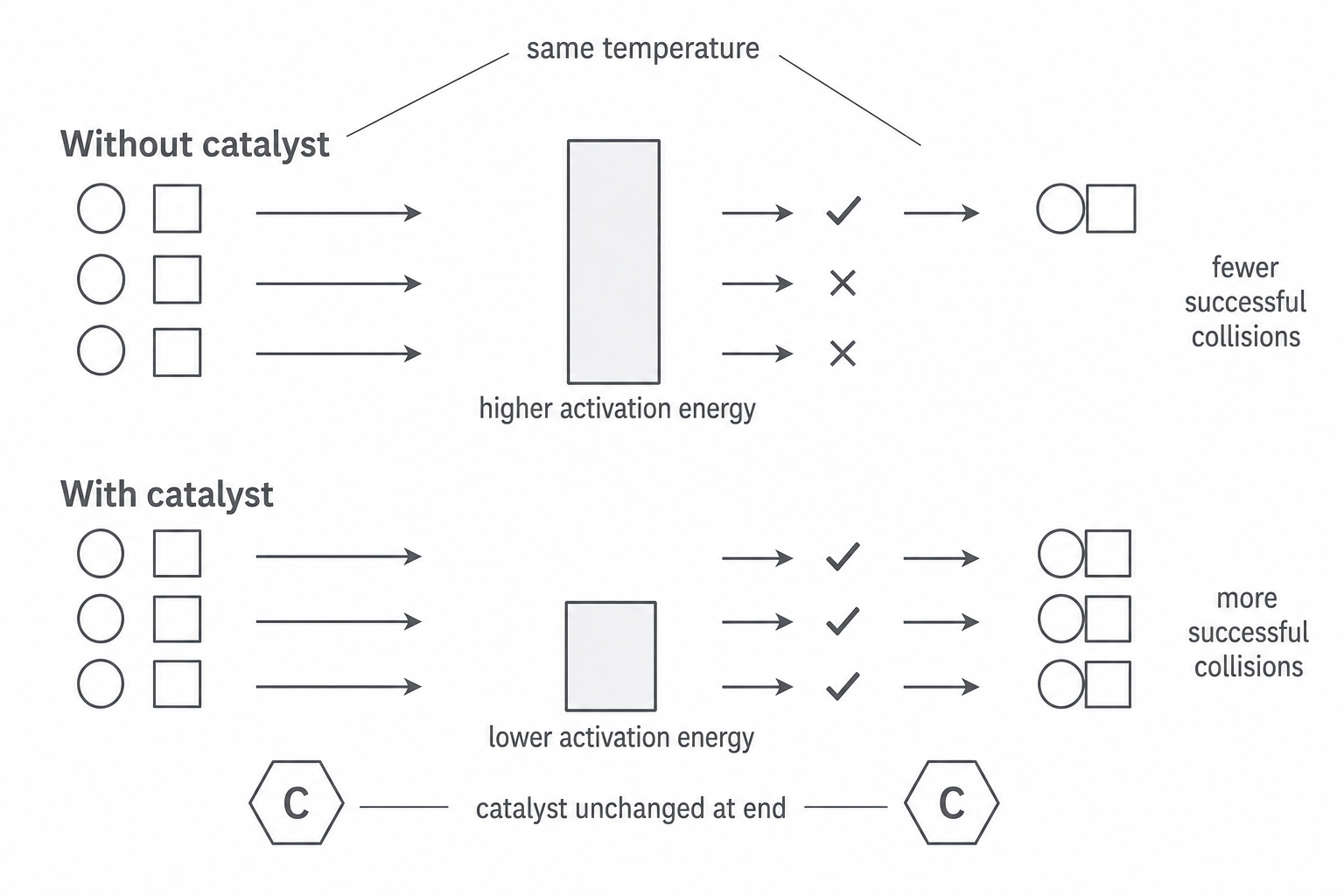
This threshold picture is a model, not a literal track followed by particles. The two rows begin at the same temperature and end with the same products. Only the energy barrier associated with the available route is lower when the catalyst is present.
The product symbols show the outcomes of successful collisions only, not a complete inventory of all particles. The unchanged unsuccessful reactants are omitted. C is a model symbol for the catalyst, not the chemical symbol for carbon in this diagram.
Investigating a potential catalyst
Pearson suggests investigating potential catalysts for hydrogen peroxide decomposition. This is a useful investigation for 7.6-7.8, but it is not a mandatory core practical.
The purpose is to test whether manganese(IV) oxide increases the rate of oxygen production from dilute hydrogen peroxide. A suitable arrangement uses a conical flask sealed to a gas syringe by a bung and delivery tube. Clamp the gas syringe horizontally so its plunger can move freely and its scale can be read at eye level.
Variables and measurements
| Role | Operational choice |
|---|---|
| Independent variable | catalyst absent or a fixed mass, such as , of manganese(IV) oxide present |
| Dependent variable | oxygen volume in recorded every for ; the time to reach a chosen volume can also be compared |
| Controlled variables | volume and concentration of hydrogen peroxide, starting temperature, flask and gas syringe, mixing action, and the mass and particle size of catalyst in every catalysed repeat |
Continue this lesson.
You’re previewing NovaLearn without an account. Create a free account to read the rest.
Create free account