Physics 10.1 - 10.3 - Atoms and circuit diagrams
Circuit diagrams describe connections using a precise set of symbols. Start with the charge and mass of atomic particles, then draw components and distinguish series and parallel routes.
Inside an atom
An atom can be represented by a simple model with a central nucleus and electrons in shells, or regions, around it. The nucleus contains protons and neutrons. Each particle has a characteristic position, relative charge and relative mass.
| Particle | Position in the atom | Relative charge | Relative mass |
|---|---|---|---|
| proton | in the nucleus | ||
| neutron | in the nucleus | ||
| electron | in shells around the nucleus | about |
In a sketch, put protons and neutrons together in the small central nucleus and electrons around it. The sketch is a model, not a scale drawing of particle sizes or an exact electron path. In a neutral atom, equal numbers of protons and electrons give zero total charge.
The word relative matters. A proton and an electron have equal-sized, opposite charges, but they do not have equal masses: an electron's mass is very small compared with the mass of either a proton or a neutron. A relative mass of about is small, not zero.
The language of circuit symbols
A circuit diagram is a model, not a picture of the apparatus. Conventional symbols let anyone who knows the code reconstruct the same connections, even if the real wires and components look very different.
[DIAGRAM: asset_name: Physics 10.1-10.6 - Charge, circuit diagrams and potential difference - diagram 01; asset_slug: physics_10_1_10_6_charge_circuit_diagrams_and_potential_difference__diagram_01; recommended_method: image_gen; description: NovaLearn monochrome circuit-symbol reference on white: exact standard symbols and direct labels for a cell with long positive and short negative line, battery, open switch, closed switch, voltmeter, ammeter, fixed resistor, variable resistor, lamp, motor, diode, thermistor, LDR and LED. Show outward arrows only on the LED and inward arrows only on the LDR; use no component-characteristic graphs, current arrows, decorative marks or colour-dependent meaning.]
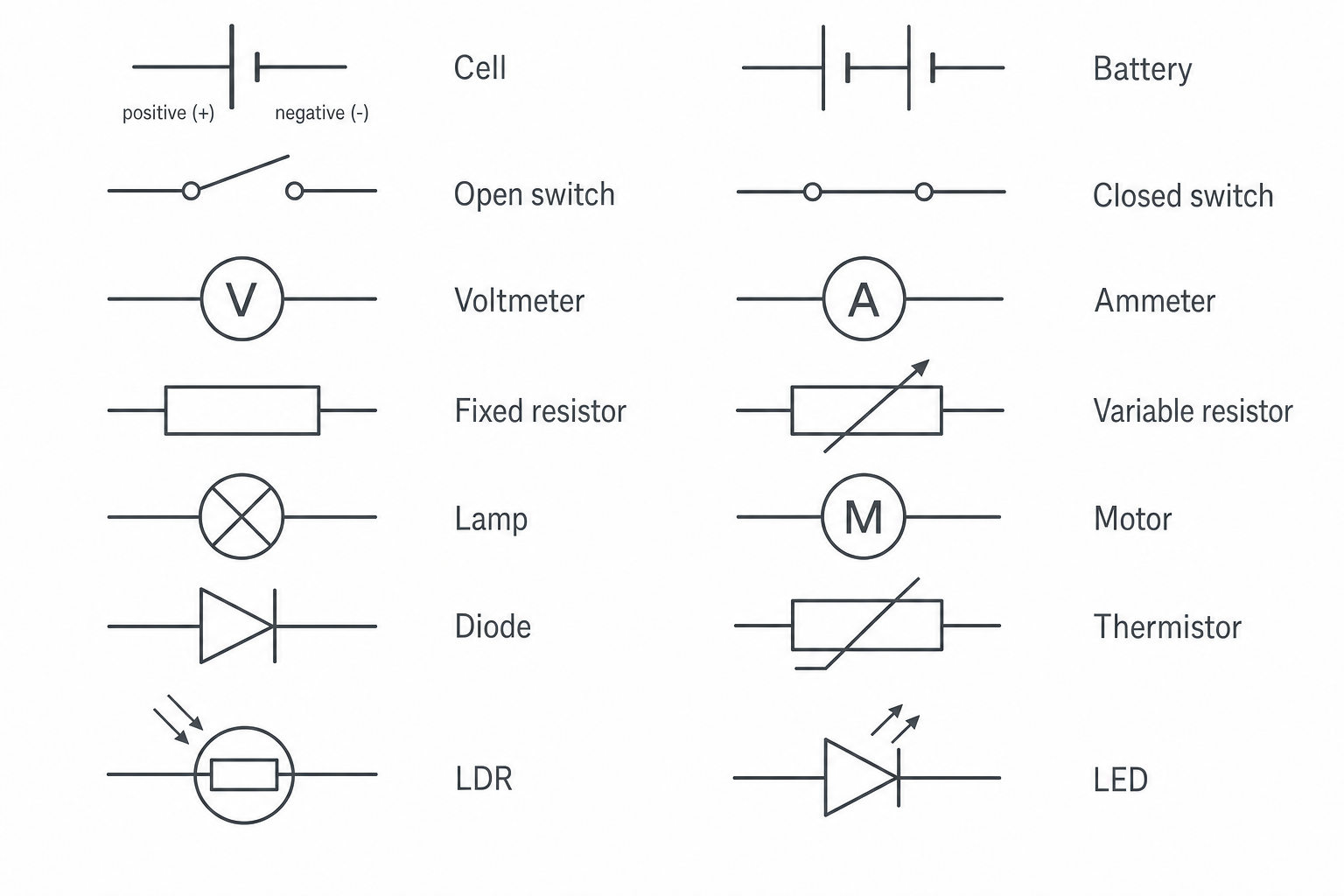
Read the symbols by looking for their distinguishing features:
Continue this lesson.
You’re previewing NovaLearn without an account. Create a free account to read the rest.
Create free account