Chemistry 8.24 - 8.26 - Greenhouse effect and climate evidence
Follow the energy transfers in the greenhouse effect, evaluate evidence of human-caused warming and compare ways to limit climate change while considering their scale and environmental effects.
What today's atmosphere contains
Air is a mixture of gases. Its particles are intermingled but are not chemically bonded into one giant substance, so each gas keeps its own chemical properties.
For dry air near Earth's surface, the composition by volume is approximately:
| Gas | Formula | Approximate proportion by volume |
|---|---|---|
| nitrogen | ||
| oxygen | ||
| argon | ||
| carbon dioxide | ||
| methane and other trace gases | for example | much less than each |
Water vapour, , is variable. Its proportion changes with temperature, weather and location, so it is not fixed in the dry-air percentages. Carbon dioxide, methane and water vapour are all greenhouse gases even though nitrogen and oxygen are much more abundant.
At the particle scale, the effect of a gas depends on the structure and behaviour of its molecules, not just on how many molecules are present. A small proportion can therefore have a significant role if its molecules absorb radiation that the main gases do not absorb strongly.
Worked conversion: percent to parts per million
ppm means parts per million. For a gas proportion by volume:
Percent and ppm
For carbon dioxide at about :
Equivalently, , and . The result is sensible: 400 molecules in every million is a small fraction, but it is not zero. Modern measurements are above , so is a useful rounded description rather than an exact unchanging value.
How the greenhouse effect keeps Earth warm
The greenhouse effect is an energy-transfer process. Follow the radiation rather than imagining a physical lid around Earth.
- The Sun transfers energy towards Earth mainly as short-wave radiation. Some is reflected, but much reaches and is absorbed by Earth's surface.
- The warmed surface emits energy upwards as longer-wave infrared radiation.
- Carbon dioxide, methane and water-vapour molecules absorb some of this outgoing infrared radiation.
- The molecules subsequently release energy. Infrared radiation is emitted in all directions, including back towards the surface and lower atmosphere.
- Some infrared still escapes to space, but the return of some energy downwards means the surface loses energy less quickly and remains warmer than it would without greenhouse gases.
[DIAGRAM: asset_name: Chemistry 8.24-8.26 - Greenhouse effect and climate evidence - diagram 01; asset_slug: chemistry_8_24_8_26_greenhouse_effect_and_climate_evidence__diagram_01; recommended_method: image_gen; description: A sparse monochrome scientific energy-pathway diagram on white. Show space at the top, a thin atmosphere containing dispersed molecules labelled carbon dioxide, methane and water vapour, and Earth's surface along the bottom. A straight downward arrow labelled Incoming short-wave radiation must reach the surface. Several upward arrows labelled Outgoing infrared radiation must begin at the warmed surface. One upward infrared arrow must continue to space and be labelled Some infrared escapes to space. Other outgoing infrared arrows must terminate at greenhouse-gas molecules, followed by clear emitted arrows in several directions including at least one back towards the surface, labelled Infrared re-emitted in all directions. Use arrowheads to preserve direction. Do not show a solid greenhouse-gas layer, total trapping, greenhouse gases reflecting incoming sunlight, ozone or an ozone hole. Use only white and #6A6B6E/neutral grey, generous whitespace and legible sans-serif labels.]
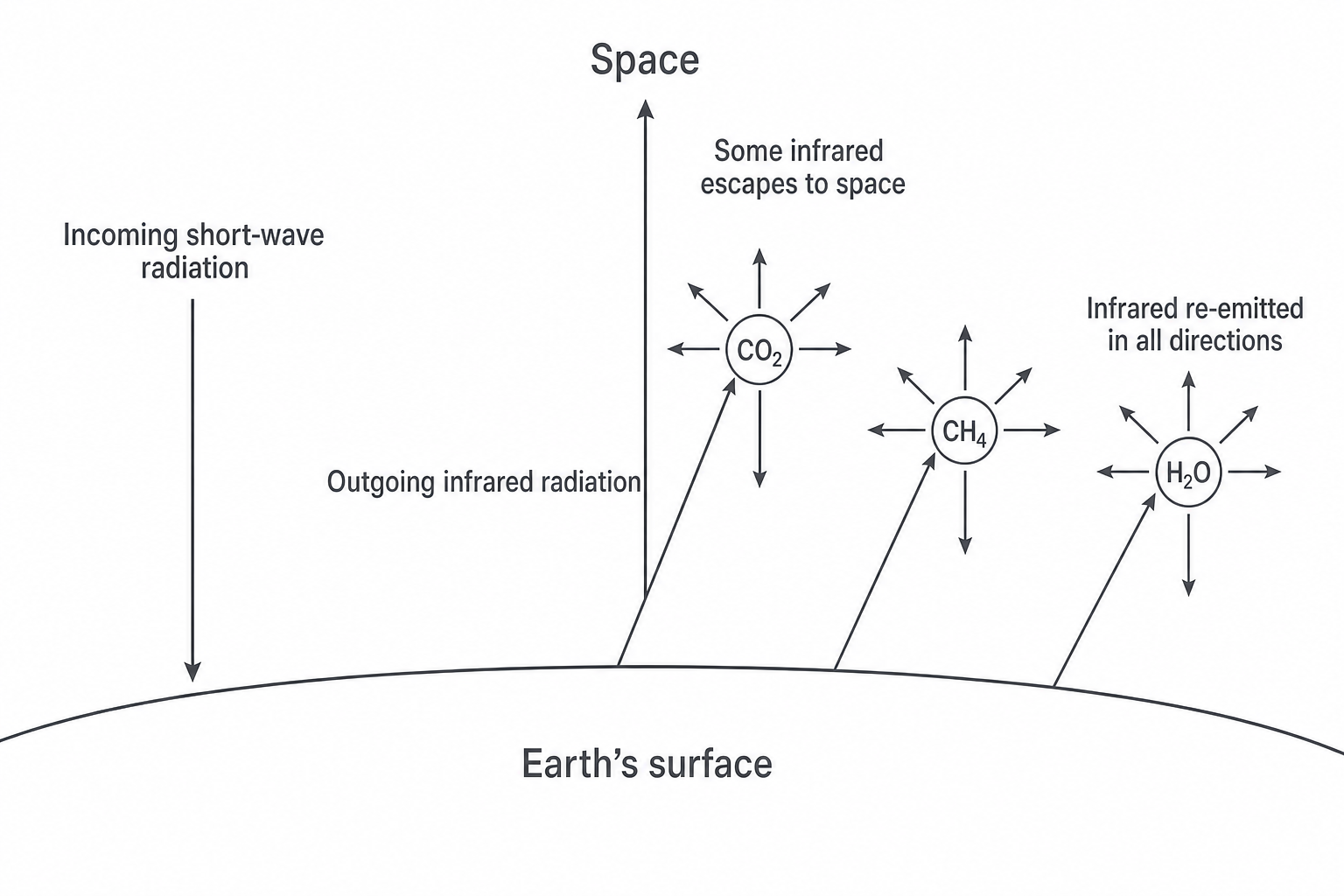
The natural greenhouse effect is essential: it keeps Earth warm enough for liquid water and life. Increasing the concentration of greenhouse gases causes more outgoing infrared radiation to be absorbed and re-emitted before energy escapes. At the original temperature, less energy escapes to space, so Earth gains energy and warms. As temperature rises, more infrared is emitted; a warmer balance can eventually be reached. This strengthening is the enhanced greenhouse effect. At a steady temperature, energy entering and leaving the whole Earth system balances; greenhouse gases do not make energy accumulate forever.
Greenhouse gases do not keep the same packet of energy forever, and they do not send all outgoing radiation back to Earth. The process is also not caused by a hole in the ozone layer: ozone chemistry and greenhouse warming are different phenomena.
Human sources and potential climate effects
Human activity can alter the concentration of greenhouse gases. The chemical source must be connected to the physical effect:
Burning coal, oil or natural gas oxidises carbon in the fuel and releases carbon dioxide. Increasing atmospheric carbon dioxide strengthens the greenhouse effect.
Complete combustion of a hydrocarbon can be represented generally as:
Livestock farming, especially keeping large numbers of ruminants such as cattle, releases methane through digestion and manure management. The important specification link is:
More livestock methane emissions can increase atmospheric methane. More outgoing infrared is then absorbed and re-emitted, enhancing the greenhouse effect.
Water vapour is also a greenhouse gas, but its atmospheric amount changes quickly with evaporation, condensation and temperature. For current human-caused warming, the directly increased carbon dioxide and methane named above are key drivers; warming can then allow more water vapour to remain in the atmosphere and amplify the change.
Climate
Climate is the long-term pattern and average of weather conditions, usually considered over decades. One hot, cold, wet or dry day does not by itself establish a climate trend.
Potential climate effects of higher carbon dioxide and methane include:
- a rise in global average temperature;
- changes in rainfall patterns, with some regions facing greater flood risk and others greater drought risk;
- more frequent or intense heatwaves and changes in some other weather extremes;
- warmer oceans and melting land ice, contributing to sea-level rise;
- changes to habitats, crop growth, water supplies and where species can survive.
These are risk statements, not promises that every place experiences the same outcome. A warmer climate can shift the likelihood or severity of an event while local geography and natural variability still affect what happens in a particular year.
Evaluating climate evidence and uncertainty
Evidence for human-caused climate change is stronger when several linked observations agree:
| Evidence line | Observed long-term pattern | What it supports |
|---|---|---|
| fossil-fuel records | global consumption rose strongly after industrialisation | human activity created a growing source of carbon dioxide |
| atmospheric carbon dioxide | the long-running Mauna Loa record rose from about in 1959 to about in 2019 | the atmospheric concentration increased substantially |
| global surface temperature | independent land and sea datasets show a long-term rise, despite year-to-year variation | the climate system has warmed over the period of rising greenhouse gases |
The Mauna Loa figures are rounded from the NOAA/Scripps annual means: in 1959 and in 2019. They describe one long-running observing site, not a direct average of all places.
The three patterns are correlated: as fossil-fuel consumption increased, atmospheric carbon dioxide and global temperature also tended to increase. Correlation is relevant evidence, but correlation alone is not proof of causation. Confidence becomes stronger because there is also a tested mechanism, greenhouse gases absorb and re-emit outgoing infrared, and because independent measurements show compatible patterns.
Continue this lesson.
You’re previewing NovaLearn without an account. Create a free account to read the rest.
Create free account