Physics 2.28 - 2.31 - Stopping distances and deceleration
Separate thinking distance from braking distance and explain how driver, vehicle and road conditions affect a stop. Understand why rapid deceleration is dangerous; only the public-road force estimates are Higher tier.
The two-stage stopping distance
Imagine a hazard appearing ahead of a moving car. The car does not begin slowing at the instant the driver sees it: it continues moving during the driver's reaction time, and only then do the brakes begin to slow it.
- Thinking distance is the distance travelled from detecting the hazard to beginning to apply the brakes.
- Braking distance is the distance travelled from the brakes beginning to act until the vehicle stops.
- Stopping distance is the complete distance from detecting the hazard until the vehicle is stationary.
Stopping-distance model
All three distances are measured in metres (m).
[DIAGRAM: asset_name: Stopping distances; asset_slug: physics_2_27_2_31_reaction_times_and_stopping_distances__diagram_01; description: Three car positions mark hazard noticed, brakes applied and vehicle at rest. Contiguous thinking and braking intervals share aligned boundaries with the total stopping-distance arrow.]
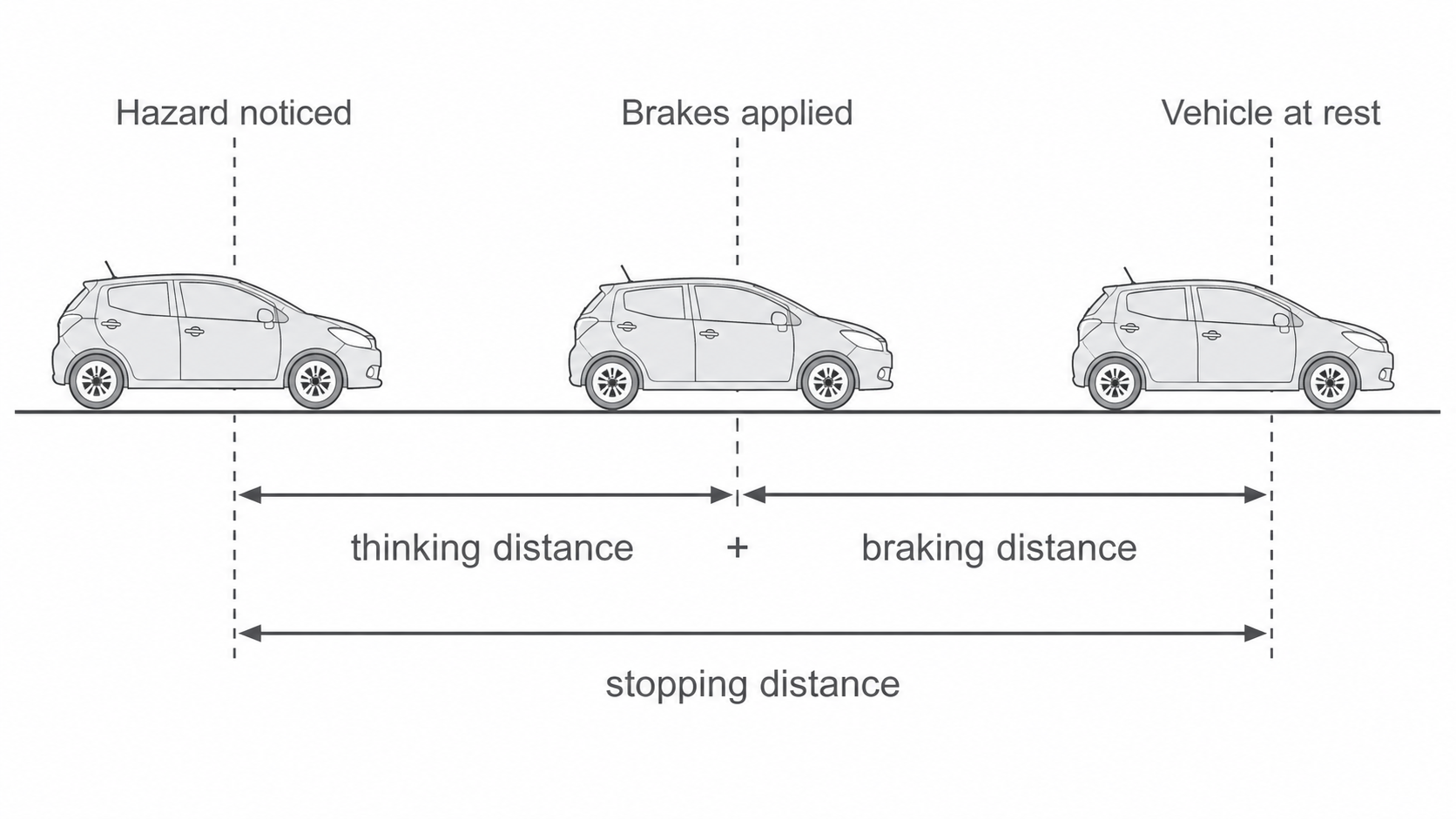
Before braking, the speed is approximately constant over the short reaction interval, so the earlier speed relationship gives
This explains rather than merely states two effects: a greater speed covers more metres each second, and a longer reaction time gives more seconds in which the vehicle continues moving before braking.
Worked example: from reaction to rest
A car travels at . The driver's reaction time is , and the braking distance under the stated conditions is . Calculate the thinking distance and stopping distance.
1. Identify quantities and units. Speed is already in , reaction time is in , and braking distance is in , so no conversion is needed.
2. Calculate thinking distance.
3. Add the two contiguous distances.
The answer is sensible: the stopping distance is larger than either component, and is a plausible human reaction time. The braking distance was supplied; this method does not predict an unknown braking distance.
Factors that change stopping distance
The most useful question for each factor is not just "does stopping distance increase?" but which component changes, and why?
| Factor | Component changed directly | Physical link |
|---|---|---|
| Greater vehicle mass | Braking distance | For the same available braking force, a larger mass has a smaller deceleration. More force would be needed to produce the same deceleration, so otherwise the vehicle travels farther while slowing. |
| Greater speed | Thinking and braking distances | More distance is covered during the same reaction time. Once braking starts, a larger speed change is also needed to reach rest, so the vehicle takes more time and distance to stop for the same deceleration. |
| Longer driver reaction time | Thinking distance | The vehicle continues at its initial speed for longer before the brakes begin to act. |
| Poorer state of the brakes | Braking distance | Worn, damaged or overheated brakes may provide a smaller effective braking force, producing less deceleration. |
| Wet, icy or loose road surface | Braking distance | The road condition can reduce grip, so less tyre-road friction is available for braking. |
| Smaller friction between tyre and road | Braking distance | Friction supplies the external horizontal force that slows the vehicle; less available friction limits braking force and can allow skidding. |
The last two rows are connected, not duplicates. Road state is a condition that can change the amount of tyre-road friction, which is the physical interaction. The brakes oppose the wheels' rotation, while tyre-road friction is what transmits a braking force between the vehicle and the road.
Mass also needs a fair comparison. The statement above holds when the available braking force and other conditions are kept the same. Real heavy vehicles may have differently designed brakes and tyres, so mass by itself does not determine one universal stopping distance.
Notice the component boundary: changing the brakes or road does not alter the driver's reaction time. Changing the driver's reaction time does not directly alter what happens after the brakes have begun to act.
Continue this lesson.
You’re previewing NovaLearn without an account. Create a free account to read the rest.
Create free account