Physics 10.22 - 10.24, 10.26 - 10.27 - Heating and electrical energy
Follow energy from the source into a resistor and its surroundings, using electron–ion collisions to explain heating. Distinguish useful heating from unwanted dissipation and calculate electrical energy from current, potential difference and time.
Equation support is provided for GCSE Combined Science Physics examinations in 2025–2027. Practise choosing, interpreting and rearranging the supplied relationships; these activities do not assume unaided equation memorisation.
From electrical transfer to thermal energy
Consider a system containing an energy source, a resistor and the nearby surroundings. A
current means that charge is moving through the resistor. As the charge moves against the
resistor's electrical resistance, the source transfers energy electrically to the resistor.
The transfer has two stages:
- The resistor gains thermal energy, so its temperature rises.
- Energy is then transferred by heating from the hotter resistor to its cooler
surroundings.
The energy that reaches the surroundings is not destroyed. It has spread out into the
thermal stores of the surroundings, where it is usually less useful.
Dissipated energy
Energy is dissipated when it spreads into the surroundings and becomes less available
for useful transfer. Dissipated energy is conserved; it has not disappeared.
This effect occurs whenever there is a current in a component with resistance. Whether the
heating is useful or unwanted depends on the component's purpose.
Why a resistor heats up
A metal can be modelled as a regular lattice of positive metal ions with mobile electrons
between them. The ions vibrate about fixed positions; they do not travel along the wire.
When a potential difference is applied, the mobile electrons still move in many directions,
but they also have an overall drift through the metal.
As an electron moves, it collides with ions in the lattice. During collisions, energy is
transferred from the moving electrons to the ions. The ions vibrate more, increasing the
thermal energy and temperature of the resistor. The hotter resistor then transfers energy
by heating to its surroundings.
[DIAGRAM: asset_name: Physics 10.22-10.27 - Heating effect and electrical energy - diagram 01; asset_slug: physics_10_22_10_27_heating_effect_and_electrical_energy__diagram_01; recommended_method: image_gen; description: NovaLearn monochrome scientific diagram on white showing a small regular lattice of labelled positive metal ions, one labelled mobile electron entering from the left along a clearly arrowed deflected path, a collision with one ion, and short motion marks around that fixed ion labelled greater ion vibration; include an inward-pointing arrow labelled energy transferred aimed at the struck ion's vibration marks, keep every ion at its lattice position, and exclude a conventional-current arrow, circuit components, colour, decorative marks and any suggestion that electrons or energy are used up.]
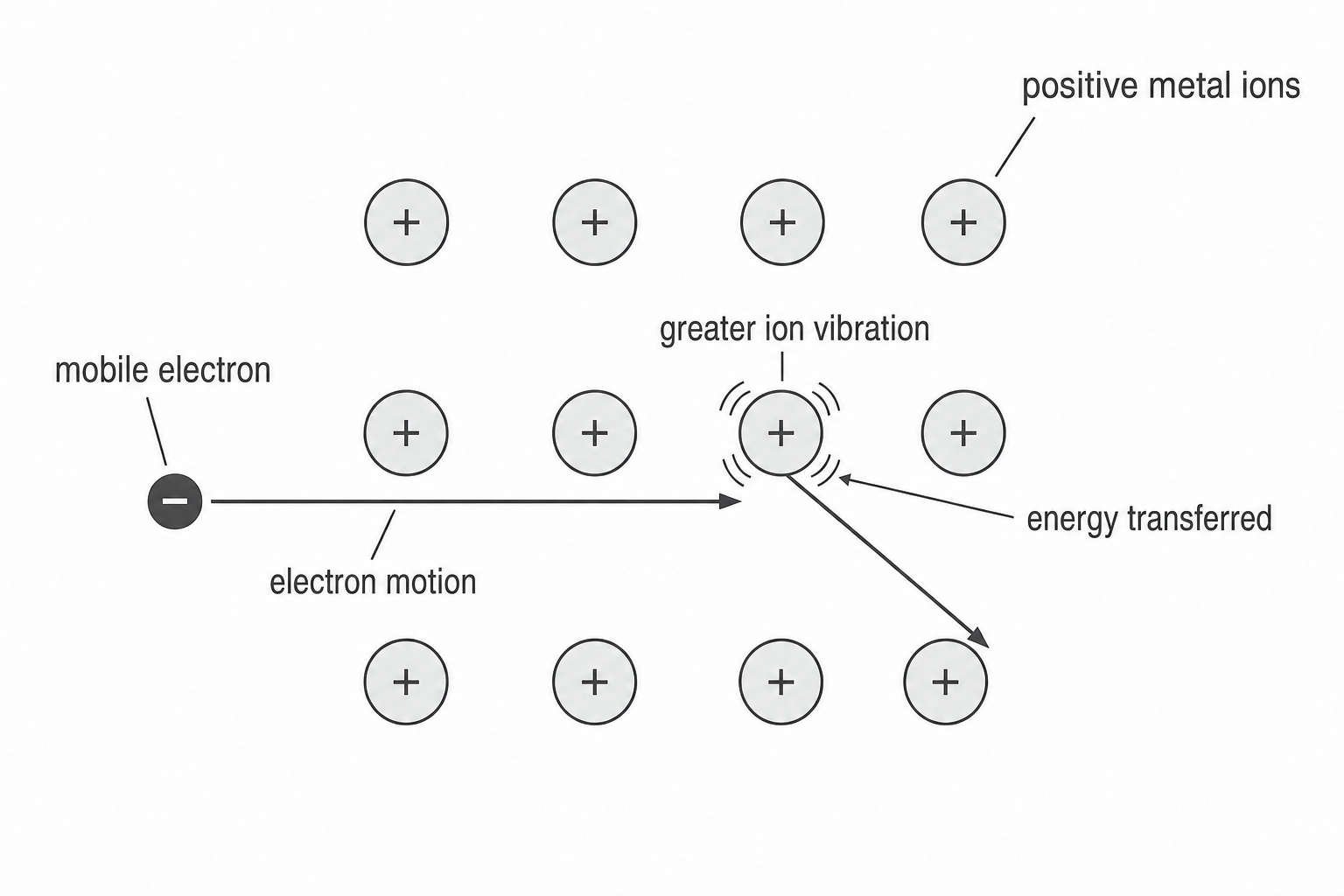
The arrows show electron motion before and after deflection, not ions leaving their lattice positions.
The model connects two scales:
- Microscopic: electron-ion collisions transfer energy to the lattice.
- Macroscopic: the resistor becomes hotter and transfers energy to the surroundings.
Continue this lesson.
You’re previewing NovaLearn without an account. Create a free account to read the rest.
Create free account