Chemistry 1.46 - Finding an empirical formula
Measure the magnesium and oxygen that combine in magnesium oxide. Learn why three cooled mass readings, controlled oxygen access and careful product collection are needed before a formula can be trusted.
Determining the formula of magnesium oxide
The formula of a simple compound can be determined by measuring the masses of the elements that combine. When magnesium is heated in air, it burns with an intense white light and forms a white solid. At the particle level, oxygen atoms from the air become joined with magnesium atoms. At the symbolic level, the measured masses can reveal the simplest atom ratio.
This is a determination, not primarily an independent-variable/dependent-variable investigation. The essential measured quantities are three masses. Procedural conditions are kept consistent so that those small mass differences mean what they are supposed to mean.
Apparatus and arrangement
Use a clean, dry crucible with a lid; clean magnesium ribbon; a balance reading to ; tongs; a pipe-clay triangle on a tripod; a Bunsen burner; a heatproof mat; and eye protection. A loose coil of magnesium fits inside the crucible while leaving space for oxygen to reach it.
[DIAGRAM: asset_slug: che_b_magnesium_oxide_method; description: Cutaway crucible on a pipe-clay triangle and tripod above a burner; a slightly lifted lid admits oxygen while retaining magnesium oxide, and tongs handle the hot lid.]
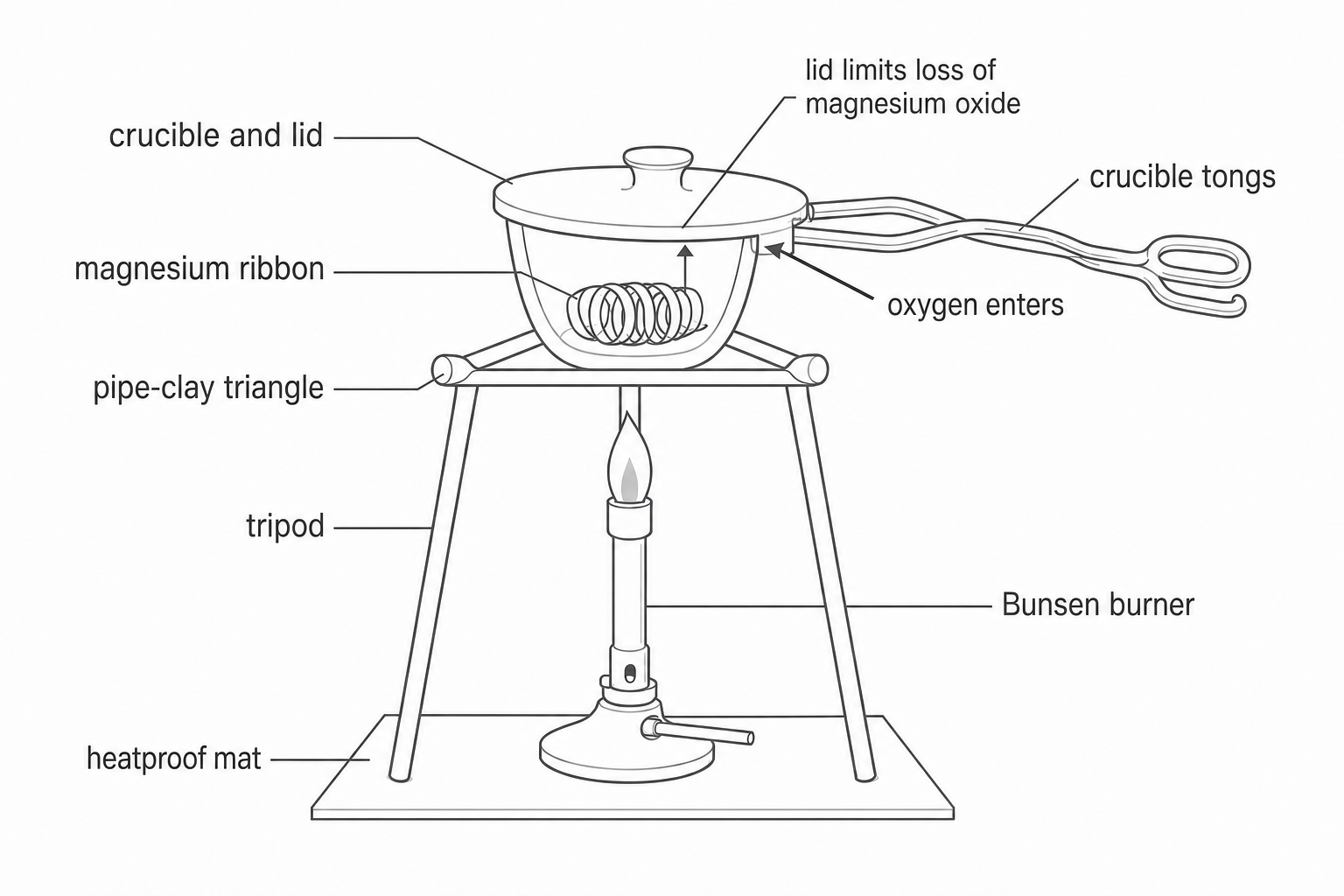
The crucible is shown as a cutaway so its contents are visible; the real crucible is opaque. The diagram represents the heating stage only. The crucible is moved to and from the balance only when it is cool.
Method
- Polish the magnesium ribbon with emery paper if it is tarnished. This removes an existing oxide coating that would otherwise be counted incorrectly as magnesium at the start.
- Weigh the clean, dry crucible and lid together. Record this as .
- Place a loose coil of magnesium in the crucible, replace the lid and weigh crucible, lid and magnesium. Record this as .
- Put the covered crucible on the pipe-clay triangle. Heat gently at first, then strongly.
- Use tongs to lift one edge of the lid slightly for short intervals. The gap admits oxygen, while the mostly closed lid limits loss of magnesium oxide smoke. Do not remove the lid completely.
- Continue heating and briefly admitting oxygen until no further reaction is seen.
- Replace the lid fully, turn off the burner and allow the crucible and contents to cool completely on the heatproof mat. Then weigh crucible, lid and product. Record this as .
- Reheat, cool and reweigh until two successive readings agree within the balance resolution. This is heating to constant mass and provides evidence that no further measurable oxygen is being added.
- Repeat the full determination with a fresh magnesium sample and compare the calculated simplest ratios. Investigate an anomalous ratio instead of averaging it blindly with consistent results.
The same crucible and lid must be included in all three readings. The same balance, cleaning method, lid-opening technique, heating endpoint and fully cooled weighing condition should be used across repeated trials. A single determination has no deliberately changed independent variable; its outcome is the calculated simplest ratio.
Safety linked to the actual hazards
| Hazard and route of harm | Proportionate control |
|---|---|
| Burning magnesium produces an intense white light that can damage eyes. | Wear eye protection, keep the lid mostly in place and never look directly at burning magnesium. |
| The Bunsen flame and crucible can cause burns; hot porcelain may look the same as cold porcelain. | Use a heatproof mat and functioning tongs, keep the bench clear, and allow the apparatus to cool fully before touching or weighing it. |
| Magnesium is flammable. | Use only the small pre-cut quantity in the assessed method and keep spare ribbon away from ignition sources. |
Continue this lesson.
You’re previewing NovaLearn without an account. Create a free account to read the rest.
Create free account