Chemistry 1.21 - 1.24, 1.27 - Ions and ionic bonding
Follow electron transfer to predict ion charges, count particles in ions, and explain how electrostatic attraction holds a giant ionic lattice together.
Electron transfer and ionic bonds
An atom is neutral when it contains equal numbers of positively charged protons and negatively charged electrons. If electrons are lost or gained, that balance changes. The charged particle formed is an ion; an ion can be one atom or a group of atoms.
Cation and anion
A cation is a positively charged ion. An anion is a negatively charged ion.
Only electrons move when an ion forms. The nucleus is unchanged, so the numbers of protons and neutrons stay the same.
- A metal atom that loses electrons has more protons than electrons and becomes a positive cation.
- A non-metal atom that gains electrons has more electrons than protons and becomes a negative anion.
For the groups assessed here, the outer electrons predict the usual ion charge:
| Periodic-table group | Change in electrons | Ion charge | Example |
|---|---|---|---|
| Group 1 | loses 1 | ||
| Group 2 | loses 2 | ||
| Group 6 | gains 2 | ||
| Group 7 | gains 1 |
The electron transfer leaves each ion with a full outer electron shell and a more stable electronic arrangement. It is better to describe this result than to say that an atom wants electrons: atoms do not have intentions.
From electron transfer to attraction
Consider sodium reacting with chlorine. A sodium atom has one outer electron and a chlorine atom has seven. One electron transfers from sodium to chlorine:
Electron transfer produces the oppositely charged ions. The ionic bond is then the strong electrostatic force of attraction between those oppositely charged ions; the transfer arrow itself is not a force or a bond.
A dot-and-cross diagram tracks where outer electrons came from. The symbols do not represent different kinds of electron. Brackets enclose each completed ion and its charge is written at the upper right. In the chloride ion below, seven dots came from chlorine and the single cross came from sodium.
[DIAGRAM: asset_name: Chemistry 1.21-1.27 - Ions, ionic formulae and ionic bonding - diagram 01; asset_slug: chemistry_1_21_1_27_ions_ionic_formulae_and_ionic_bonding__diagram_01; recommended_method: image_gen; description: A two-panel monochrome model on white linking electron transfer to lattice structure. Left: outer-shell dot-and-cross diagrams for sodium and chlorine, with one cross moving from sodium to chlorine; resulting bracketed Na+ has eight crosses and Cl- has seven dots plus the transferred cross, with charges and ion labels. Right: a labelled 4 by 4 checkerboard slice of alternating Na+ and Cl- ions, a caption that it repeats in 3D, and double-headed attraction arrows only between one central ion and its four nearest opposite ions. No molecules, shared pairs, covalent lines, like-charge connections, colour coding or property claims.]
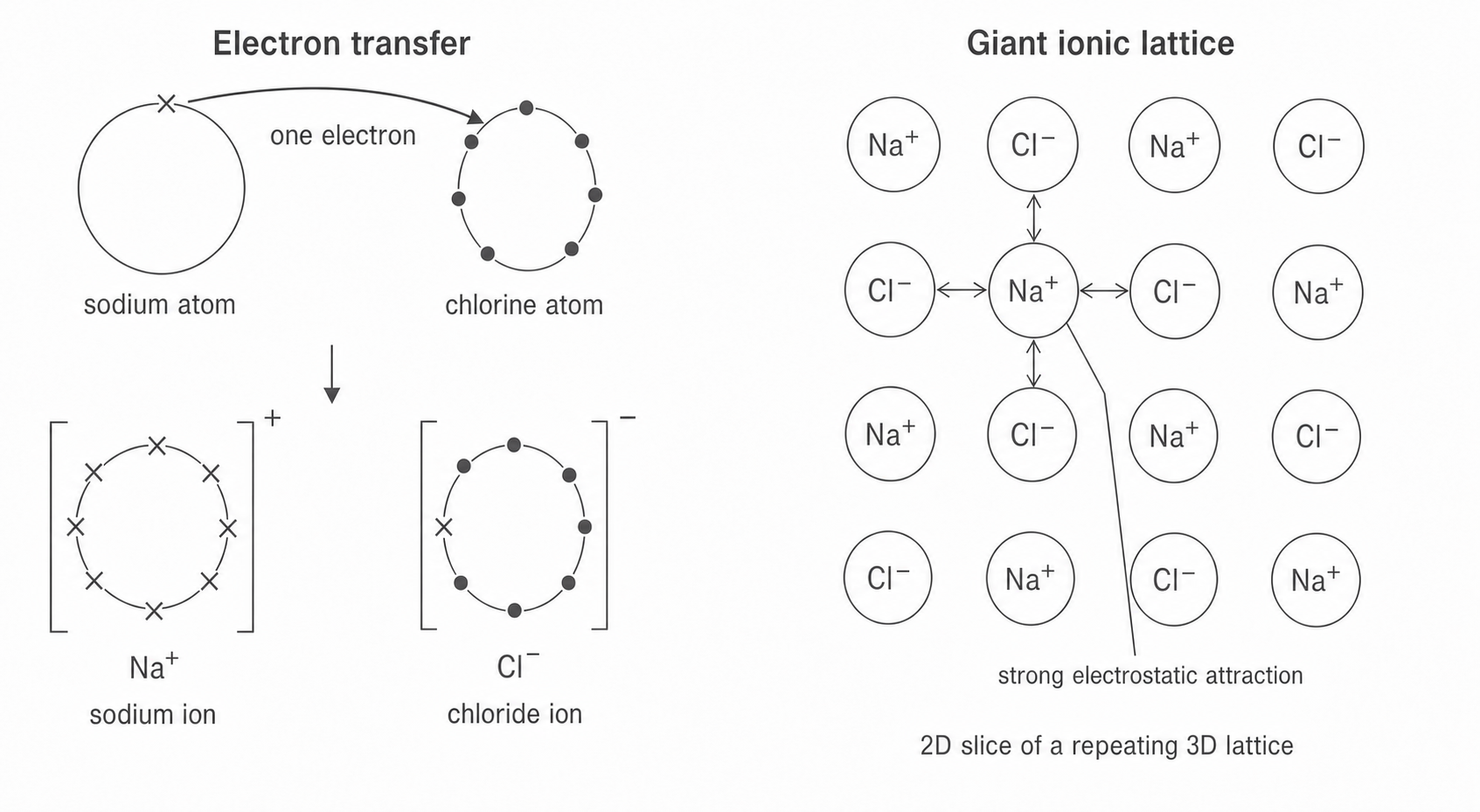
The eight crosses shown on the sodium ion are its newly exposed outer shell: those electrons were already present in the inner shell of the sodium atom. Only the single outer electron is transferred; eight new electrons have not appeared.
The right panel prevents a common misreading of the left: after formation, each ion is attracted to neighbouring ions of opposite charge, not only to the particular atom involved in its electron transfer. The small checkerboard is a 2D slice through a structure that continues in three dimensions.
Continue this lesson.
You’re previewing NovaLearn without an account. Create a free account to read the rest.
Create free account