Physics 3.3 - 3.6 - Energy transfers and conservation
Energy-transfer diagrams show where energy starts, how it transfers and where it ends up. Follow five familiar changes and use conservation to check that every joule is accounted for within the chosen system.
Systems, stores and pathways
Physics starts an energy account by choosing a system: the object or group of interacting objects being studied. The boundary is an imaginary line around that system. Energy can be transferred between stores inside the boundary, and it can cross the boundary into or out of the system.
Energy store
An energy store is a way energy is associated with the state of a system at an instant. The amount stored is measured in joules (J).
This lesson needs four stores most often:
| Store | When its amount changes |
|---|---|
| Kinetic | It increases when an object speeds up and decreases when the object slows down. |
| Gravitational | It increases when the separation of an object and Earth increases, and decreases when that separation decreases. It belongs to the object-Earth system. |
| Thermal | It increases when the temperature of an object or its surroundings rises. |
| Chemical | It decreases in a fuel-oxygen, food-oxygen or battery system when a process transfers energy from it. |
A transfer pathway is different from a store. It describes how energy is moved between stores or across a system boundary. In this lesson, forces can transfer energy by mechanical working, an electric current can transfer energy by electrical working, and a temperature difference can transfer energy by heating. A store is shown at a particular time; a pathway happens during a time interval.
For example, choose a trolley as the system. A person pushes it and the push causes it to accelerate. Energy crosses the trolley's boundary by mechanical working, so the trolley's kinetic store increases. The force causes the acceleration; energy is the quantity being accounted for, not the cause of the motion.
The arrows and boxes used later are models. An energy arrow is not a material pipe, and energy is not a fluid travelling along a visible track.
Drawing and reading energy-transfer diagrams
A qualitative energy-transfer diagram separates stores from pathways:
[starting store] -- transfer pathway --> [final store]
The box labels tell you where energy is stored at the chosen start and end instants. The arrowhead shows the direction of transfer, and the arrow label names how the transfer occurs. For a car using friction brakes, a simple account is:
[kinetic store of car] -- mechanical working and heating --> [thermal stores of brakes, road and surroundings]
That line is bookkeeping, not a picture of the car's path. To draw a sound scientific diagram:
- State the system and the start and end instants.
- Put only stores in boxes.
- Draw arrows in the direction energy is transferred and label their pathways.
- Include every important final store or transfer across the boundary.
- Check that the energy account balances.
A Sankey diagram adds quantity. Each arrow's width is proportional to the energy it represents. A single input arrow can split into several output arrows, but the combined output widths must equal the input width because energy is conserved.
Energy account
Energy supplied is accounted for by an increase in stores inside the boundary and transfers out. If the device stores no net extra energy during the interval, input equals total output. A Sankey may instead label each branch by the destination whose store increases, as in the kettle example.
For a chosen scale, .
Worked Sankey construction
During one interval, 1200 J is transferred electrically to a kettle system. Of this, 900 J increases the thermal store of the water and 300 J increases the thermal stores of the kettle body and nearby surroundings. Use the scale .
- Check the account: , so all the input is represented.
- Input width: .
- Water branch width: .
- Kettle-and-surroundings branch width: .
- Draw: start with a 12 mm-wide arrow. Split it into a 9 mm branch and a 3 mm branch, keeping both arrowheads visible and labelling each destination store.
- Sense-check the geometry: . The branches are narrower, but no energy has disappeared.
[DIAGRAM: asset_name: Physics 3.3-3.6 Sankey account; asset_slug: phy_b_sankey_1200_900_300; recommended_method: matplotlib; description: Exact input arrow of width 12 units splits into a 9-unit water branch and 3-unit kettle-and-surroundings branch, labelled 1200 J, 900 J and 300 J. The energy widths are 12:9:3; arrowheads are direction indicators, not measured widths.]
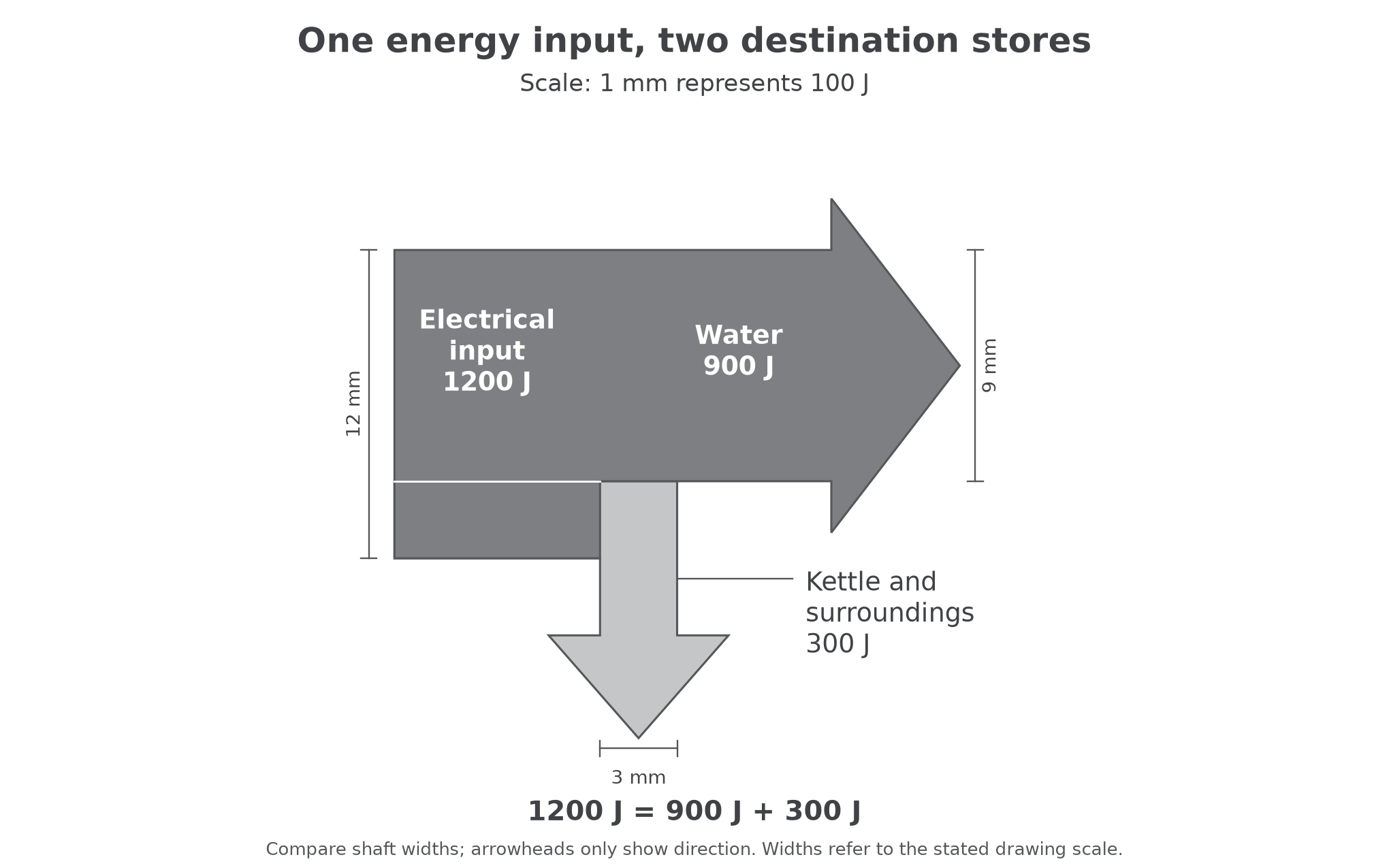
To interpret a Sankey diagram, read the arrow labels before judging the widths. A wide arrow represents a larger transfer than a narrow arrow drawn to the same scale. Add all branches before deciding whether the account conserves energy.
You can also compare transfers over a common time. If the kettle receives in , the mean input rate is . The two destination rates are and , which also add to the input rate. This compares transfers on the same energy and time scale.
Five changes, one accounting rule
For each required change, first describe what physically causes the change. Then compare the stores at the start and end. The precise account depends on the system boundary and on whether resistive effects are included.
| Required change | Useful system and physical mechanism | Store changes and transfers |
|---|---|---|
| An object projected upwards or up a slope | After release, choose object + Earth. For a vertical throw, gravity acts opposite the upward motion. On a slope, the component of gravity down the slope opposes the motion. In either case the object slows. | The kinetic store decreases while the gravitational store increases. In an ideal model with no air resistance, the decrease in one equals the increase in the other. When air resistance is included, energy also transfers to the thermal store of the air. |
| A moving object hitting an obstacle | Choose object + obstacle + nearby surroundings. Contact forces rapidly slow and deform the objects. | The moving object's kinetic store decreases. Thermal stores of the object and obstacle increase; deformation may temporarily increase an elastic store, and sound waves can carry energy into the surroundings. If the object rebounds, it still has some kinetic-store energy afterwards. |
| An object accelerated by a constant force | If the system is the object, an external force does work through a distance. A constant resultant force in the direction of motion on a constant mass gives constant acceleration, so the object speeds up. | Energy enters by mechanical working and the object's kinetic store increases. Constant force does not mean constant kinetic store or constant speed. |
| A vehicle slowing down | Choose vehicle + brakes/road + nearby air. Frictional contact forces oppose the motion and cause deceleration. | The vehicle's kinetic store decreases. Thermal stores of the brakes, tyres, road and air increase. The kinetic amount has been transferred, not destroyed. |
| Bringing water to the boil in an electric kettle | Choose kettle + water, and identify the mains supply as outside the boundary. Current through the heating element transfers energy electrically; the hot element transfers energy to the water by heating. | Energy enters the system and the thermal store of the water increases until it reaches boiling temperature. Thermal stores of the kettle body and surroundings also increase. Electricity is a pathway here, not a store inside the wire. |
The upward-projectile and braking accounts can look like opposites: one changes kinetic storage mainly into gravitational storage, while the other changes kinetic storage mainly into thermal storage. Conservation does not predict which change occurs. Forces, current and temperature differences explain the mechanism; conservation checks whether the energy account is possible and complete.
For a collision, avoid the shortcut kinetic energy becomes sound. Sound is a wave that carries some energy away from the collision region. A wider system eventually accounts for that energy in the motion and thermal stores of matter in the surroundings.
Continue this lesson.
You’re previewing NovaLearn without an account. Create a free account to read the rest.
Create free account