Physics 6.17 - Evidence for atomic models
Unexpected alpha-particle deflections changed the model of the atom. Separate the observations from their explanations, then see why the nuclear model was refined to include allowed electron energy levels.
Models changed by evidence
A scientific model is a representation used to explain observations and make
predictions. It is not a photograph of an atom. A model remains useful only while its
predictions agree with evidence; surprising evidence can force the model to change.
From plum pudding to a nucleus
The plum pudding model represented an atom as a sphere of spread-out positive charge
with negative electrons embedded in it. Because the positive charge was diffuse, a fast,
positively charged alpha particle was expected to experience only small forces as it passed
through. The model therefore predicted straight paths or, at most, small deflections.
Rutherford's team directed alpha particles at a very thin gold foil and detected where the
particles went. Three observations mattered:
| Observation | What it implied |
|---|---|
| Most alpha particles passed straight through, or changed direction very little. | Most of an atom is empty space. |
| Some alpha particles were deflected through noticeable or large angles. | Positive charge is concentrated rather than spread throughout the atom. Positive alpha particles were repelled by that positive region. |
| A very small number were deflected backwards. | Most of the atom's mass and positive charge are concentrated in a tiny, dense nucleus. Only a rare close approach produces such a large change in direction. |
[DIAGRAM: asset_slug: phy_d_atomic_models_checked; description: Three labelled panels: diffuse positive charge with embedded electrons, alpha-particle path outcomes at thin gold foil, and the later Bohr allowed-level refinement. The drawings are schematic and not to scale.]
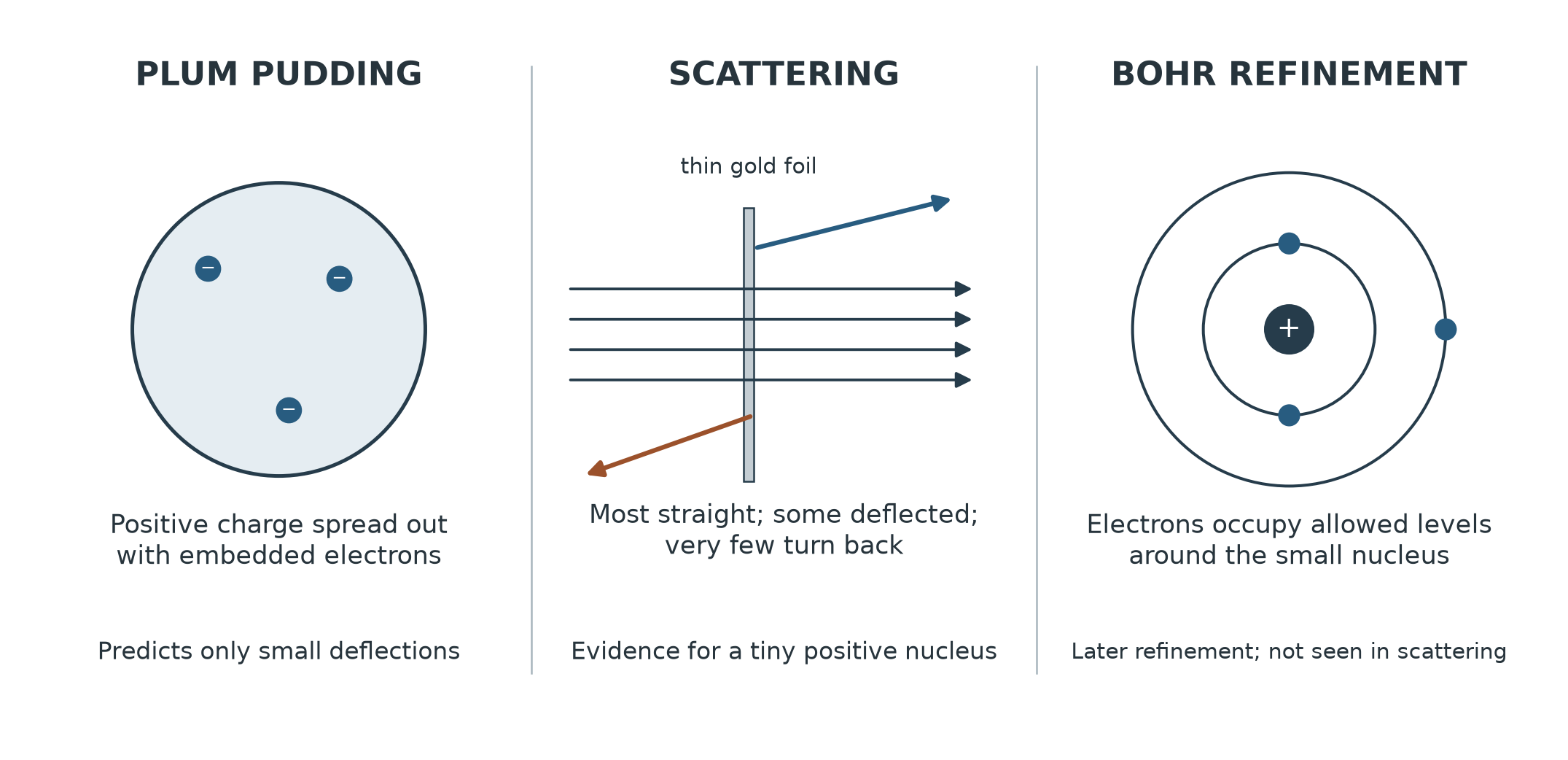
The evidence rejected the plum pudding model and led to the nuclear model: a tiny,
positively charged nucleus at the centre, with electrons outside it and mostly empty space
between. The diagram cannot preserve the true scale; the nucleus is far smaller relative to
the atom than it appears.
Continue this lesson.
You’re previewing NovaLearn without an account. Create a free account to read the rest.
Create free account