Chemistry 8.16 - 8.17 - Cracking hydrocarbons
Crude oil does not supply hydrocarbons in the proportions people demand. Connect the bonds and atom balances in cracking with the useful fuels and chemical feedstocks it produces.
From separation to reaction
Fractional distillation gives refineries mixtures called fractions. It separates the hydrocarbon molecules already present in crude oil because they have different boiling points. It does not break covalent bonds and it does not turn one molecule into another.
Cracking does something different. It is a chemical reaction in which larger hydrocarbon molecules are broken down and their atoms are rearranged into smaller hydrocarbon molecules.
Hydrocarbon
A compound containing carbon and hydrogen only.
The starting molecules for this lesson are alkanes. An alkane is saturated: every bond between neighbouring carbon atoms is a single covalent bond. Some products are alkenes. An alkene is unsaturated because it contains at least one carbon-carbon double bond, written .
| Process | What happens to the molecules? | Are new substances formed? |
|---|---|---|
| Fractional distillation | Existing molecules are separated into fractions | No |
| Cracking | Large molecules are changed into smaller molecules | Yes |
This distinction matters. Saying that cracking "separates a long molecule" hides the chemistry: covalent bonds break, atoms rearrange, and new covalent bonds form.
Molecules, bonds and equations
Cracking begins with a larger saturated alkane molecule. In a refinery, or in a small-scale demonstration, hydrocarbon vapour is heated strongly; a hot catalyst may be used to make the reaction happen faster. Breaking covalent bonds requires energy. The atoms then rearrange and new bonds form, producing two or more smaller molecules.
A simple cracking outcome contains:
- a smaller alkane, with only single carbon-carbon bonds;
- a smaller alkene, with at least one double bond.
The double bond is not drawn merely as a label. It represents the bonding feature that makes the alkene unsaturated.
[DIAGRAM: asset_name: Chemistry 8.16-8.17 - Cracking hydrocarbons - diagram 01; asset_slug: chemistry_8_16_8_17_cracking_hydrocarbons__diagram_01; recommended_method: image_gen; description: NovaLearn monochrome carbon-bond model on white: one six-carbon saturated alkane chain with only single C-C bonds changes left-to-right through a cracking arrow into one four-carbon alkane with only single C-C bonds and one two-carbon alkene with exactly one C=C double bond; label all three molecule types, state that hydrogen atoms are omitted, conserve six carbon nodes as 6 -> 4 + 2, and exclude apparatus, flames, bromine water and decorative chemistry marks.]
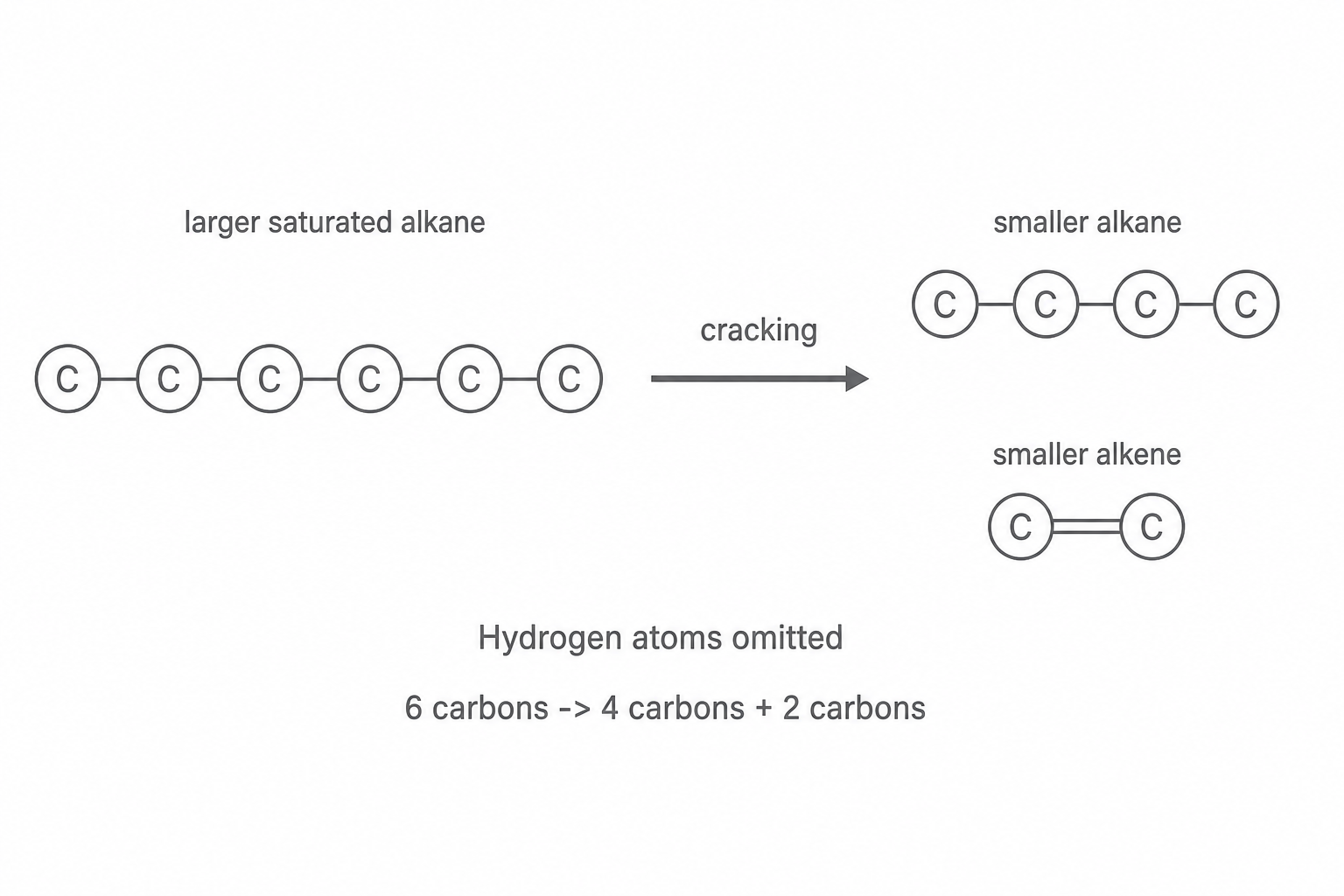
At the symbolic level, one possible reaction is:
The larger alkane forms a smaller alkane and an alkene.
This is one possible cracking route, not the only one. A real process forms a mixture. The equation is useful because it shows conservation: there are six carbon atoms and fourteen hydrogen atoms on each side.
Why does an unsaturated product appear in this simple two-product model? If the six-carbon alkane split into two saturated alkanes, each product would need enough hydrogen to complete all its single bonds. Together they would require more hydrogen atoms than the original molecule contains. A carbon-carbon double bond allows one product to contain fewer hydrogen atoms while all carbon and hydrogen atoms remain conserved.
Worked example: finding a product formula
One cracking route starts with and makes plus one unknown hydrocarbon.
- Conserve carbon: the unknown contains carbon atoms.
- Conserve hydrogen: the unknown contains hydrogen atoms.
- Write the formula: the unknown product is .
- Complete and check the equation:
Carbon: . Hydrogen: .
Both atom totals balance, so the formula is chemically possible. In this cracking model, is the alkene product; its unsaturation is a bonding fact, not something proved by the molecular formula alone.
Why cracking is necessary
Fractional distillation cannot choose how much of each fraction crude oil contains. It only separates what is already there. The proportions supplied therefore do not necessarily match the proportions people and industry demand.
Refineries may have more large, heavy hydrocarbon molecules than customers need, while demand for shorter-chain fuel molecules is greater than the amount obtained directly by distillation. Industry also needs alkenes as chemical feedstocks, including starting materials for making polymers.
Continue this lesson.
You’re previewing NovaLearn without an account. Create a free account to read the rest.
Create free account