Chemistry 3.22 - 3.24, 3.25(e), 3.26 - Molten electrolysis
Connect the direct current supply, electrode charges and ion movement. Predict the products of molten binary compounds and explain the lead bromide demonstration.
Building an electrolysis cell
An ionic solid contains charged particles, but those ions are locked in a lattice. They cannot move through the solid, so the solid does not conduct electricity. Melting the ionic compound, or dissolving it in water, frees its ions to move.
Electrolyte
An electrolyte is an ionic compound in the molten state or dissolved in water, so it contains mobile ions that can carry charge through the liquid.
Water acidified with sulfuric acid is one named setup in this lesson. The acid forms mobile ions in water and allows a useful current to flow; pure water contains too few ions to conduct well.
Electrolysis uses electrical energy from a direct current (DC) supply to decompose an electrolyte. Direct current matters because the two supply terminals keep the same polarity. Two conducting electrodes dip into the electrolyte:
- the cathode is connected to the negative terminal;
- the anode is connected to the positive terminal.
Graphite electrodes are often used. They are described as inert because they conduct electricity but are not intended to become reactants or products in the electrolysis.
Opposite charges attract, so the electrode connections determine the ion routes:
- positively charged cations migrate through the electrolyte to the negative cathode;
- negatively charged anions migrate through the electrolyte to the positive anode.
[DIAGRAM: asset_name: Chemistry 3.22-3.29 - Electrolysis, products and redox - diagram 01; asset_slug: chemistry_3_22_3_29_electrolysis_products_and_redox__diagram_01; recommended_method: image_gen; description: Landscape common-content electrolysis-cell diagram on a white background with #6A6B6E linework only. Show a beaker of electrolyte with two separate vertical inert graphite electrodes connected by uncrossed wires to a DC supply: the left electrode is labelled 'Cathode (-)' and connects to the negative terminal; the right electrode is labelled 'Anode (+)' and connects to the positive terminal. Inside the liquid, show positively charged cations with clear arrowheads moving towards the cathode and negatively charged anions with clear arrowheads moving towards the anode, using separate vertical lanes so arrows do not cross. Label 'DC supply', 'electrolyte', 'cations move to cathode' and 'anions move to anode'. Exclude products, gas bubbles, half-equations, electron-flow arrows, conventional-current arrows, salt bridges and decorative particles.]
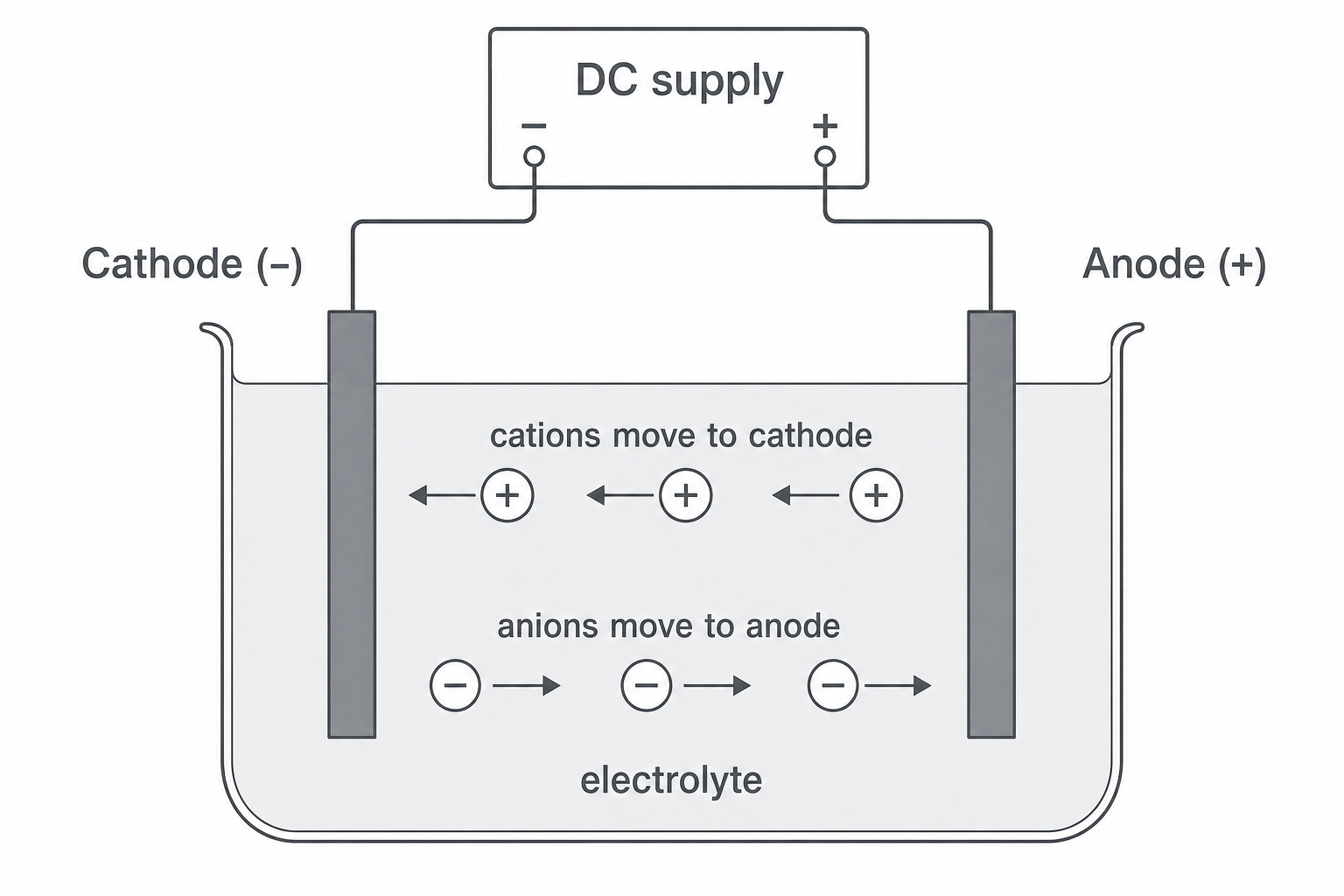
Charge through the liquid is therefore carried by moving ions. The products form only when selected ions reach and are discharged at the electrode surfaces.
Continue this lesson.
You’re previewing NovaLearn without an account. Create a free account to read the rest.
Create free account