Physics 10.32 - 10.36 - AC, DC and domestic supply
A battery and a wall socket can both run motors and heaters, but their voltage and current patterns differ. Connect source polarity to charge movement and interpret the voltage and frequency of the UK domestic supply.
Energy transfers in domestic devices
An electrical device is a system that receives energy and transfers it to other energy
stores. The electric current is not an energy store and is not "used up" by the device:
current describes moving charge, while energy is transferred by the electrical pathway.
For a battery-powered device, the starting store is the chemical energy store of the
battery. When the circuit is closed, the battery supplies a direct potential difference
and energy is transferred electrically to the device. The a.c. mains is different: it is an
external supply that transfers energy electrically into a connected device.
What happens next depends on the components in the device:
| Domestic device | Supply | Main useful energy transfer |
|---|---|---|
| Cordless fan | battery | chemical store of battery → electrical transfer → kinetic store of the motor, fan blades and moving air |
| Toaster | a.c. mains | electrical transfer → thermal store of the heating elements, bread and surroundings |
| Hairdryer | a.c. mains | electrical transfer → kinetic store of the motor and moving air, and thermal store of the heating element and air |
Real devices also transfer some energy to the thermal store of their surroundings, for
example because a motor and its wires warm up. A motor is identified by a moving output;
a heating device is identified by an intended rise in temperature. A device such as a
hairdryer can contain both.
Worked example
A rechargeable electric toothbrush is running from its battery. Describe the main energy
pathway that turns the brush head.
Solution
Energy begins in the battery's chemical energy store. It is transferred electrically to
the motor, increasing the kinetic energy store of the motor and moving brush head. Some
energy also reaches thermal stores, but that is not the intended output. This pathway is
physically sensible because the final moving component has a kinetic energy store.
Direct and alternating voltage
Potential difference, or voltage, tells us how much energy is transferred per unit of
charge. A voltage source has two terminals with a polarity. That polarity determines which
way the source tends to drive charge around a closed circuit.
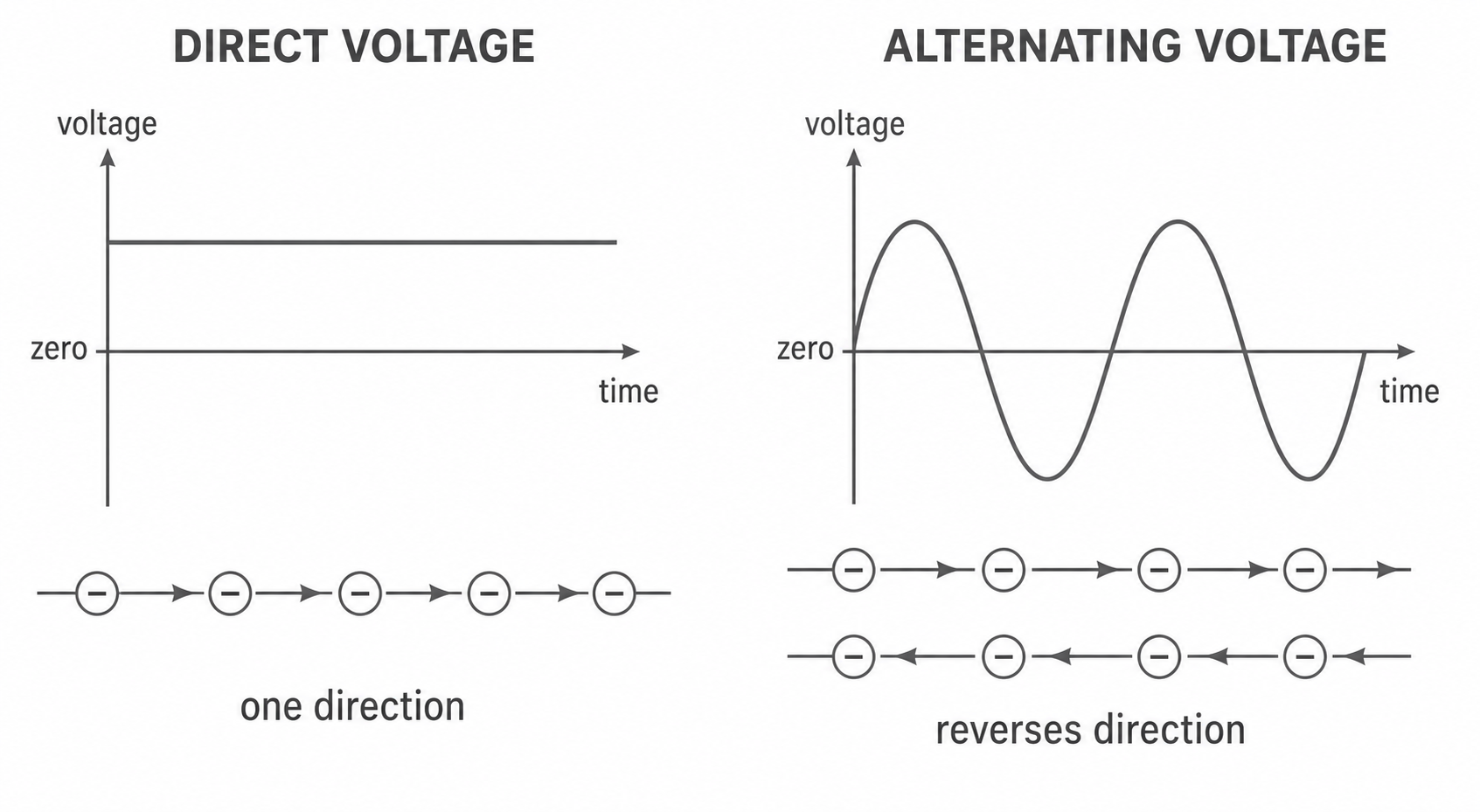
A direct voltage keeps the same polarity: the terminal that is at higher potential does
not repeatedly swap with the terminal at lower potential. An ideal cell or battery is often
shown on a voltage-time graph as a horizontal line on one side of zero.
An alternating voltage repeatedly reverses polarity. On a voltage-time graph, its value
alternates between opposite sides of zero. A smooth wave is a useful model of the domestic
supply, but the defining idea is the repeated reversal of polarity, not the exact curve
shape.
[DIAGRAM: asset_name: Physics 10.32-10.36 - AC, DC and domestic supply - diagram 01; asset_slug: physics_10_32_10_36_ac_dc_and_domestic_supply__diagram_01; recommended_method: image_gen; description: Monochrome two-column comparison of direct and alternating voltage. The direct-voltage column shows a voltage-time trace remaining above zero and one wire snapshot with charge-motion arrows all in one direction. The alternating-voltage column shows a smooth voltage-time trace crossing zero and two wire snapshots with charge-motion arrows in opposite directions. Required short labels: direct voltage, alternating voltage, voltage, time, zero, one direction, reverses direction. Arrowheads and graph crossing must be unambiguous. Exclude numerical scales, peak or RMS voltage, plug wiring, transmission and colour-dependent meaning.]
Continue this lesson.
You’re previewing NovaLearn without an account. Create a free account to read the rest.
Create free account