Chemistry 1.47 - Conservation of mass
A balance can show no change, a loss or a gain during a reaction. Explain all three by tracking atoms and deciding whether a gas crosses the boundary of the measured system.
Tracking mass across boundaries
In a chemical reaction, atoms are rearranged into new combinations. Atoms are not
created or destroyed, so the total mass of all the reactants equals the total mass
of all the products.
Law of conservation of mass
In a chemical reaction, total mass is conserved: total mass of reactants equals
total mass of products.
To apply the law to a balance reading, first choose the system being measured.
For a flask on a balance, a useful system is the flask, its closure and everything
inside it. The system boundary is the imaginary surface around that whole measured
assembly.
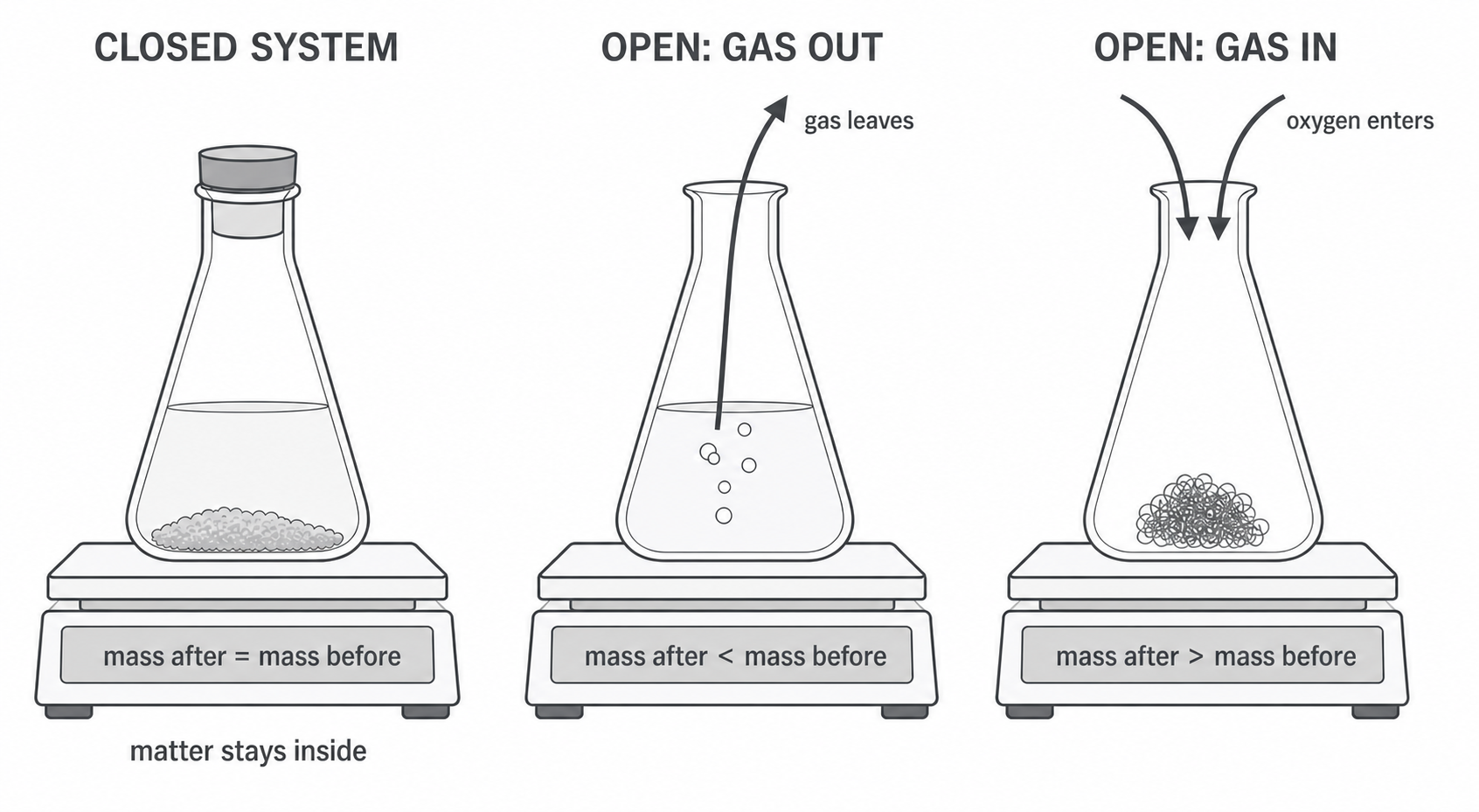
- In a closed system, matter cannot cross the boundary. Energy may still pass
between the system and its surroundings. - In an open system, matter can cross the boundary. A gas can leave or enter,
even when no liquid or solid is spilled.
The law itself always holds. Closing the system does not make mass conservation
start working; it makes sure the balance includes the same collection of matter
before and after the reaction.
A precipitate in a closed flask
Suppose sodium carbonate solution and calcium nitrate solution are kept apart
inside a stoppered flask. The whole assembly is weighed, then tilted so the
solutions mix without opening the flask.
Macroscopic evidence: the clear solutions become cloudy and a white solid
appears. An insoluble solid formed from solutions is called a precipitate.
Particle explanation: the ions have been rearranged. Calcium ions and carbonate
ions form solid calcium carbonate, while the other ions remain in solution. Every
atom that was present before mixing is still somewhere inside the flask.
Symbolic representation:
The balanced equation contains the same number of atoms of each element on both
sides. Because no matter crosses the closed boundary, the mass of the stoppered
flask and its contents is unchanged, within the uncertainty of the balance. The
solid has mass, but its atoms came from the solutions; its appearance did not add
new matter.
An open flask that loses gas
Calcium carbonate reacting with hydrochloric acid produces carbon dioxide:
Fizzing is macroscopic evidence that gas is being produced. In an open flask,
carbon dioxide particles leave the measured system. The final reading for the
flask and what remains inside is therefore lower. Mass has not been destroyed:
Total reactant mass = mass of products remaining + mass of escaped carbon dioxide.
An open flask that gains gas
An open system can also gain measured mass. If iron in an open flask reacts with
oxygen from the air, oxygen particles cross into the measured system and become
part of solid iron oxide:
The final mass of flask and solid is higher than its initial mass because oxygen
entered. Again, no mass was created: the initial measurement simply did not include
the oxygen that was still outside the chosen boundary.
[DIAGRAM: asset_name: Chemistry 1.47-1.49 - Conservation of mass and concentrations - diagram 01; asset_slug: chemistry_1_47_1_49_conservation_of_mass_and_concentrations__diagram_01; recommended_method: image_gen; description: A clean three-panel monochrome scientific diagram, each panel showing a flask on a balance as the measured system: left, a stoppered closed flask containing a newly formed precipitate, no arrows crossing the boundary, labelled 'matter stays inside' and 'mass after = mass before'; centre, an open fizzing flask with one clear upward arrow labelled 'gas leaves' and 'mass after < mass before'; right, an open flask containing reacting iron with clear downward arrows from outside labelled 'oxygen enters' and 'mass after > mass before'. Arrowheads must point outward in the centre and inward in the right panel. Use only white and #6A6B6E with neutral grey fills, direct legible labels, no equations, no particle counts and no decorative marks.]
Continue this lesson.
You’re previewing NovaLearn without an account. Create a free account to read the rest.
Create free account