Physics 8.5 - 8.9 - Work and energy changes
Push a trolley, lift a suitcase or speed up a bicycle and a force changes an energy store. This lesson connects the measurable work done by a force with changes in gravitational potential energy and kinetic energy, so three equations describe one physical story. The direction of motion, vertical height and speed squared each matter.
Work as energy transfer
Pearson supplies an equation sheet for the 2025–2027 GCSE Combined Science Physics exams. Practise selecting equations, understanding their quantities, converting units and rearranging them. The independent calculations here include the equation support they need.
In physics, work done has a precise meaning. Choose the object or group of objects that forms the system. When a force acts while an object moves in the force's direction, the force transfers energy mechanically. A force acting opposite the movement transfers energy away from that object's mechanical stores.
Work done
Work done by a force is equal to the energy transferred by that force.
Both work done and energy transferred are measured in joules (J). Force is a different quantity, measured in newtons (N).
An object does not "contain work", and a moving object does not "carry force". A force is an interaction that can change motion; work done measures an associated energy transfer.
There must be movement in the direction of the named force. Holding a stationary bag requires an upward force, but the bag does not move, so that force does no mechanical work on the bag. One joule is transferred when a force of 1 N moves an object 1 m in the force direction.
Measuring and calculating work
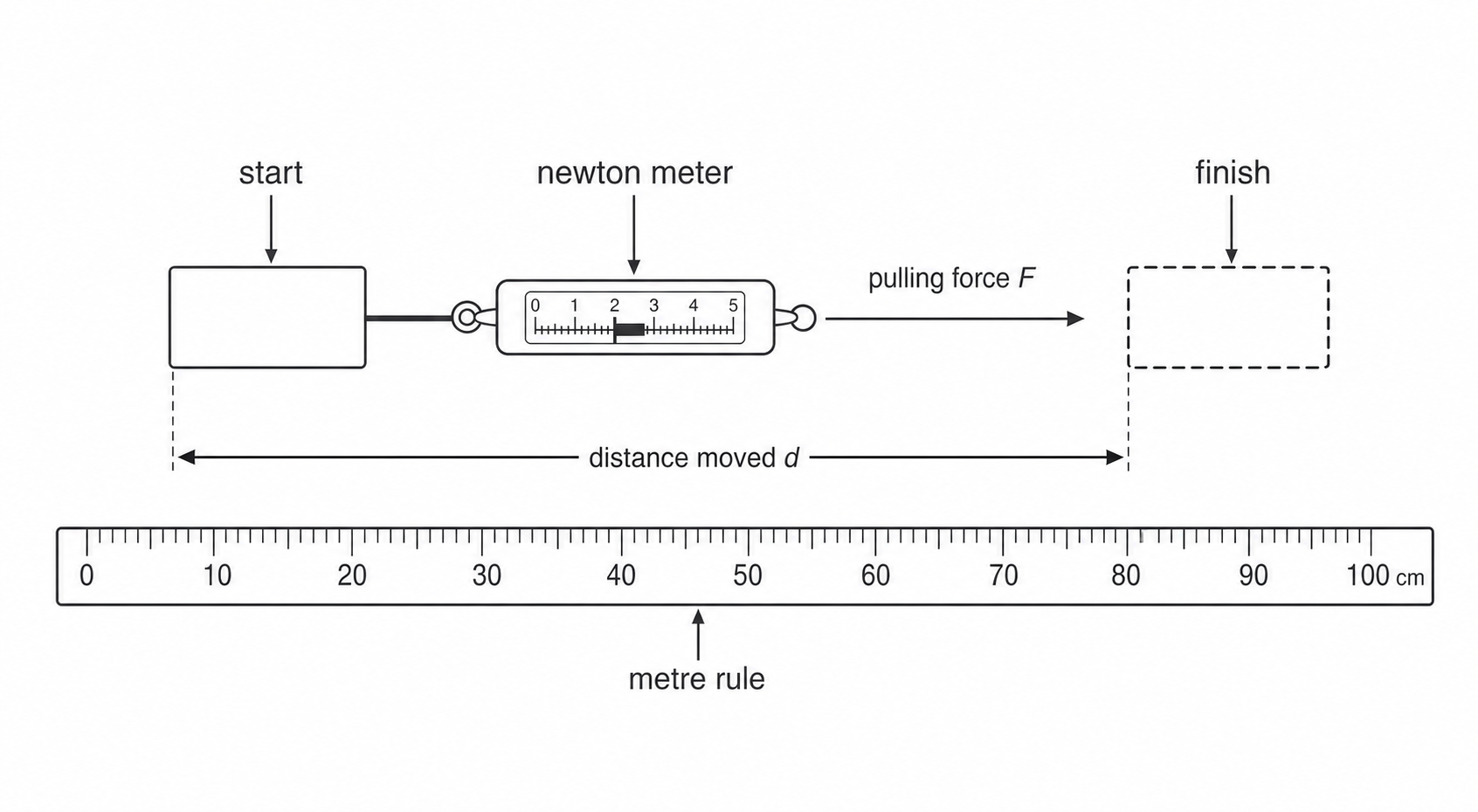
To measure the work done by a steady pulling force:
- Zero a newton meter (force meter), attach it to the object and pull in a straight line.
- Keep the meter aligned with the direction of movement and record the steady force in newtons.
- Use a metre rule or tape measure to find the distance moved in that same direction, in metres.
- Multiply the force by the aligned distance.
[DIAGRAM: asset_name: Physics 8.5-8.9 - Work done, GPE and kinetic energy - diagram 01; asset_slug: physics_8_5_8_9_work_done_gpe_and_kinetic_energy__diagram_01; recommended_method: image_gen; description: NovaLearn monochrome apparatus diagram on white: a newton meter positioned in front of and connected horizontally to the right-hand side of a block so it pulls the block right; a rightward arrow labelled pulling force F aligned with the motion; clearly separated start and finish block positions; a metre rule below; and a horizontal dimension arrow labelled distance moved d. Labels must point unambiguously, arrowheads must be visible, and the image must exclude an angled pull, vertical displacement, colour and decorative detail.]
Work done
- = work done, or energy transferred, in joules (J)
- = force in newtons (N)
- = distance moved in the direction of the force, in metres (m)
Worked example
A trolley is pulled 2.5 m by a steady horizontal force of 18 N. Calculate the work done by the pulling force.
Solution
The force and movement are in the same direction, so the full 2.5 m is used.
The unit product is , so and describe the same work. Convert centimetres to metres before multiplying: . The answer is sensible: each metre transfers 18 J, so 2.5 m transfers more than 36 J but less than 54 J.
Work and energy changes
Work links a force to a change in an energy store. The force is the interaction that changes the system; the work done is the amount of energy transferred.
- When a lifting force raises an object, the gravitational potential energy of the object-Earth system increases.
- When a resultant force speeds up an object, the object's kinetic energy increases.
- When the resultant force opposes the motion, the object's kinetic store decreases. An individual resistive force can do work while another force supplies energy: at constant speed their effects balance, so kinetic energy need not change.
If no other energy transfer needs to be included, the magnitude of the change in the relevant energy store equals the work done:
Worked example
A resultant force does 85 J of work on a cart on a level track. The cart initially has 25 J of kinetic energy. The force acts in the direction of travel. Calculate its final kinetic energy.
Solution
The force speeds up the cart, so its kinetic store increases by 85 J.
Continue this lesson.
You’re previewing NovaLearn without an account. Create a free account to read the rest.
Create free account