Physics 14.1-14.4 - Particle model and density
A particle model can explain why solids keep their shape, liquids flow and gases spread out, even though the particles themselves are too small to see. Density then gives a precise way to compare how much mass is packed into a volume. In this lesson, you will use both ideas and learn the core practical for measuring the densities of a solid and a liquid.
The kinetic particle model
Matter can be represented using a kinetic particle model. "Kinetic" refers to movement: the model describes both the arrangement of particles and how they move. A particle may represent an atom or a molecule, depending on the substance.
The circles in a particle diagram are not photographs and are not drawn to scale. They are a model that helps us reason about matter. The gaps are spaces between particles; they are not filled with air unless the substance itself is a mixture containing air.
| State | Particle arrangement | Particle movement | What the model explains |
|---|---|---|---|
| Solid | Very close together, usually in an ordered arrangement | Vibrate about fixed positions | A solid keeps a fixed shape and volume |
| Liquid | Close together in an irregular arrangement | Move around and past one another | A liquid flows, takes the shape of its container and keeps a fixed volume |
| Gas | Far apart in a random arrangement | Move rapidly in random directions | A gas spreads out to fill its container and can be compressed |
[DIAGRAM: asset_name: Physics 14.1-14.4 - Particle model and density - diagram 01; asset_slug: physics_14_1_14_4_particle_model_and_density__diagram_01; recommended_method: image_gen; description: Three schematic regions with equal-sized particles: 18 close ordered solid particles, 18 close irregular liquid particles, and five widely separated gas particles. Labels describe vibration, movement past neighbours and random gas motion. These are representative regions, not one closed sample changing state; arrows show motion, not forces.]
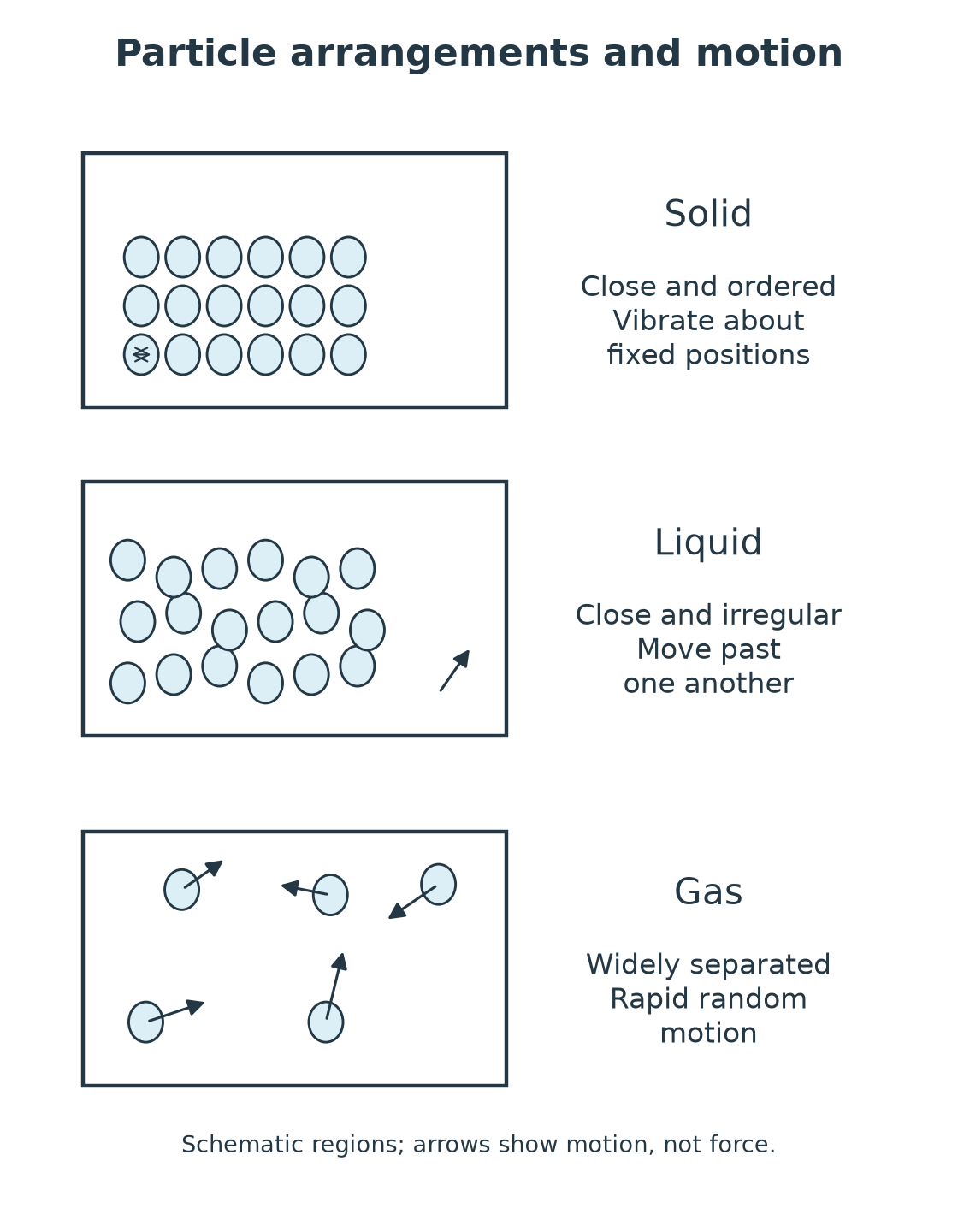
The particles in a solid are not motionless. They vibrate while remaining centred on fixed positions. In a liquid, particles remain close but can change neighbours. In a gas, particles are separated by much larger gaps and move freely through the available space.
This lesson's particle model, density equation and core practical are common to both Foundation and Higher tier.
Density as mass per unit volume
Two objects can have the same size but different masses. Density compares them fairly by asking how much mass there is in each unit of volume.
Density
Density is the mass per unit volume of a substance.
The symbol for density is the Greek letter (rho). Mass is and volume is .
Density
In SI units, mass is in kilograms (kg), volume is in cubic metres (), and density is in kilograms per cubic metre ().
In a laboratory, mass is often measured in grams and volume in cubic centimetres, so density may be calculated in . Keep one consistent unit set throughout a calculation:
- kg with gives ;
- g with gives ;
- .
For volume conversion, cube the length conversion: , so . Hence . Dividing a cubic-centimetre value by 100 alone is not a volume conversion.
You may need either rearranged form:
Worked example: calculating density
A block has a mass of and a volume of . Calculate its density.
Solution
- The values already use kg and , so no conversion is needed.
- Select the equation: .
- Substitute: .
- Calculate: .
The answer has three significant figures, matching the data. A value of a few thousand is physically plausible for a dense solid.
Worked example: rearranging to find volume
A metal sample has mass and density . Find its volume.
Solution
The units are consistent, and multiplying the answer back by the density gives , so the rearrangement passes a sense-check.
Core practical: density of a solid
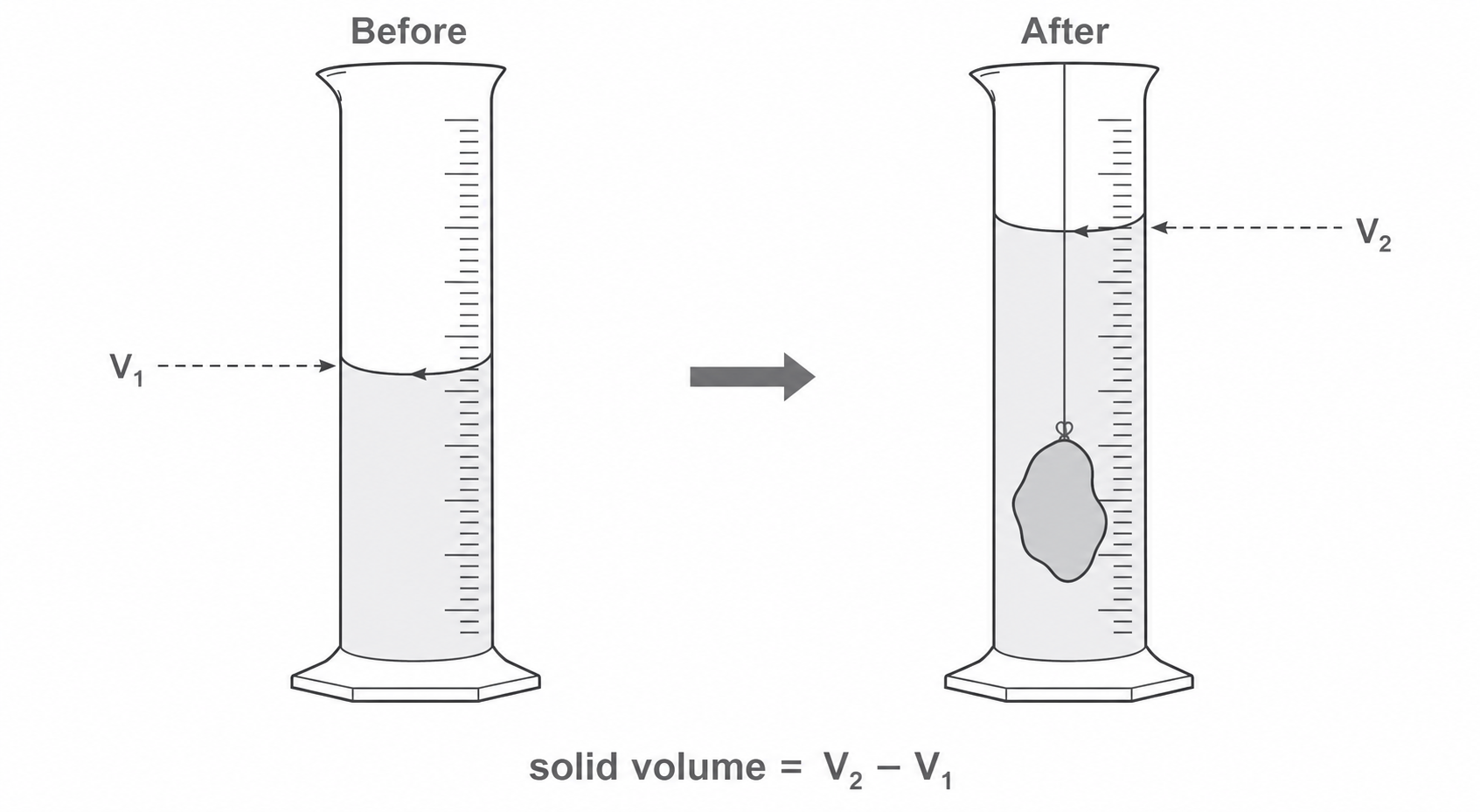
The purpose is to determine the density of an irregular, non-porous solid. Its mass is measured directly. Its volume is found from the volume of water it displaces.
Apparatus: a balance, measuring cylinder, water, thin thread and a dry irregular solid that does not dissolve in or absorb water.
[DIAGRAM: asset_name: Physics 14.1-14.4 - Particle model and density - diagram 02; asset_slug: physics_14_1_14_4_particle_model_and_density__diagram_02; recommended_method: image_gen; description: Landscape NovaLearn-monochrome before-and-after measuring-cylinder diagram with identical rising scales: initial concave meniscus V1, final higher concave meniscus V2, one irregular non-porous solid fully submerged on a thin thread with no bubbles, eye-level guides, and the equation solid volume = V2 - V1; no added or lost water.]
Method
- Place the dry solid on a zeroed balance and record its mass in g.
- Part-fill a measuring cylinder with enough water to cover the solid. At eye level, read the bottom of the water's meniscus and record the initial volume in .
- Lower the solid gently into the water using thin thread. Make sure it is fully submerged, with no trapped air bubbles and no water spilled.
- Read the new volume at eye level using the same part of the meniscus.
- Calculate the solid's volume: .
- Calculate its density: .
- Return the water to a suitable starting level and repeat the displacement measurement at least three times. Investigate unexpected readings, repeat them where possible, and calculate a mean from valid results. Do not discard a value just because it disagrees with your prediction.
Continue this lesson.
You’re previewing NovaLearn without an account. Create a free account to read the rest.
Create free account