Physics 15.1-15.6 - Springs and elastic distortion
Connect forces and changes of shape to spring stiffness, graphs and elastic energy. Measure extension under different loads, distinguish elastic recovery from a linear graph, and calculate the work done in the spring practical.
Forces and distortion
A distortion is a change in an object's shape. Pulling its ends apart can stretch it, pushing its ends together can compress it, and forces applied at different positions can bend it. Springs, rubber bands and foam objects can all be distorted.
To produce a maintained distortion, more than one force acts on different parts of the object. For example, consider the spring as the system when a mass hangs from it:
- the support pulls upwards on the top of the spring;
- the load pulls downwards on the bottom of the spring.
These two forces act on the same spring, so they are not a Newton's third-law pair. The support is essential: pulling an unsupported object mainly accelerates it. For compression, forces push inwards at opposite ends. For bending a strip, two supports push up while a central force pushes down; the forces act at different positions on the same object.
Elastic and inelastic distortion
- In an elastic distortion, the object returns to its original length and shape when the forces are removed.
- In an inelastic distortion, it does not fully return, so some distortion is permanent.
The test is what happens after unloading. An object can stretch a long way and still be elastic if it returns, while a spring stretched beyond a safe limit may become inelastically distorted.
Extension and spring constant
Let the unloaded length of a spring be and its length under a force be . Its extension is the change in length:
Extension is not the spring's total loaded length. In the spring equation it must be measured in metres.
Linear elastic distortion
- is the force exerted on the spring in newtons, .
- is the spring constant in newtons per metre, .
- is the extension in metres, .
This relationship applies to the linear region of the force-extension relationship. The spring constant measures stiffness: a larger means that a larger force is needed for the same extension. Rearranging gives or .
Worked example
A spring is long when unloaded and long when a force of is applied. Calculate its spring constant.
Solution
- Find the extension: .
- Convert to metres: .
- Rearrange the equation: .
- Substitute: .
- Sense-check: , which recovers the given force. A stiffness of means each of extension needs while the relationship remains linear.
Force-extension graphs
A force-extension graph connects measurements to the spring model. Plot extension horizontally and force vertically. For the straight spring region with this orientation, the gradient is
.
[DIAGRAM: asset_name: Physics 15.1-15.6 - Springs and elastic distortion - diagram 02; asset_slug: physics_15_1_15_6_springs_and_elastic_distortion__diagram_02; recommended_method: matplotlib; description: Two uncluttered monochrome force-extension plots with extension x in metres on each horizontal axis and force F in newtons on each vertical axis. The left plot is a straight line through the origin labelled linear: constant gradient. The right plot is a smooth upward-curving line from the origin labelled non-linear: changing gradient. No numerical scale, energy area, limit labels or separate-science material.]
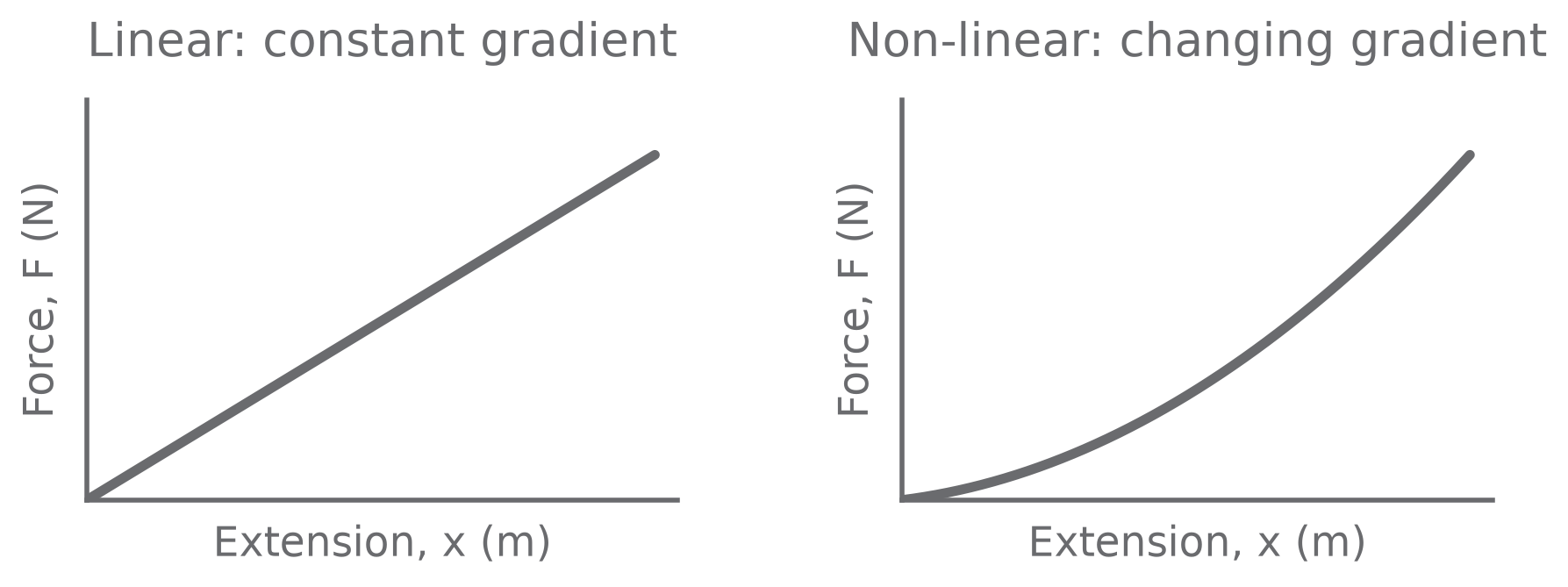
A linear relationship has a straight-line graph and constant gradient. If that straight line passes through the origin, force is directly proportional to extension: doubling doubles . The ideal linear spring follows , so one value of describes the whole straight section.
A non-linear relationship has a changing gradient, so its graph is curved and a single constant cannot describe the whole relationship. A straight line that does not pass through the origin is still linear, but it is not a direct proportion.
Gradient and intercept
The general straight-line form is . Here, the mathematical means gradient, not mass. For force plotted against extension, write : vertical coordinate is force, horizontal coordinate is extension, gradient is stiffness , and the force intercept is .
For an ideal spring measured from its genuinely unloaded length, , giving . With a non-zero intercept, is not the gradient; use . A non-zero intercept may reflect preload or a measurement zero offset. Check the unloaded length, hanger contribution and force zero before interpreting it. Correct a demonstrated offset in the measurements; do not force the fitted line through the origin just to obtain the expected answer.
Linearity and elasticity answer different questions:
- linear or non-linear describes the shape of the force-extension graph;
- elastic or inelastic describes whether the object returns to its original shape after the force is removed.
A curved force-extension graph is not proof that an object is inelastic. To test elasticity, unload it and compare its final length with its original length.
Work done in stretching
For every student, the physical link is that an applied force moving the end of a spring does work and transfers energy to the spring's elastic store. As the extension increases, the required force can also change, so the final force is not automatically the force acting throughout the movement.
For a linearly elastic spring, force rises uniformly from zero to the final value . On a graph of against , the work done is the triangular area under the straight line:
Since , this becomes:
Energy transferred in stretching
- is the energy transferred, or work done, in joules, .
- is the spring constant in .
- is the extension in , not the total length.
The factor is needed because the force grows from zero: its average value during a linear stretch is half the final force. The equation applies to a linearly elastic spring over the extension being considered.
Continue this lesson.
You’re previewing NovaLearn without an account. Create a free account to read the rest.
Create free account