Physics 5.9 - Refraction in glass core practical
Trace a narrow beam through a rectangular glass block. Measure its angles from the normal, investigate how incidence affects refraction, and improve the reliability of each ray trace.
Reading a ray through glass
A ray is a model: a straight line showing the direction in which a wave and its energy propagate. Its arrowhead points in the travel direction. A ray is not a narrow material track inside the light.
At the point where a ray meets a boundary, draw a normal at to the surface. The angle of incidence, , is between the incident ray and the normal. The angle of refraction, , is between the refracted ray inside the block and the normal. Neither angle is measured from the glass surface.
In the glass-block practical, observe this path:
- At an oblique angle, the ray entering glass from air changes direction towards the normal, so is smaller than .
- At the second face, the ray leaving glass for air changes direction away from the normal.
- Because the two faces of a rectangular block are parallel, the emergent ray is parallel to the incident ray but shifted sideways.
- If the ray travels along the normal, and its direction does not turn.
[DIAGRAM: asset_slug: phy_c_glass_tracing_verified; description: Rectangular glass block with incident and emergent rays parallel, bending towards the normal on entry and away on exit. Both normals and separated ray marks shown.]
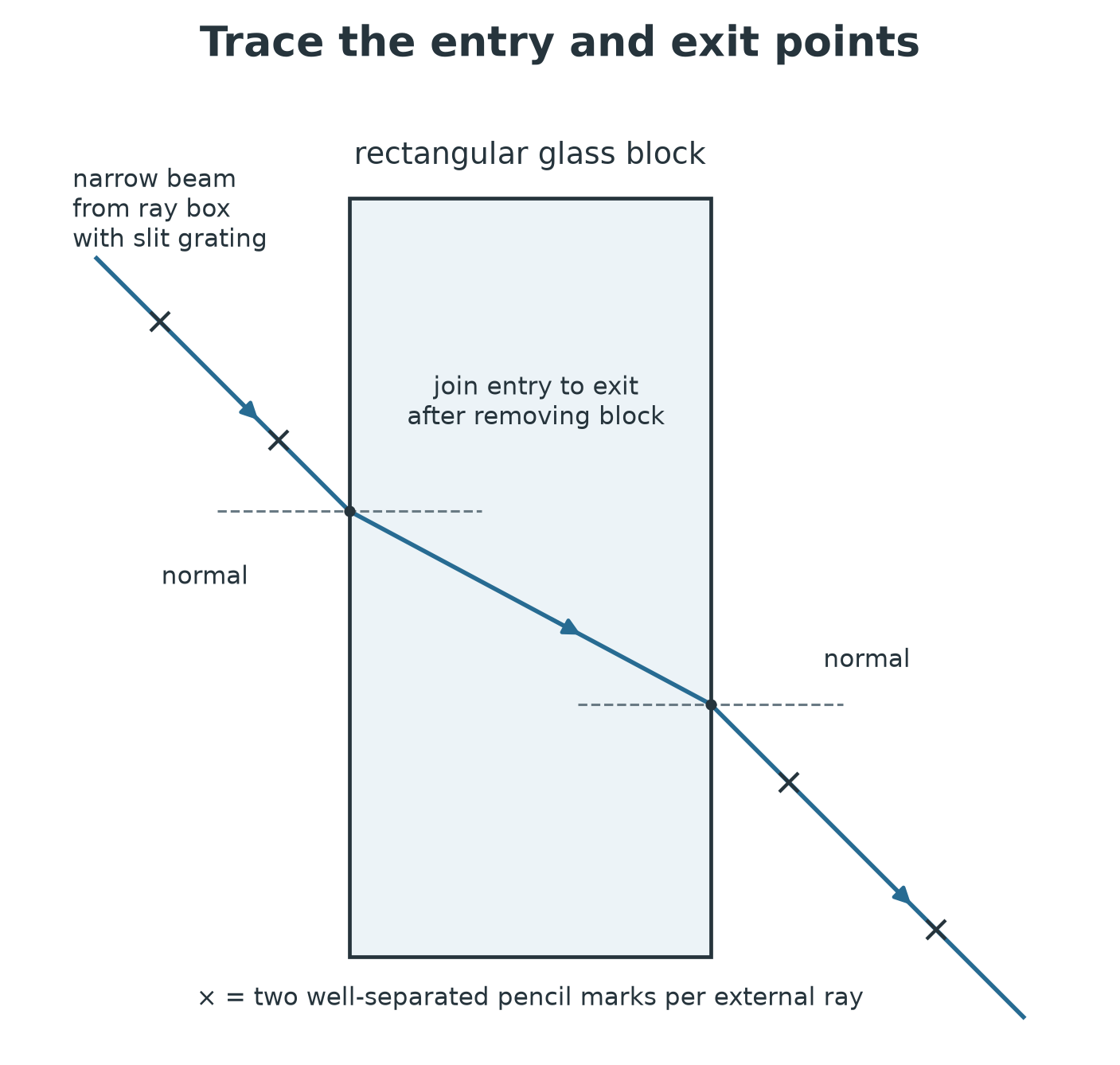
The practical turns this geometry into evidence. Its purpose is to investigate how changing affects , while also tracing the complete path through the rectangular block.
The glass-block core practical
Apparatus and arrangement
Use a ray box fitted with a single-slit grating and low-voltage power supply, a rectangular glass block, white paper, a sharp pencil, a ruler and a protractor. The single-slit grating produces a narrow beam whose centre can be traced more precisely than a broad patch of light.
| Variable role | Quantity and operation |
|---|---|
| Independent variable | Angle of incidence , in degrees, set and measured from the normal. |
| Dependent variable | Angle of refraction inside the glass, in degrees, measured from the normal at the first face. |
| Controlled variables | Same block, material, face and orientation; same entry point; same ray box and single-slit setting; same paper and angle-measurement method. |
Reproducible method
- Fix a sheet of white paper flat on the bench. Place the rectangular glass block near its centre and trace its outline with a fine pencil.
- Mark a point near the middle of one face. Use a ruler and protractor to draw a normal through this point at to the face.
- Draw an incident guide line at to the normal. Replace the block exactly on its outline.
- Fit the single-slit grating, switch on the ray box and align the centre of its narrow ray with the incident guide line. Keep the beam at bench level.
- Mark two well-separated points along the incident ray, the points where the ray meets and leaves the block, and two well-separated points along the emergent ray. Do not move the block while marking.
- Switch off the ray box and remove the block. Join the points with a ruler to reconstruct the incident, refracted and emergent ray paths. Draw a normal at the exit face too.
- Put the protractor centre exactly at the entry point, align its zero line with the normal, and measure and to the nearest degree. View from directly above to reduce parallax.
- Repeat for . This gives a useful range at equal intervals rather than changing several factors at once.
- Make three independent traces for each incidence angle, using a fresh outline or fresh sheet each time. Calculate the mean . Repeat an obviously inconsistent trace before excluding it; do not discard a result only because it misses the trend.
Continue this lesson.
You’re previewing NovaLearn without an account. Create a free account to read the rest.
Create free account