Chemistry 1.32 - 1.34 - Structure and properties
Use melting, boiling, solubility and electrical conduction to infer how particles are arranged. Distinguish the strong attractions in an ionic lattice from the weaker forces between separate molecules.
Four ways particles can be organised
A physical property can be observed or measured without making a new substance. Melting point, boiling point, water solubility and electrical conductivity are physical properties. Their values are not random: they depend on which particles are present, how those particles are arranged and what holds them together.
Bonding and structure
Bonding describes the attractions that hold atoms or ions together. Structure describes how the atoms, ions or molecules are arranged throughout the substance.
These are related but not interchangeable. Two substances may both contain covalent bonds but have different structures: one may contain separate small molecules, while the other is one giant network. Their physical properties will then be very different.
The four classifications are:
- Ionic: a compound containing positive and negative ions in a giant, repeating lattice, held together by strong electrostatic attractions between oppositely charged ions. Sodium chloride, , is ionic. The formula gives the ion ratio; it does not mean that solid sodium chloride contains separate molecules.
- Simple molecular (covalent): an element or compound containing separate, small molecules. Strong covalent bonds join atoms within each molecule, while intermolecular forces act between different molecules. Oxygen, , is a molecular element and water, , is a molecular compound.
- Giant covalent: an element or compound containing a continuous network of atoms joined by many strong covalent bonds. Silicon(IV) oxide, , is a giant covalent compound; its formula gives an atom ratio in the network rather than a separate molecule.
- Metallic: a metal element with a giant structure of positive metal ions and delocalised electrons. The mobile electrons are shared through the structure rather than belonging to one atom. Copper, , has metallic bonding.
The broad property patterns are useful, but words such as typical, many and usually matter. A pattern supports a classification; it is not a law without exceptions.
| Structure type | Relative melting and boiling points | Solubility in water | Conductivity as a solid | Conductivity when molten or mixed with water |
|---|---|---|---|---|
| ionic | high | many dissolve, but not all | no: ions are fixed | yes when molten; an aqueous solution conducts if the compound dissolves because ions can move |
| simple molecular | low | varies; some dissolve and some do not | poor | poor as a liquid; a solution of neutral molecules is also a poor conductor |
| giant covalent | very high | generally insoluble | usually poor; it depends on whether mobile electrons exist | generally no aqueous solution forms; molten-state tests are usually impractical |
| metallic | often high, although values vary | generally insoluble; some metals react instead of simply dissolving | good: electrons can move | conducts when molten; the original metal does not normally form an aqueous solution |
Solubility is therefore supporting evidence, not a decision by itself. Both sodium chloride and sucrose dissolve in water, but sodium chloride solution contains mobile ions and conducts; sucrose solution contains neutral molecules and conducts poorly. If a metal reacts with water and ions enter solution, the solution contains new substances rather than the original metallic structure.
Why ionic properties change with state
An ionic lattice contains a regular three-dimensional arrangement of positive and negative ions. Every ion is attracted to several nearby ions of opposite charge, so strong electrostatic attractions extend in all directions through the structure.
To melt an ionic compound, enough energy must be transferred to overcome many of these strong attractions so that the ions can move past one another. Separating the ions still further to form a gas requires even more energy. Ionic compounds therefore have high melting points and high boiling points.
Electrical conduction needs two things:
- charged particles must be present;
- those charged particles must be free to move through the material.
Ions are charged in every state. In a solid, however, they only vibrate around fixed positions in the lattice, so they cannot carry charge from one place to another. When the compound is molten, the lattice has broken down and the ions can move, so the liquid conducts. When a soluble ionic compound is in aqueous solution, water has separated the ions and they can move through the solution, so it also conducts.
[DIAGRAM: asset_name: Chemistry 1.32-1.34 - Structure, bonding and physical properties - diagram 01; asset_slug: chemistry_1_32_1_34_structure_bonding_and_physical_properties__diagram_01; recommended_method: image_gen; description: Three-panel monochrome particle diagram labelled Ionic solid, Molten ionic compound and Ionic compound in water; the same positive and negative ions are ordered with no movement arrows in the solid, disordered with clear movement arrows when molten, and separated among water molecules with movement arrows in the aqueous state; arrows mean ion mobility, and the image must exclude electrons, electrodes, electrolysis products and discrete NaCl pairs.]
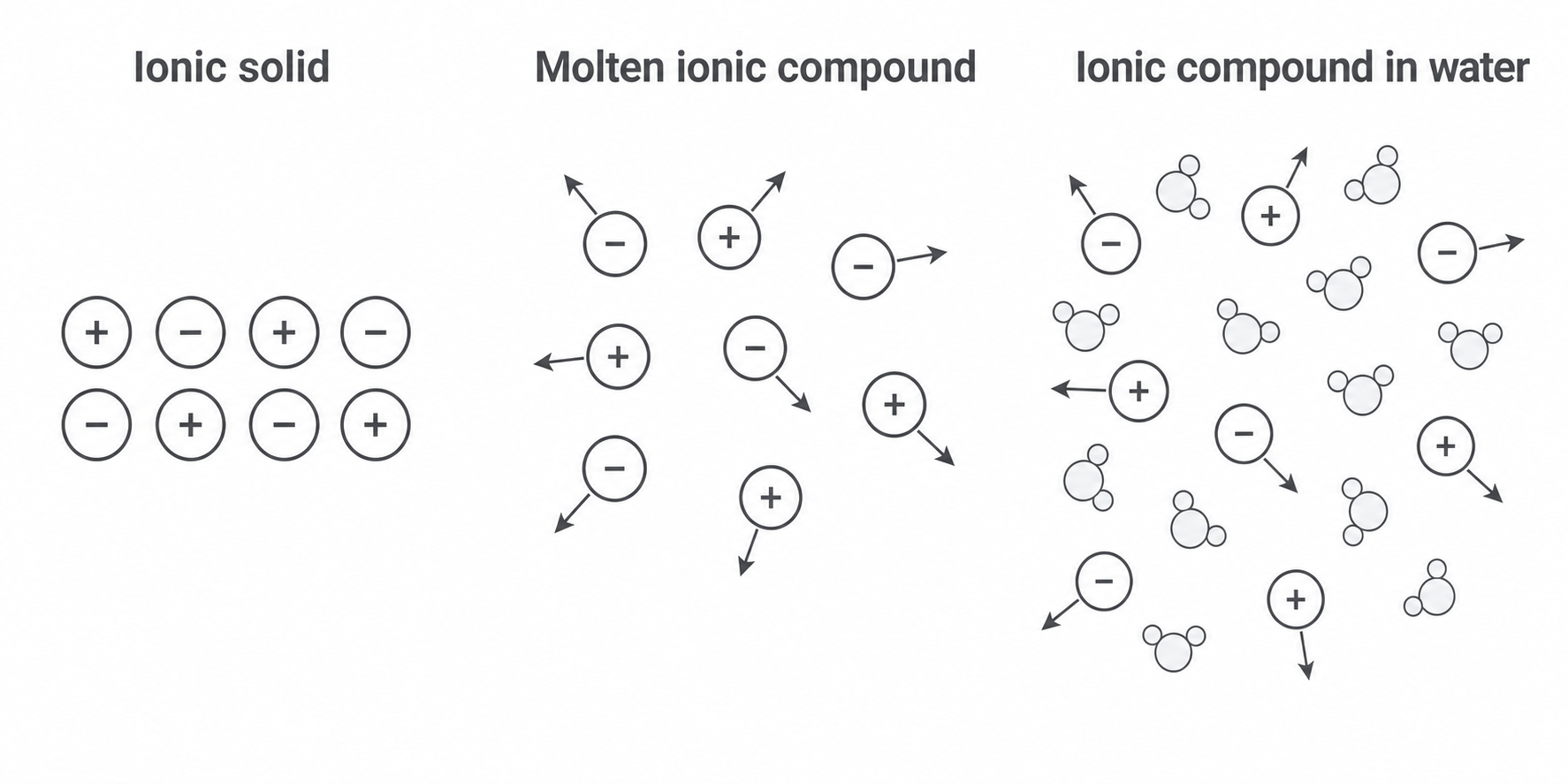
The movement arrows in the diagram mean that ions can change position; they do not mean that all positive ions move one way and all negative ions move the other without an applied potential difference. Melting or dissolving does not create charge. It changes the ions' freedom to move.
Forces within and between molecules
A simple molecular substance contains many separate molecules. There are two different levels of attraction, and confusing them reverses the explanation:
- Within each molecule: strong covalent bonds hold its atoms together.
- Between different molecules: intermolecular forces attract one molecule to another.
In a typical simple molecular substance, the intermolecular forces are much weaker than the covalent bonds. During melting or boiling, energy overcomes the intermolecular forces so that whole molecules can move further apart. The covalent bonds within each molecule are not broken in this physical change. Because the forces that must be overcome are relatively weak, the melting and boiling points are relatively low.
For example, when water boils, molecules separate from one another and move further apart. The O-H covalent bonds inside each water molecule remain. Saying "the covalent bonds are weak" would not explain boiling correctly.
Typical simple molecular substances are poor electrical conductors in solid and liquid states. Their molecules have no overall charge, and they do not contain mobile ions or delocalised electrons. A molecular substance may dissolve in water, but if it remains as neutral molecules, its solution still has no mobile charge carriers. This is why a sucrose solution conducts poorly even though the sucrose has dissolved.
Continue this lesson.
You’re previewing NovaLearn without an account. Create a free account to read the rest.
Create free account