Chemistry 2.11 - Ink chromatography and distillation
Investigate aqueous inks using both required methods: separate their dyes by paper chromatography, then collect water by simple distillation. Build a method you can explain, carry out safely and evaluate from its observations.
Core practical: run the chromatogram
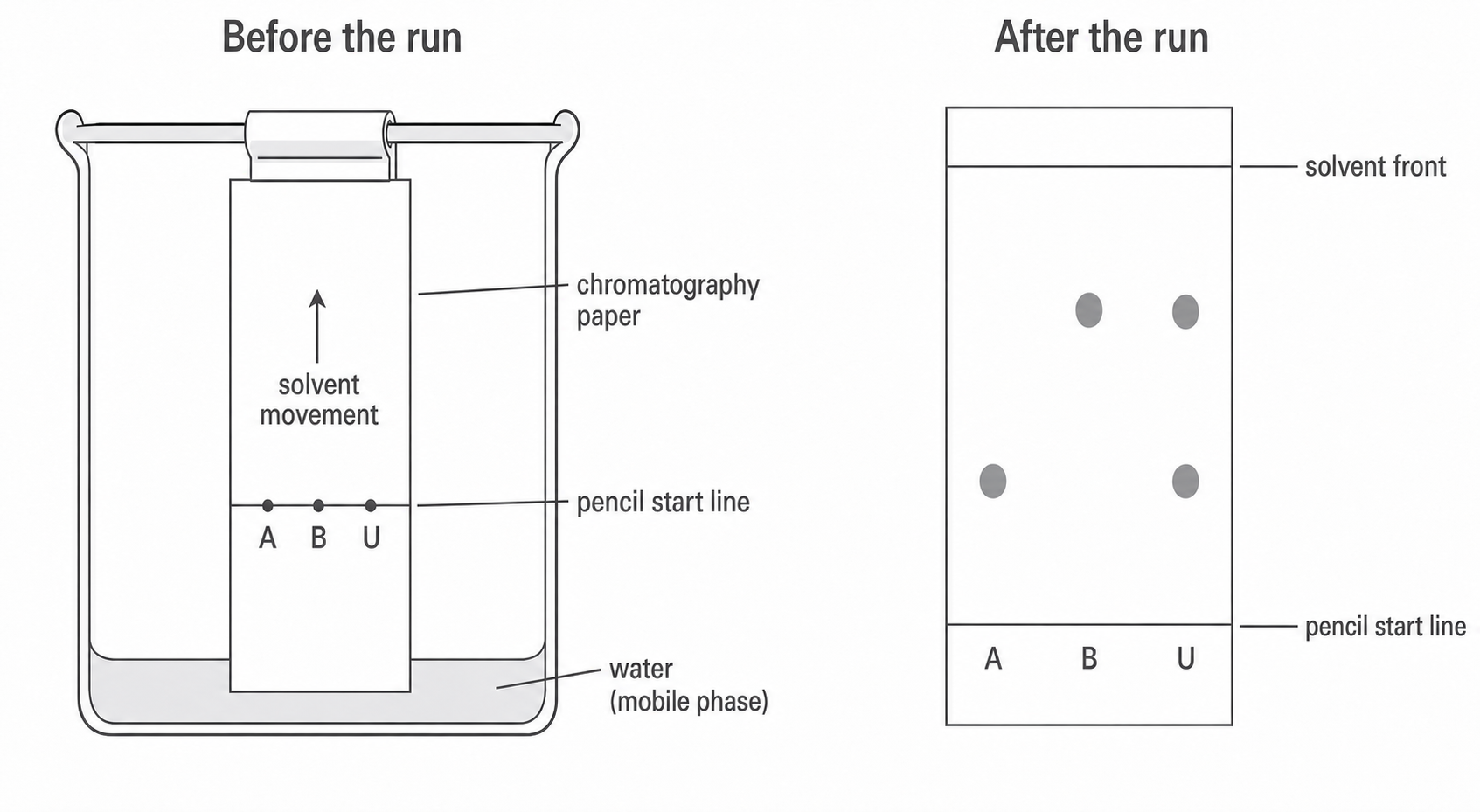
The purpose is to separate the dyes in several inks and use their patterns as evidence about composition. A useful comparison places known dyes A and B and an unknown ink U on the same sheet, so every sample experiences the same mobile phase, stationary phase and run conditions.
Variables and measurements
| Practical role | Choice in this investigation |
|---|---|
| Independent variable | The ink sample: A, B or unknown U |
| Dependent outcomes | Number and position of separated spots; distance travelled by each spot in cm; calculated values |
| Controlled variables | Solvent and its depth, type and size of paper, start-line height, amount/size of each ink spot, chamber conditions and the point at which the run is stopped |
Use a beaker, chromatography paper, pencil, ruler, capillary tubes or fine pipettes, a support rod and paper clip, water-soluble inks, water and eye protection. Use a fresh applicator for each sample to prevent cross-contamination.
[DIAGRAM: asset_name: Chemistry 2.9-2.11 - Chromatography and ink analysis - diagram 01; asset_slug: che_c_ink_practical_chromatography; recommended_method: image_gen; description: Two-panel monochrome scientific diagram on white. Left panel must show a beaker with water labelled mobile phase below a horizontal pencil start line, a vertical chromatography-paper strip hanging freely from a support, small labelled sample spots A, B and U on the line, and one upward arrow labelled solvent movement. Right panel must show the removed developed paper with the same A, B and U lane labels, the original pencil start line, a horizontal solvent front above every spot, and separated grey dye spots in which U has two spots aligned horizontally with the single spots in A and B. Label chromatography paper, pencil start line, water (mobile phase), solvent movement and solvent front; keep all labels legible and leaders unambiguous. Do not show the start line touching or below the water, do not place any dye above the solvent front, do not use colour-dependent meaning, and do not add exact scales or decorative laboratory objects.]
Reproducible method
- Cut the paper so it hangs close to the bottom of the empty beaker without touching the base or sides. Handle it by the edges.
- Use a ruler and pencil to draw a horizontal start line about from the lower edge. Mark and label three evenly spaced positions A, B and U in pencil.
- Use a separate capillary tube for each ink to place a small spot at its labelled position. Let each spot dry; if it is too faint, add another tiny drop at exactly the same point and let it dry again. Small concentrated spots separate more clearly than large wet spots.
- Add water to the beaker to a depth of about . Check that this level is below the pencil start line and every sample spot.
- Suspend the paper vertically with only its lower edge in the water. Keep the paper still. A loose lid can reduce evaporation if the apparatus provides one.
- Allow the solvent to rise until its front is near, but not at, the top of the paper. Remove the paper without tilting it.
- Immediately mark the solvent front in pencil before the solvent evaporates. Leave the chromatogram to dry.
- For each original sample lane, record the number and appearance of spots. Measure from the pencil start line to the centre of each spot and from the same line to the solvent front, recording distances consistently, for example to .
- Repeat the run with fresh paper and the same conditions. Similar spot patterns and values increase confidence that the result is repeatable; investigate rather than silently discard a different result.
Calculate each ratio as , using the same distance unit. For example, . The ratio has no unit. Compare patterns and ratios only under the same conditions.
Use one row for every separated spot so that no component is hidden during processing:
| Sample | Spot description | Spot distance / | Solvent-front distance / | Possible known match | |
|---|---|---|---|---|---|
Safety
Water is the preferred solvent for washable inks and is low hazard, but wear eye protection and clean spills promptly. Handle glass capillary tubes carefully and never use a mouth pipette. Some permanent inks need flammable or harmful organic solvents: only use a teacher-selected, risk-assessed solvent with the required ventilation, and keep it away from every naked flame. Chromatography with such a solvent and the Bunsen-heated distillation must be carried out as separate activities after flammable solvent has been cleared.
Core practical: distil water from ink
This is the second required part of the investigation. Chromatography separates the dyes; simple distillation collects the water from aqueous ink. Heating vaporises the water. The non-volatile dyes do not vaporise under these conditions and stay in the flask. Cooling changes the water vapour back into liquid distillate; no new substance is made.
Continue this lesson.
You’re previewing NovaLearn without an account. Create a free account to read the rest.
Create free account