Physics 13.5 - 13.6 - How transformers work
A transformer transfers energy between two separate circuits through a changing magnetic field. Follow how AC in the primary induces an output, why steady DC cannot sustain it, and how the output voltage can be increased or decreased. This is Higher-tier content.
Linking two separate circuits
A transformer has a primary coil connected to an input circuit and a secondary coil connected to a separate output circuit. The coils are wound around a soft iron core, which can magnetise and reverse its magnetisation readily. The core links the changing field through both coils.
The two windings are electrically insulated. Charge flows around each circuit separately; it does not travel through the core from one winding into the other.
[DIAGRAM: asset_slug: phy_g_transformer_link; description: Two separate circuits: AC source and primary on the left, secondary and lamp on the right; a closed soft iron core links a reversing magnetic field.]
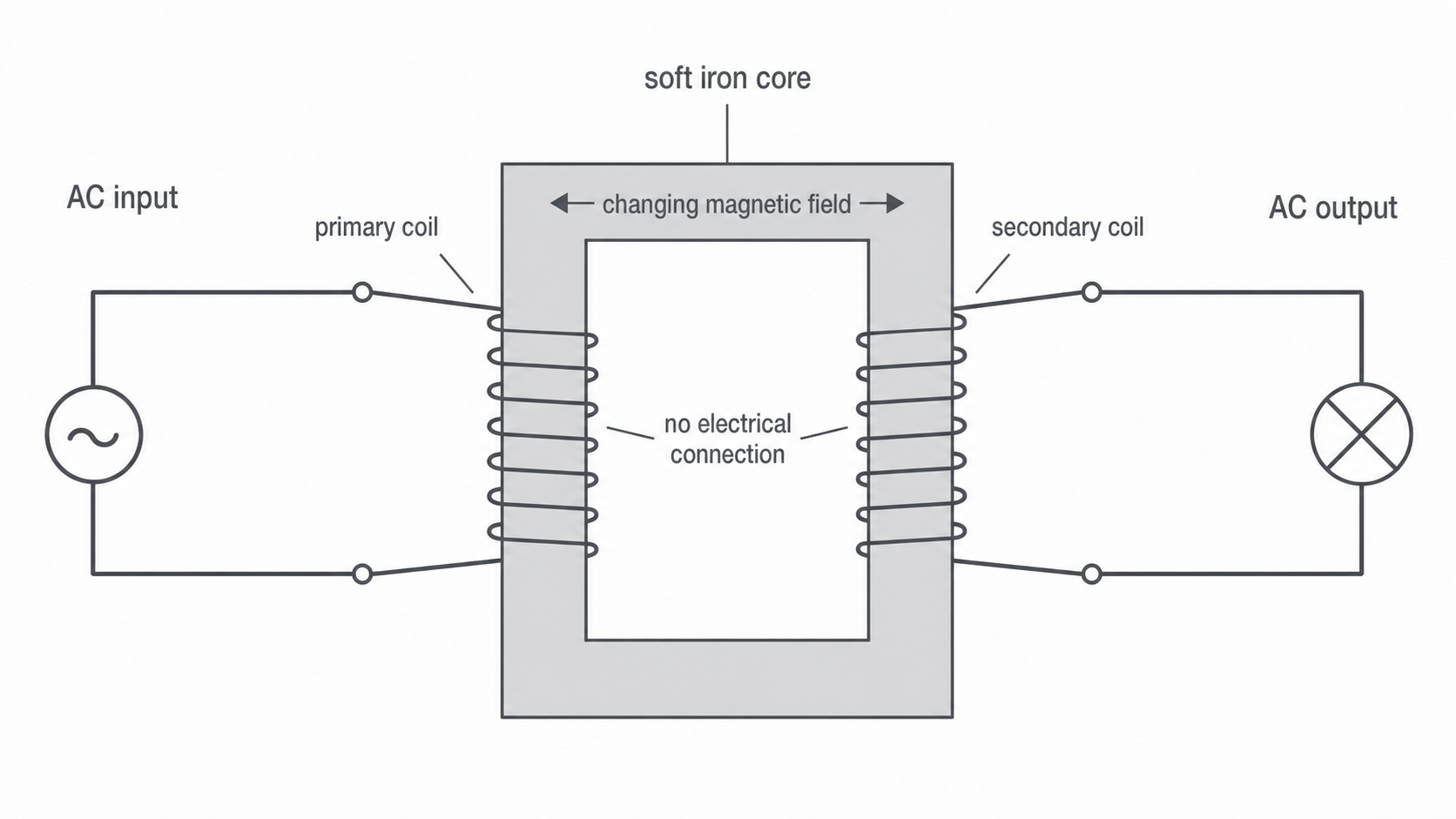
Follow the energy-transfer mechanism:
- An alternating potential difference across the primary drives an alternating current.
- This changing current produces a magnetic field that changes in size and direction in the core.
- The changing field links the secondary coil and induces an alternating potential difference across it.
- If the secondary circuit is complete, that potential difference drives an alternating current through the load.
An open secondary can therefore have a voltage across its ends even though no load current flows. The diagram shows a closed secondary, so current can flow through its lamp.
Continue this lesson.
You’re previewing NovaLearn without an account. Create a free account to read the rest.
Create free account