Physics 2.27 - Measuring reaction time
Measure the delay between a stimulus and a response using ruler and electronic methods. Plan fair repeats, convert ruler distances to times, and recognise the limits of each method.
Measuring reaction time
Reaction time is the time between a stimulus being detected and the person making the chosen response. In a driving context, the stimulus might be seeing a hazard and the response might be beginning to press the brake pedal. It is a time, measured in seconds, not the distance travelled while the response is being made.
A useful GCSE range for human reaction times is approximately 0.2-, with a simple visual response often towards the lower end. Results vary with the person, the stimulus and the method, so the range is not a judgement that every result must fit.
A ruler-drop method
Use a metre ruler, a conversion table or a ruler calibrated in reaction time, a chair and a table.
- The participant sits with one forearm supported and holds a thumb and finger just open on either side of the ruler. The mark is level with the top of the thumb.
- A partner releases the vertical ruler after a random delay and without a countdown. The participant catches it as soon as they see it move.
- Read the distance fallen at the top of the thumb. Convert that distance into a reaction time using the supplied table or calibrated scale.
- Repeat at least five times. Calculate a mean reaction time and the range, and investigate an unusual result before deciding whether there is a reason to exclude it.
[DIAGRAM: asset_name: Ruler-drop measurement; asset_slug: combined_phy_a_reaction_ruler; description: Before release, the zero mark is level with the stationary finger. After a 20 cm fall the 20 cm mark is at the same finger height. This models ruler movement, not hand movement.]
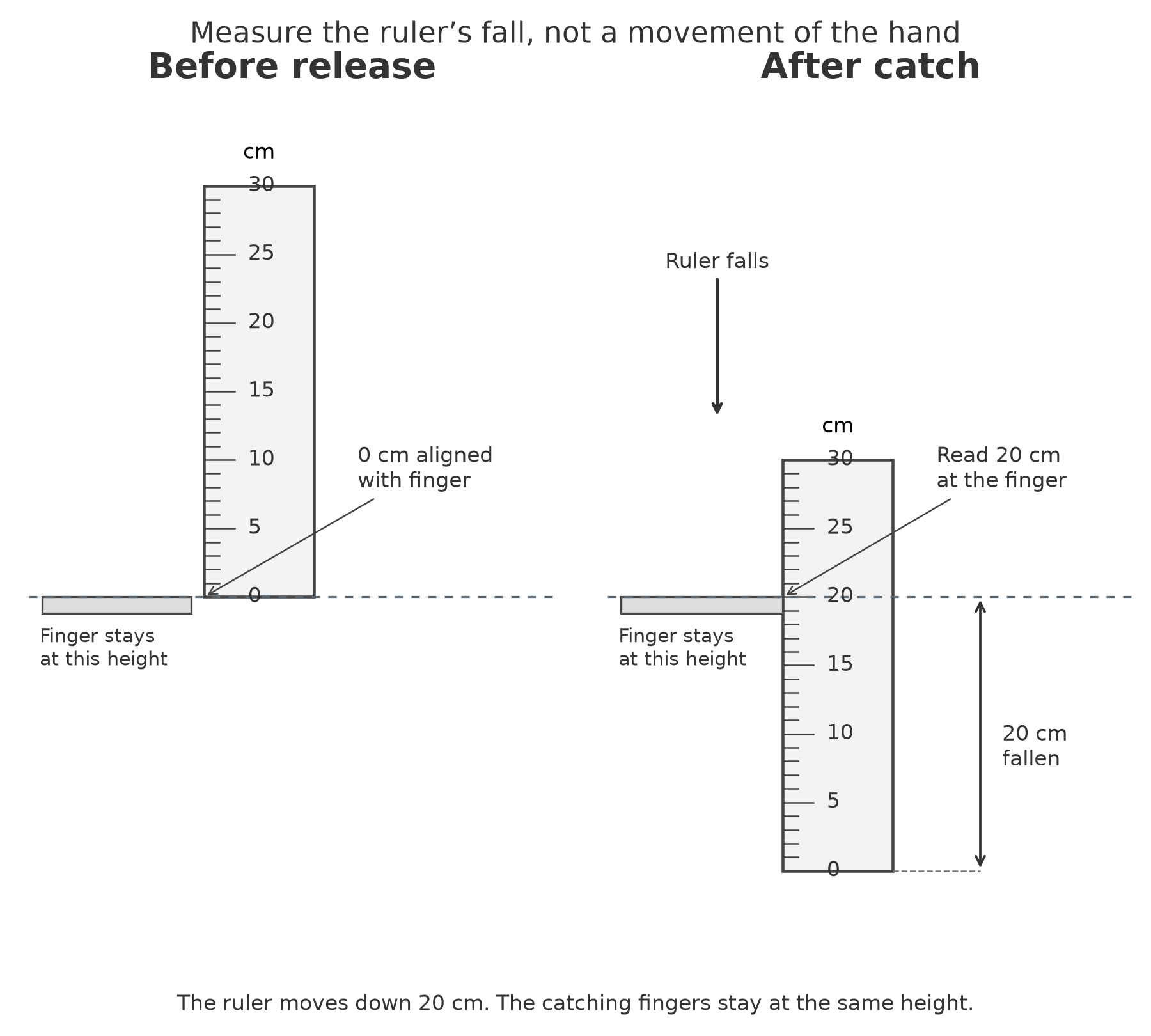
A conversion table turns fall distance into time. These approximate values assume free fall from rest near Earth; the participant does not have to time the fall with a second stopwatch.
| Distance fallen / cm | Reaction time / s |
|---|---|
| 5 | 0.10 |
| 10 | 0.14 |
| 20 | 0.20 |
| 30 | 0.24 |
| 40 | 0.28 |
| 80 | 0.40 |
For example, the catch shown represents about . Keep the catching fingers at the original height so the ruler reading measures the fall.
The random delay matters because a predictable countdown lets the participant anticipate the release. The starting alignment, same hand, same ruler, same dropper, same conversion method and same surroundings should be controlled. Keep the ruler away from the face and feet, and work seated at a clear table so nobody lunges or trips.
A ruler test is simple but limited. The dropper may give an unintended cue; reading the ruler adds uncertainty; practice may improve later trials; and a ruler may fall through the hand before a long response is completed. A metre ruler falls its full length in about , so it cannot measure the upper end of the broad range; an electronic timer can. An automatic release, a fixed hand position and a counterbalanced order of test conditions target those limitations directly.
Continue this lesson.
You’re previewing NovaLearn without an account. Create a free account to read the rest.
Create free account