Physics 12.7 - 12.9 - Current and solenoid fields
A current creates a magnetic field that can turn a compass. Connect the circular field around a straight wire to the strong, almost uniform field inside a solenoid, where the fields of many turns combine.
Showing the magnetic effect of a current
When current flows, the conductor produces a magnetic field in the surrounding space. The field can affect a nearby compass, even though the wire is not a permanent magnet.
Electromagnet
An electromagnet is a device that uses an electric current to produce a magnetic field.
A simple demonstration provides evidence for this magnetic effect:
- Connect a long straight insulated wire, a switch and a low-voltage direct-current supply in series. Place the straight section just above a compass, parallel to the needle’s direction with the current off. The wire’s field is then sideways to the Earth’s local horizontal field, so switching current on produces a clear deflection.
- With the switch open, record the compass direction.
- Close the switch briefly. The compass needle deflects, showing that an additional magnetic field is present while current flows.
- Open the switch. The needle returns towards its original direction as the field due to the current disappears.
- Reverse the supply connections and repeat. The compass deflects in the opposite direction, evidence that reversing the current reverses the field direction.
Use a low voltage and close the switch only briefly because a large current can heat the wire. Limit the current with a suitable resistor and switch off between readings.
The compass responds to the resultant magnetic field at its position, including Earth's field. It would therefore be misleading to say that there is no magnetic field at all when the switch is open; only the field produced by this current has been removed.
Comparing current measurements
Current is charge transferred per second: . If passes a point in the wire in , then . A second setting of is , twice that current. With the same wire and compass position, the larger current produces a stronger magnetic field. Convert both readings to the same unit before comparing them; is not greater than .
The field around a straight conductor
Magnetic field lines are a model used to show field direction and relative strength. They are not physical threads and they are not paths followed by charge. The direction of a field line is the direction in which the north-seeking end of a tiny compass would point at that position.
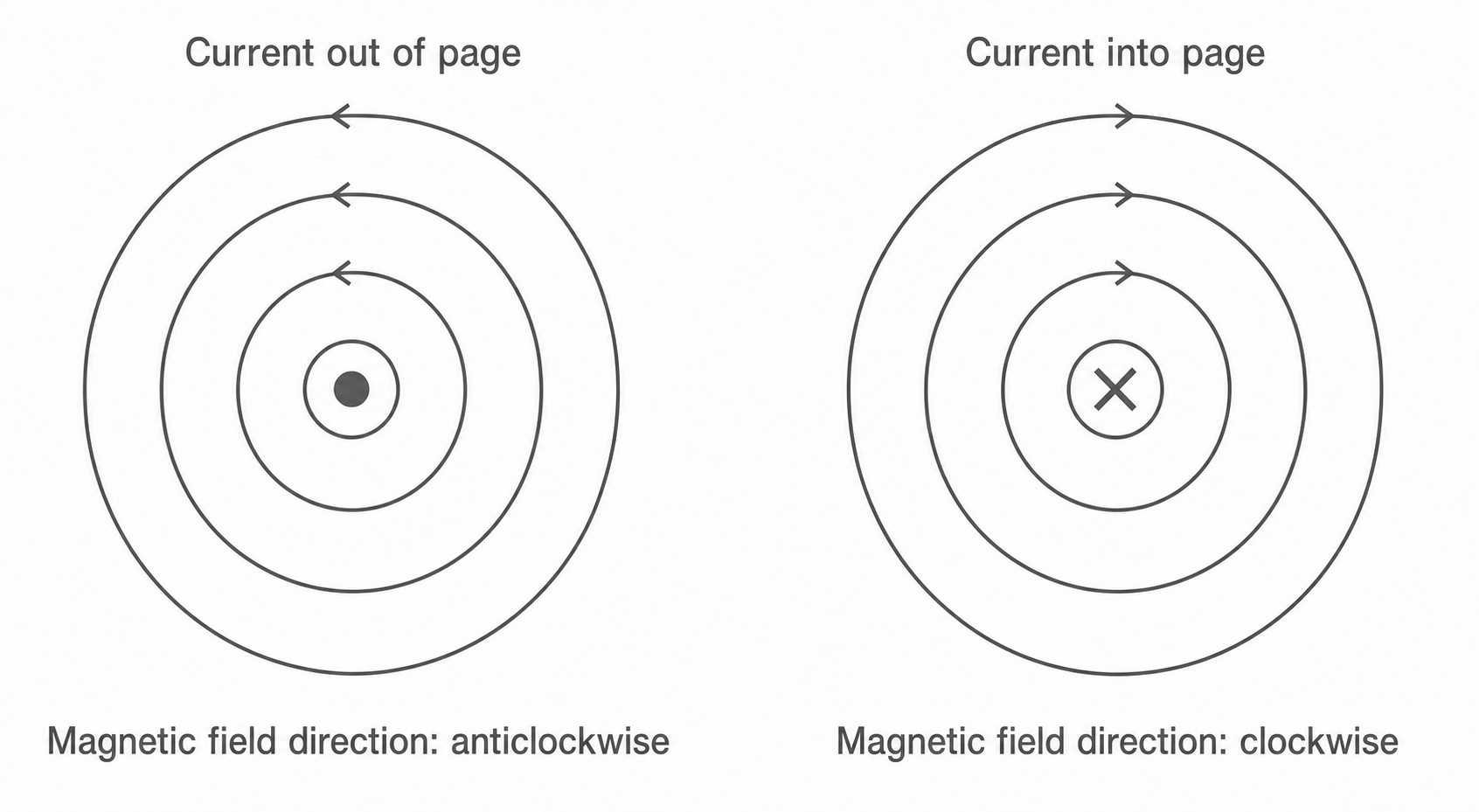
Around a long straight current-carrying conductor, the field lines are concentric circles centred on the conductor. These circles lie in planes at right angles to the wire. The direction around the circles depends on the direction of the conventional current.
Use the right-hand grip rule:
- Point your right thumb in the direction of the conventional current.
- Curl your fingers around the conductor.
- Your curled fingers show the direction of the magnetic field.
In an end-on diagram, a dot represents current coming out of the page, like the tip of an arrow. A cross represents current going into the page, like the tail feathers of an arrow. Current out of the page produces an anticlockwise field when viewed facing the page; current into the page produces a clockwise field.
[DIAGRAM: asset_name: Physics 12.7-12.9 - Electromagnets and solenoids - diagram 01; asset_slug: physics_12_7_12_9_electromagnets_and_solenoids__diagram_01; recommended_method: image_gen; description: Two equal end-on views of one long straight conductor on a white background. Left: a central dot labelled current out of page, with three concentric circular magnetic field lines carrying clear anticlockwise arrowheads. Right: a central cross labelled current into page, with three concentric circular magnetic field lines carrying clear clockwise arrowheads. Include the label magnetic field direction below each panel. Use only #6A6B6E, generous spacing and exact labels; circles must be centred, arrows must not cross, and no hand, battery, force arrow, electron-flow arrow, colour or decorative marks may appear.]
Continue this lesson.
You’re previewing NovaLearn without an account. Create a free account to read the rest.
Create free account