Chemistry 3.19 - 3.20 - Solubility and precipitates
Use the common solubility rules to predict whether two solutions form a precipitate. Follow the ions into the solid and explain what remains dissolved.
From solutions to solids
Imagine mixing magnesium sulfate solution with sodium carbonate solution. The mixture quickly becomes cloudy and a solid may settle. That solid did not appear because the water changed state: it is a new, insoluble substance formed by a chemical reaction.
Precipitate
A precipitate is an insoluble solid formed when substances in solution react.
Chemists can describe this at three connected levels:
- Macroscopic observation: the mixture becomes cloudy because tiny solid particles are suspended in the liquid. The solid can settle or be trapped by filter paper.
- Particle model: magnesium sulfate solution contains separate, mobile and ions. Sodium carbonate solution contains separate, mobile and ions. When the solutions mix, and ions become part of a solid magnesium carbonate structure; and remain dissolved.
- Symbolic model: (aq) means dissolved in water and (s) means solid. The balanced formula equation records the solid magnesium carbonate product while the sodium sulfate remains dissolved.
Water molecules surround the dissolved ions, but a simplified particle diagram may leave most water molecules out so that the ion changes are visible. The ions that remain aqueous have not disappeared and have not been turned into water.
[DIAGRAM: asset_name: Chemistry 3.19-3.21 - Solubility rules and precipitates - diagram 01; asset_slug: chemistry_3_19_3_21_solubility_rules_and_precipitates__diagram_01; recommended_method: image_gen; description: Two-panel monochrome particle model of mixing magnesium sulfate and sodium carbonate solutions. Before mixing, show separate mobile , , and ions dispersed in water; after mixing, show and joined in a clearly labelled precipitate at the bottom while and remain separated and labelled aqueous. Conserve a simple 2 : 2 : 4 : 2 particle count across panels, use arrows only for the left-to-right mixing sequence, and exclude bonds between spectator ions, colour-dependent meaning, molecular salt particles and any claim that water is produced.]
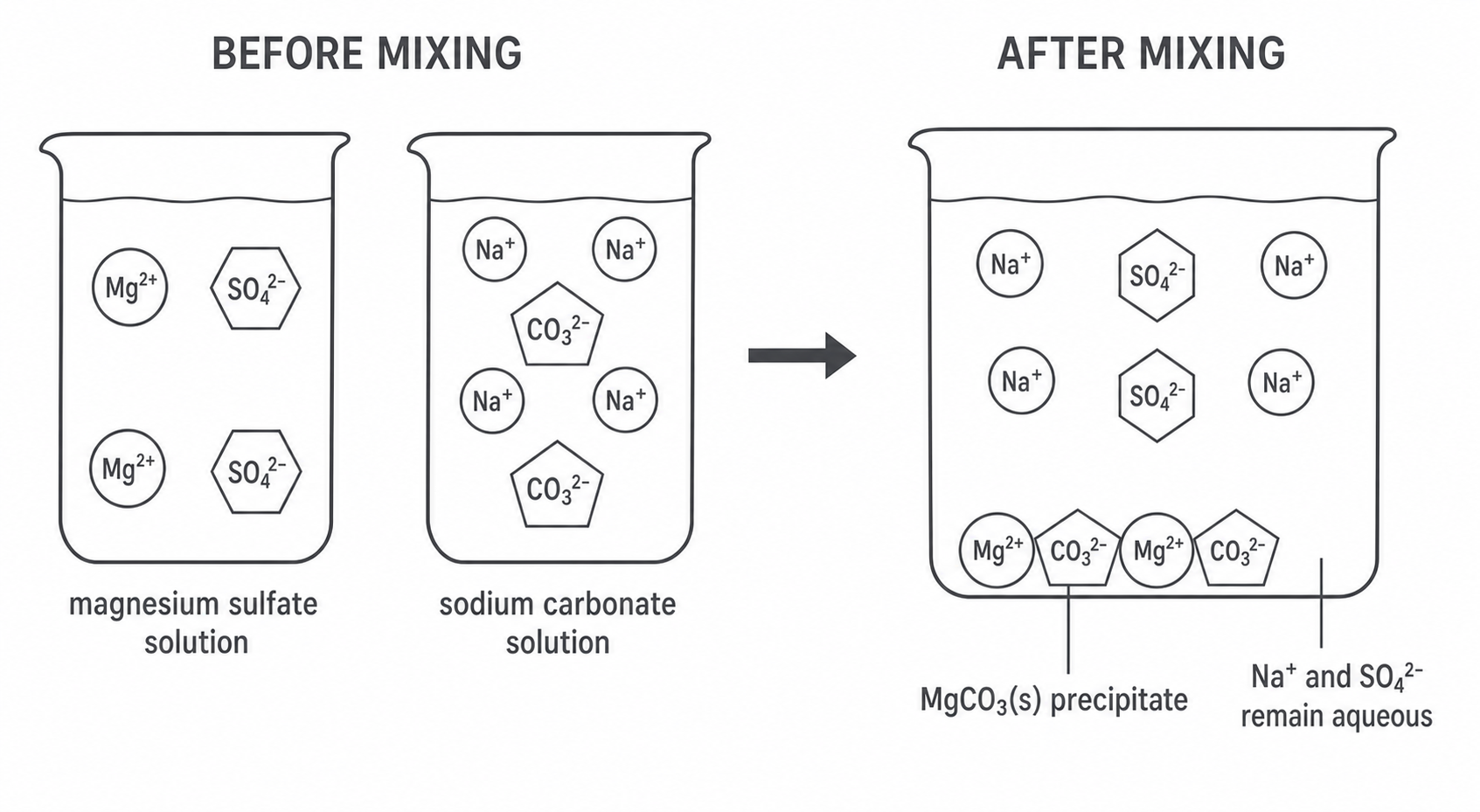
The diagram is a model, not a picture at true scale. In particular, the cluster at the bottom represents a giant ionic solid containing many ions, not a small magnesium carbonate molecule.
The solubility rules
Solubility describes how well a substance dissolves in a particular solvent. Here the solvent is water, and the Pearson rules classify common ionic substances as soluble or insoluble for GCSE predictions.
| Type of substance | General rule in water | Exceptions to remember |
|---|---|---|
| sodium, potassium and ammonium salts | soluble | none in this rule set |
| nitrates | soluble | none in this rule set |
| common chlorides | soluble | silver chloride and lead chloride are insoluble |
| common sulfates | soluble | lead sulfate, barium sulfate and calcium sulfate are insoluble |
| common carbonates | insoluble | sodium, potassium and ammonium carbonates are soluble |
| common hydroxides | insoluble | sodium, potassium and ammonium hydroxides are soluble |
Apply the named-ion rules first. Potassium carbonate contains potassium, so it is soluble even though most carbonates are insoluble. Calcium hydroxide has no sodium, potassium or ammonium cation, so it is classified as insoluble by this specification rule set.
These are general rules for common substances, not a claim that every insoluble solid has exactly zero solubility. Some substances dissolve to a small extent. For the predictions in this lesson, use the categories and exceptions in the table exactly.
Continue this lesson.
You’re previewing NovaLearn without an account. Create a free account to read the rest.
Create free account