Physics 13.8 - 13.9 - The National Grid
Electrical energy travels through a network of cables and transformers. Explain how high transmission voltage reduces heating losses and why the voltage is reduced before local distribution and domestic use.
The National Grid route
The National Grid is a network of cables and transformers that transfers electrical energy from places where it is generated to places where it is used. The cables have resistance, so transferring energy through them can warm the cables and the surroundings.
A useful model of the route is:
- a power station or another generator supplies an alternating potential difference;
- a step-up transformer increases the potential difference before long-distance transmission;
- transmission cables carry electrical energy across the country at high potential difference;
- step-down transformers at regional and local substations decrease the potential difference for distribution and domestic use.
In a real network, the potential difference is often reduced in several stages. The simple route below shows the purpose and order of the changes. The arrows show the direction of energy transfer through the model, not the movement of individual electrons.
[DIAGRAM: asset_name: Physics 13.8-13.10 - National Grid and transformer power - diagram 01; asset_slug: physics_13_8_13_10_national_grid_and_transformer_power__diagram_01; recommended_method: image_gen; description: A wide monochrome left-to-right National Grid route: labelled Power station, Step-up transformer, HIGH VOLTAGE TRANSMISSION with pylons, Step-down transformer and Local homes. Clear arrows all point from the power station towards homes; voltage increases after the step-up transformer and voltage decreases after the step-down transformer. Exclude transformer coil internals, out-of-scope equations, numerical voltages, electron-flow arrows and line-loss calculations.]
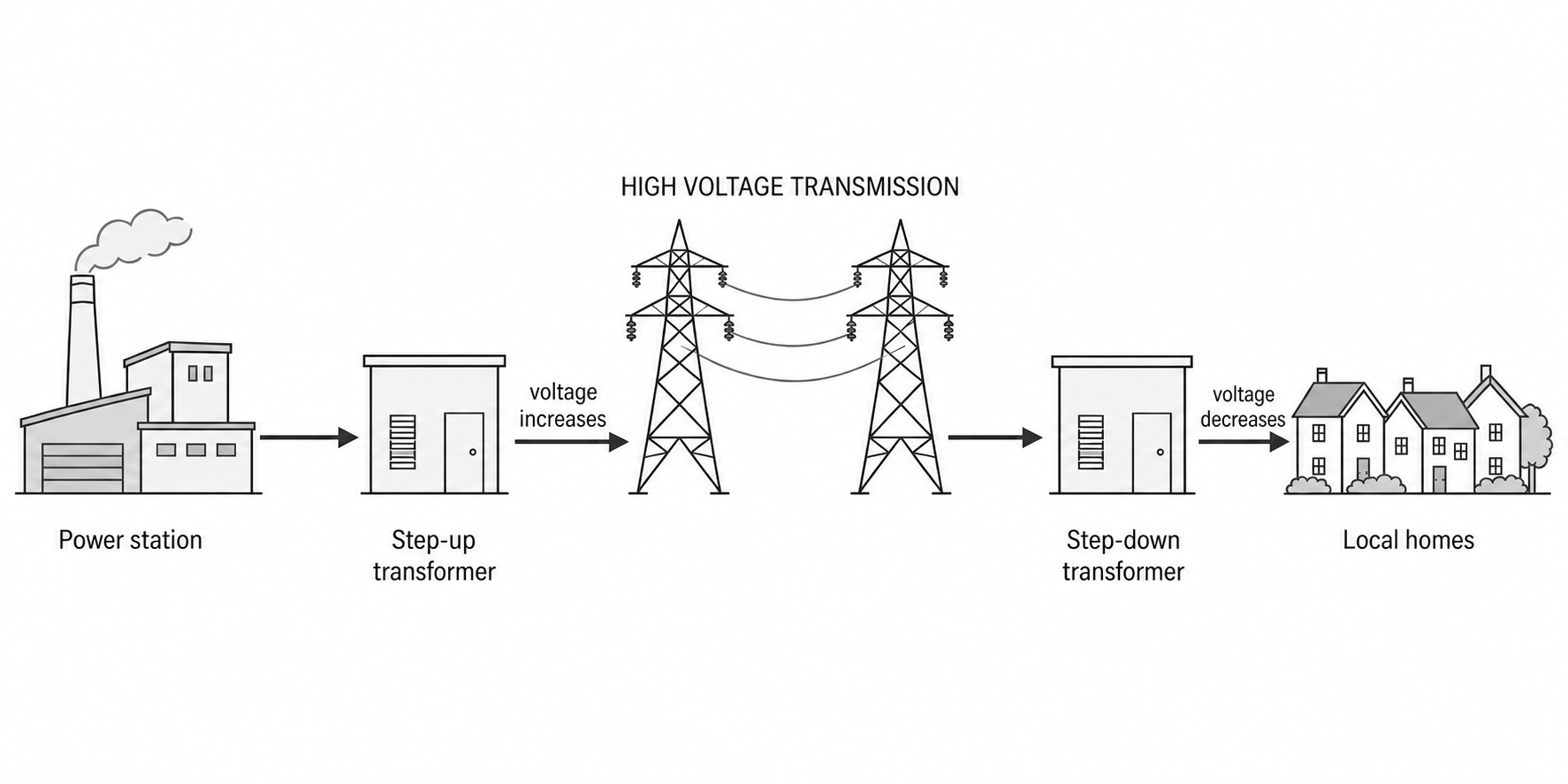
A pylon supports transmission cables; it does not generate electricity. A transformer changes potential difference in an alternating-current system, but it is not an energy source.
Why transmission uses high potential difference
Electrical power is the rate at which energy is transferred. Consider a section of the Grid that must transfer the same power in two different ways.
- If the potential difference is increased, the same power can be transferred with a smaller current.
- Transmission cables have resistance. A current through a resistance causes heating, so the smaller current produces less heating in the cables.
- Less energy is dissipated to the thermal stores of the cables and surroundings, so more of the input energy reaches consumers. The transmission is therefore more efficient.
The complete causal chain is:
higher potential difference → lower current for the same power → less heating of the cables → less energy dissipated → greater efficiency
The high potential difference does not reduce the resistance of the cables. It allows the required power to be transferred using a lower current. Current is not "used up" along the route; energy is transferred to the surroundings by heating.
Continue this lesson.
You’re previewing NovaLearn without an account. Create a free account to read the rest.
Create free account