Biology 9.15 - Nitrogen cycle and farming
Follow the bacterial conversions that make nitrate available to plants, and explain how fertilisers and legume crop rotations replace nitrogen removed by harvesting.
Nitrogen and nitrate uptake
Plants need nitrogen to make amino acids and proteins for new cells and growth. Although the atmosphere contains a large store of nitrogen gas, most plants cannot use nitrogen in the form . They obtain nitrogen mainly by absorbing dissolved nitrate ions, , from soil water through their roots.
Making nitrate available therefore requires conversions between different nitrogen compounds. Microorganisms carry out the key conversions.
| Group | Starting material | Action and product |
|---|---|---|
| nitrogen-fixing bacteria | nitrogen gas in air spaces in soil | convert into ammonia/ammonium compounds; some live freely and some live in legume root nodules |
| decomposer microorganisms | nitrogen compounds in dead organisms and waste | break down organic material and release ammonia, which forms ammonium ions, , in soil |
| nitrifying bacteria | ammonium ions | convert ammonium through nitrite into nitrate ions |
| denitrifying bacteria | nitrate ions | convert nitrates back into nitrogen gas, returning nitrogen to the atmosphere |
Following the nitrogen cycle
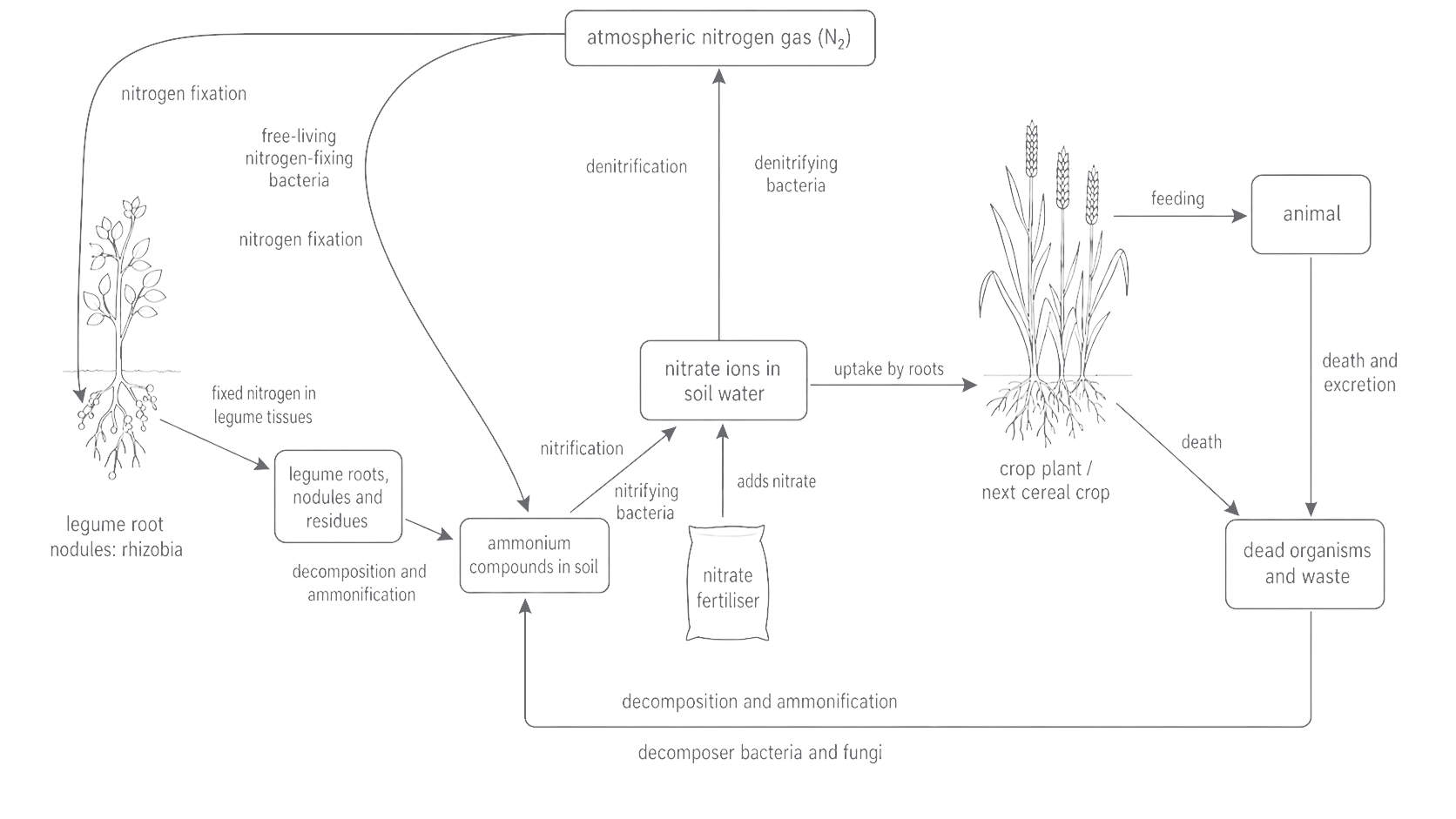
Nitrogen fixation moves nitrogen from the abiotic atmosphere into compounds that can enter living biomass. Plants use absorbed nitrogen compounds to make amino acids and proteins. Feeding then moves those compounds into animals.
Waste and dead biomass still contain nitrogen. Decomposer microorganisms return that organic nitrogen to ammonium compounds in soil, and nitrifying bacteria convert ammonium into nitrate. Roots can absorb the nitrate again. Denitrifying bacteria complete another return route by converting soil nitrate to atmospheric nitrogen gas.
The cycle is not one bacterium doing every job. Different bacterial groups carry out different chemical conversions, and plants do not usually absorb nitrogen gas directly from the air.
[DIAGRAM: asset_slug: biof_nitrogen_cycle; description: Nitrogen fixation by free-living and root-nodule bacteria, ammonium, nitrification, nitrate uptake and feeding, decomposition, denitrification and nitrate fertiliser.]
Fertilisers and crop rotation
Harvesting removes nitrogen in plant biomass from a field. Farmers can restore plant-available nitrogen in two assigned ways:
- Fertilisers add nitrogen-containing compounds. Nitrate fertilisers supply nitrate ions directly; ammonium fertilisers supply ammonium ions that nitrifying bacteria can convert into nitrates. The ions dissolve in soil water and can be taken up by roots.
- Crop rotation alternates crops. A legume such as peas, beans or clover is grown in one part of the rotation. Nitrogen-fixing bacteria in its root nodules convert atmospheric nitrogen into nitrogen compounds used by the legume. When roots and other residues remain and decompose, ammonium compounds are released; nitrifying bacteria then make nitrates available to the next crop.
Continue this lesson.
You’re previewing NovaLearn without an account. Create a free account to read the rest.
Create free account