Physics 2.20 - 2.22 - Circular motion and inertial mass
Explain changing velocity at constant speed and the inward force that keeps an object moving in a circle. Use force divided by acceleration to compare inertial masses. This lesson is Higher tier only.
Direction in circular motion
Higher tier only
Speed gives only how fast an object moves. Velocity gives both speed and direction. An object in a circular orbit can therefore keep the same speed while its velocity changes continuously, because the direction of motion changes at every point.
At any instant, the velocity points along the tangent to the circle. Equal-length velocity arrows at different positions can show equal speed, but the arrows point in different directions and so represent different velocities. A change in velocity means that the object is accelerating, even when it is not speeding up or slowing down.
To produce that continually changing direction, there must be a resultant force towards the centre of the circle. This inward resultant is called the centripetal force.
Centripetal force names the role of the resultant force; it is not an additional type of force. Depending on the situation, the inward resultant could be provided by friction on a turning car, tension in a string, or gravity acting on an orbiting object.
[DIAGRAM: asset_name: Physics 2.20-2.26 - Circular motion, inertial mass and momentum - diagram 01; asset_slug: physics_2_20_2_26_circular_motion_inertial_mass_and_momentum__diagram_01; recommended_method: image_gen; description: A clean monochrome two-panel qualitative circular-motion model on white. Left panel: one circular path with the centre marked and the same object shown at the top and right-hand positions; equal-length velocity arrows are tangent to the path, pointing right at the top and downward at the right for clockwise motion, with the direct labels 'velocity' and 'same speed, different direction'. Right panel: an object at the right-hand edge of a circle with a downward tangent arrow labelled 'velocity' and a separate arrow beginning at the object and pointing left exactly towards the marked centre, labelled 'resultant centripetal force'. Use #6A6B6E only, visible arrowheads, generous spacing, no outward arrow, no centrifugal force, no formulas and no decorative marks.]
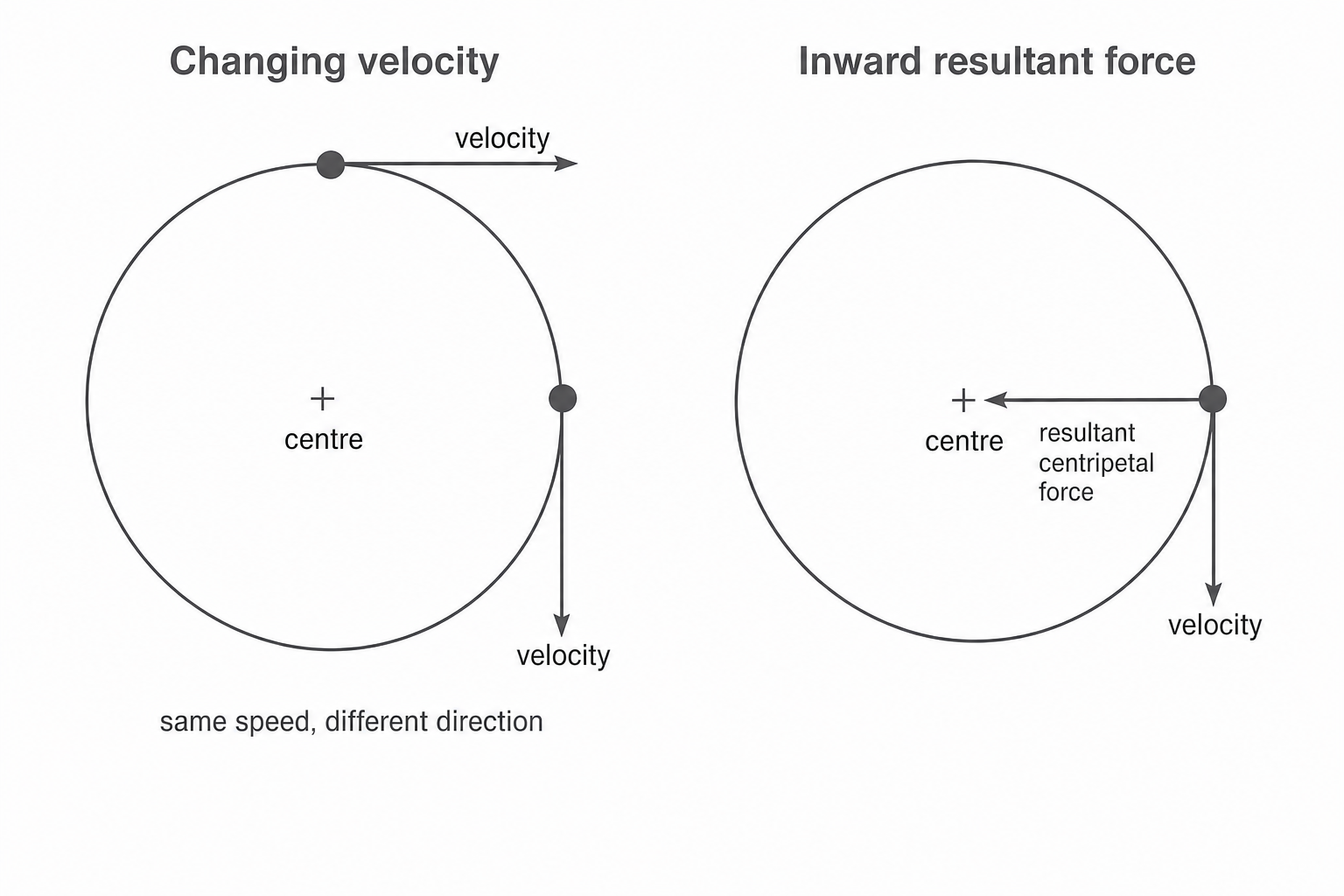
If the inward resultant force suddenly became zero, the object would no longer curve. At the instant of release it would continue in a straight line along the tangent, following Newton's first law. It would not shoot radially outward from the centre.
Continue this lesson.
You’re previewing NovaLearn without an account. Create a free account to read the rest.
Create free account