Chemistry 7.1-7.2 - Investigating reaction rates
Investigate reaction rates by collecting carbon dioxide from marble chips and acid, and by timing the disappearing cross as warmed sodium thiosulfate reacts with acid. Plan fair measurements, process graphs and judge the limitations of each method.
Core practical: collecting a gas
Marble is calcium carbonate. It reacts with hydrochloric acid and produces carbon dioxide, seen as fizzing and measured as gas volume:
calcium carbonate + hydrochloric acid → calcium chloride + water + carbon dioxide
The purpose is to investigate how one changed condition affects rate while all other relevant conditions are controlled. The continuous measurement of carbon dioxide volume also shows how rate changes as the reaction proceeds.
[DIAGRAM: asset_name: Chemistry 7.1-7.5 - Rates, collision theory and graphs - diagram 01; asset_slug: combined_che_f_rates_gas_apparatus; recommended_method: image_gen; description: NovaLearn monochrome scientific apparatus diagram on white showing a clamped horizontal gas syringe connected by an airtight delivery tube and one-hole bung to a conical flask containing hydrochloric acid and marble chips; label gas syringe, clamp, delivery tube, airtight bung, conical flask, hydrochloric acid + marble chips, carbon dioxide, and show a single arrow from flask through tube into syringe plus an outward plunger-motion arrow; no heat source, open vessel, water trough, extra outlets or decorative particle imagery.]
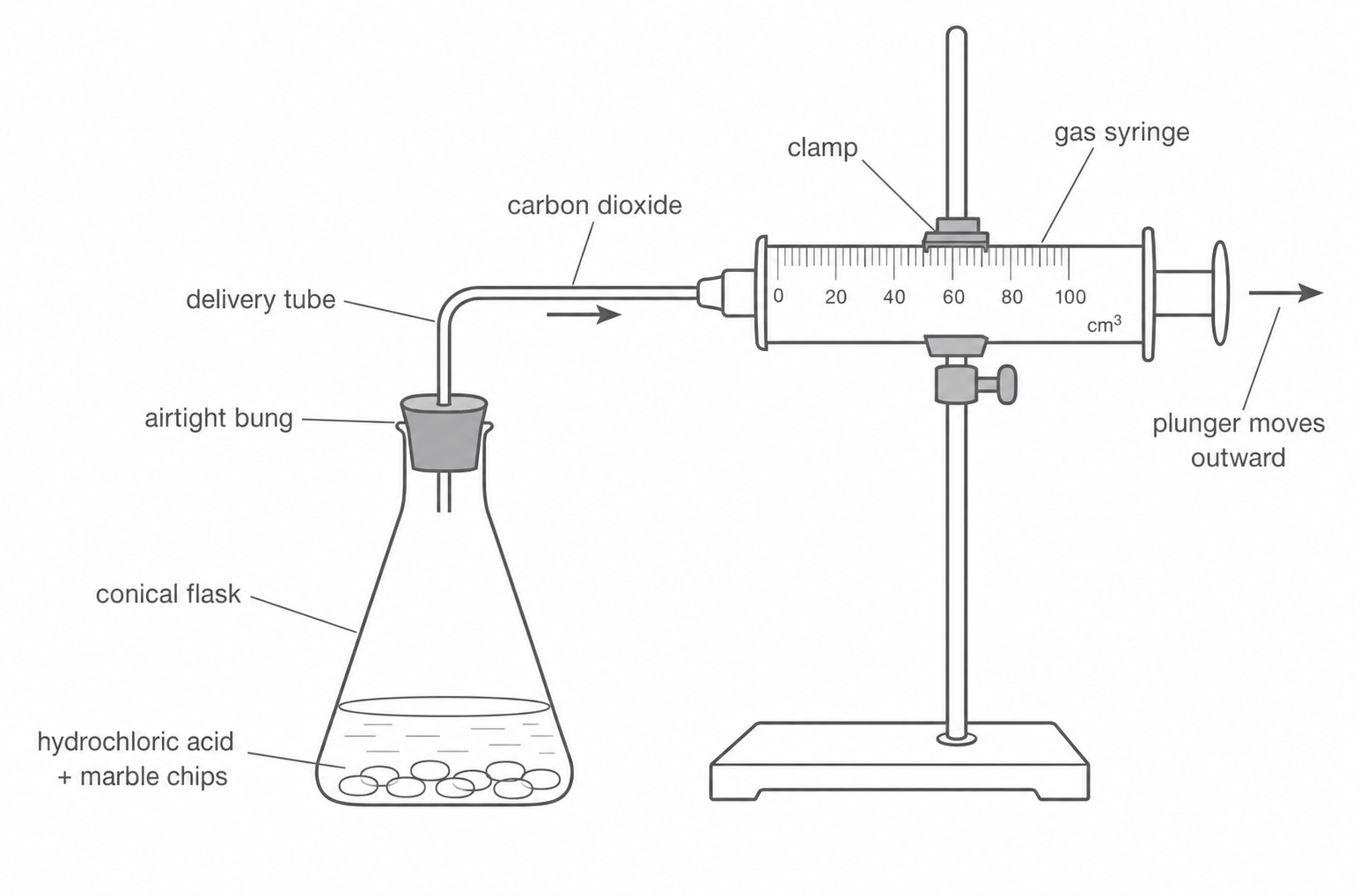
Variables for a concentration investigation
| Role | Variable | How it is set or measured |
|---|---|---|
| Independent | Hydrochloric acid concentration, | Use at least five values across a sensible school-approved range, for example to |
| Dependent | Carbon dioxide volume, , at each time | Read the gas syringe every until the volume is constant |
| Controlled | Acid volume | Measure each time with the same suitable measuring device |
| Controlled | Marble mass and surface area | Use from the same size range of chips for every run |
| Controlled | Temperature | Allow reagents to reach the same room temperature and monitor it |
| Controlled | Apparatus and mixing/start technique | Use the same flask, tubing, syringe and operator routine |
The quantities must be checked by the teacher/technician so that all of marble can react at every chosen acid concentration and the expected gas volume remains below the syringe capacity. Because the marble mass is unchanged and can react completely in every run, equal final gas volumes are a reasonable expectation.
Reproducible method
- Wear eye protection. Clamp the gas-syringe barrel horizontally, check that the plunger moves freely, set it to zero and point the plunger away from people.
- Connect the syringe to a conical flask with airtight tubing and a one-hole bung. Check every connection for leaks and make sure the gas path is not blocked.
- Measure of the first hydrochloric acid concentration into the flask. Weigh of marble chips from the chosen size range.
- Add the marble, fit the bung immediately and start the timer at the same event. Swirl once in the same way for every run.
- Record carbon dioxide volume every until three consecutive readings are unchanged. Never let the plunger reach the end of its scale.
- Rinse and dry the flask, reset the syringe and repeat at least three times at that concentration. Identify anomalies rather than automatically deleting inconvenient values; repeat an anomalous run where possible.
- Repeat for at least four more concentrations while keeping all controlled variables fixed.
Record raw readings before calculating means. A useful table has concentration in its heading, then columns for time / , gas volume, run 1 / , run 2, run 3 and mean gas volume / . Plot mean gas volume on the vertical axis against time on the horizontal axis for each concentration.
To investigate surface area:volume ratio instead, use equal masses of large chips and smaller chips while keeping acid concentration, acid volume and temperature constant. To investigate temperature, equilibrate the reagents to each chosen temperature in a water bath and record the actual starting temperature, while keeping concentration, volume, marble mass and chip size constant. Change only one independent variable in one investigation.
Risks and method-specific limitations
- Dilute hydrochloric acid can irritate eyes and skin: use eye protection, small controlled volumes and the school's spill procedure.
- A blocked route can build pressure or eject the syringe plunger: keep the route clear, clamp the barrel and point the plunger away from people.
- Gas escaping before the bung is fitted makes early volumes too low. Use the same rapid start routine; a sealed addition system can reduce this start-up loss if approved apparatus is available.
- Leaks reduce every volume reading. Test the assembled system before collecting data and refit loose tubing or bungs.
- A sticking plunger changes the pressure and can delay movement. Check free motion while dry and replace a faulty syringe.
These are systematic method effects when they push repeated results in the same direction. Repeats can reveal scatter, but repeats alone do not repair a leaking seal or a consistently late start.
From measurements to a rate
On each gas-volume graph, the vertical increase divided by the time interval is the mean rate. For example, a rise from zero to in the first gives . Compare the same early interval across runs. A steeper curve near the start shows a greater initial rate; Higher students can calculate the instantaneous initial rate from a tangent. A final plateau shows how much gas was collected, not its rate of formation.
Plot concentration (the changed condition) on the horizontal axis and the calculated early rate on the vertical axis to investigate their relationship. This second graph answers a different question from the gas-volume-against-time graph. Check whether rate divided by concentration stays constant before claiming proportionality.
Core practical: the disappearing cross
Sodium thiosulfate solution reacts with dilute hydrochloric acid to form solid sulfur. The suspended sulfur makes the mixture increasingly cloudy, so a black cross beneath the flask eventually becomes hidden:
sodium thiosulfate + hydrochloric acid → sodium chloride + sulfur dioxide + sulfur + water
The cross disappearing is a fixed optical endpoint. It does not mean every reactant particle has been used up. Because every run uses the same flask, liquid depth, cross and viewing rule, reaching that same endpoint sooner indicates a faster reaction.
Variables for the required temperature investigation
| Role | Variable | How it is set or measured |
|---|---|---|
| Independent | Starting temperature of sodium thiosulfate, | Warm it in a water bath to five values, for example , and measure immediately before mixing |
| Dependent | Time for the cross to disappear, | Start on acid addition and stop at the first loss of visibility from directly above |
| Controlled | Volumes and concentrations | Use the same sodium thiosulfate and dilute hydrochloric acid from the same stock solutions |
| Controlled | Optical geometry | Use the same flask, cross, total liquid depth, lighting, viewing height and observer |
| Controlled | Mixing | Use one identical swirl immediately after addition |
Continue this lesson.
You’re previewing NovaLearn without an account. Create a free account to read the rest.
Create free account