Chemistry 7.9-7.13 - Heat changes and bonds
Measure heat changes when salts dissolve and when solutions react. Connect warming and cooling to energy transfers, then explain the result by comparing bond breaking with bond making.
Temperature as evidence
Chemical changes are often accompanied by a transfer of heat energy. When a change happens in solution, a thermometer in the reaction mixture can reveal that transfer: the measured temperature rises when the mixture gains energy and falls when the mixture loses energy.
Pearson names four kinds of change for which this evidence can be collected:
| Kind of change | What happens | What must be measured |
|---|---|---|
| a salt dissolving in water | a solid salt becomes dispersed as particles in the water | the temperature before dissolving and the highest or lowest temperature afterwards |
| neutralisation | an acid reacts with an alkali to form a salt and water | the temperature before mixing and the highest or lowest temperature afterwards |
| displacement | a more reactive element displaces a less reactive element from its compound | the temperature before the reactants meet and the highest or lowest temperature afterwards |
| precipitation | two solutions react to form an insoluble solid | the temperature before mixing and the highest or lowest temperature afterwards |
Dissolving one salt may warm the water while dissolving a different salt may cool it. Acid–alkali neutralisation gives out heat, but measure the actual temperature change for each experiment: apparatus and conditions affect what the thermometer records. Do not label all dissolving or precipitation changes the same way.
Exothermic change
An exothermic change or reaction gives out heat energy to the surroundings. The immediate surroundings usually warm, so a solution experiment usually gives a temperature rise.
Endothermic change
An endothermic change or reaction takes in heat energy from the surroundings. The immediate surroundings usually cool, so a solution experiment usually gives a temperature fall.
Here the chemical system means the particles undergoing the change. The immediate surroundings include the water or solution receiving or supplying the transferred energy, as well as the cup and nearby air. An endothermic process does not "give out cold": energy moves from the surroundings into the chemical system.
Measuring a solution temperature change
A simple investigation can classify selected dissolving, neutralisation, displacement and precipitation changes. This is useful practical reasoning for Chemistry 7.9, but it is not an Edexcel core practical.
[DIAGRAM: asset_name: Chemistry 7.9-7.14 - Exothermic, endothermic and bond energies - diagram 01; asset_slug: chemistry_7_9_7_14_exothermic_endothermic_and_bond_energies__diagram_01; recommended_method: image_gen; description: Portrait cross-section of a polystyrene cup nested securely in a beaker support, with a closing lid, thermometer bulb immersed in the reaction mixture without touching the bottom, a separate stirring rod, and direct labels; outward arrows show reduced but not eliminated energy transfer to the surroundings; exclude heat sources, numerical scales, chemical formulae and reaction-profile graphs.]
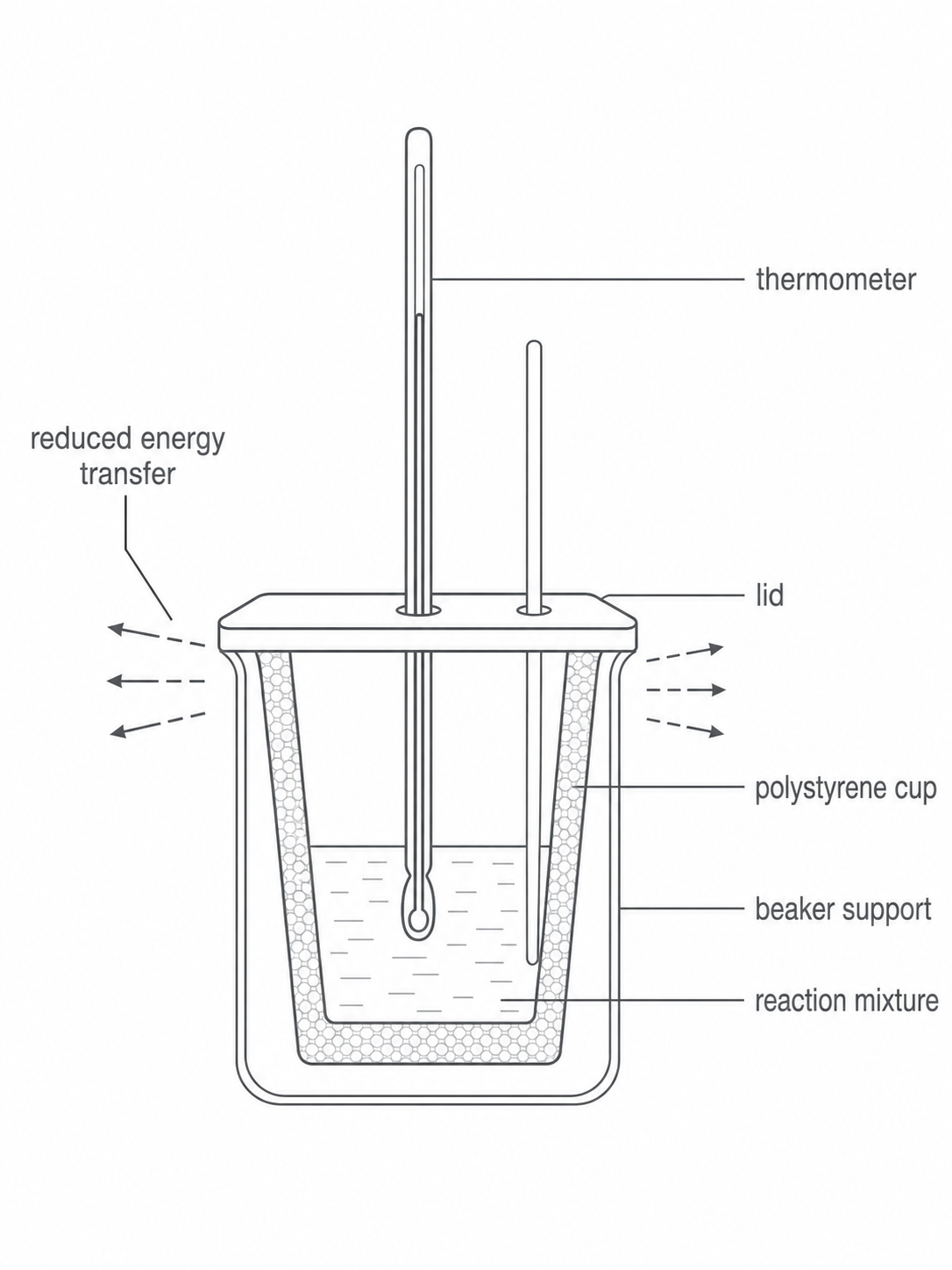
The polystyrene cup slows energy transfer to or from the room. The beaker supports the light cup, the lid reduces exchange with the air, and the thermometer bulb must be immersed without touching the vessel. The arrangement reduces unwanted transfer; it does not eliminate it. The diagram's outward arrows illustrate energy leaking to the room during an exothermic run; during an endothermic run, unwanted energy transfer is in the opposite direction, from the room into the colder mixture.
A workable method
- Place the polystyrene cup in a beaker and fit a lid with holes for the thermometer and stirring rod.
- Measure a fixed volume of the first solution into the cup. Let both reactants reach the same starting temperature, then record that initial temperature.
- Measure a fixed amount of the second reactant. Add it, replace the lid immediately and stir at a consistent rate.
- Record the temperature at regular short intervals until a clear maximum or minimum has been passed. Use the highest value for a rise or the lowest value for a fall.
- Repeat each selected change at least three times. Identify anomalous results before calculating a mean signed temperature change.
If the independent variable is the selected reaction or dissolving process, the dependent variable is its signed temperature change in . Keep total solution volume, reactant concentrations or measured solid amounts, initial temperature, cup and lid, thermometer depth, stirring, and measurement timing as consistent as the chemistry allows. When different chemicals are being classified, compare the sign fairly; a raw temperature-change size is not automatically a fair comparison of energy per mole.
Signed temperature change
Temperature change is the extreme temperature minus the initial temperature.
A positive is a rise; a negative is a fall.
Worked example
A neutralisation mixture starts at and reaches a maximum of .
Continue this lesson.
You’re previewing NovaLearn without an account. Create a free account to read the rest.
Create free account