Chemistry 1.35 - 1.37 - Diamond and graphite
Diamond and graphite contain the same element but behave very differently. Follow the carbon bonds and mobile electrons to explain cutting tools, electrodes and lubricants.
One element, different networks
Diamond and graphite both contain carbon atoms only, but their atoms are connected differently. They are different forms of the same element. The name allotrope is useful for different structural forms of one element.
Giant covalent structure
A giant covalent structure is an extended network of atoms joined by many strong covalent bonds. It does not consist of separate small molecules.
In diamond, every carbon atom forms four covalent bonds to four other carbon atoms. The bonds point in different directions, producing a rigid, three-dimensional network. The pattern continues throughout the crystal: there is no separate diamond molecule with an edge shown in a structural diagram.
In graphite, every carbon atom forms three covalent bonds to three other carbon atoms. The atoms form flat sheets of joined hexagonal rings. Strong covalent bonds extend across each sheet, while only weak forces of attraction act between one sheet and the next. The fourth outer electron from each carbon is not fixed in one covalent bond; these electrons are delocalised and can move along the sheets.
[DIAGRAM: asset_slug: che_b_diamond_graphite_v2; description: Local tetrahedral four-neighbour diamond model and two hexagonal graphite sheets; each graphite interior atom has three neighbours, strong bonds lie within layers, and opposite arrows show sliding.]
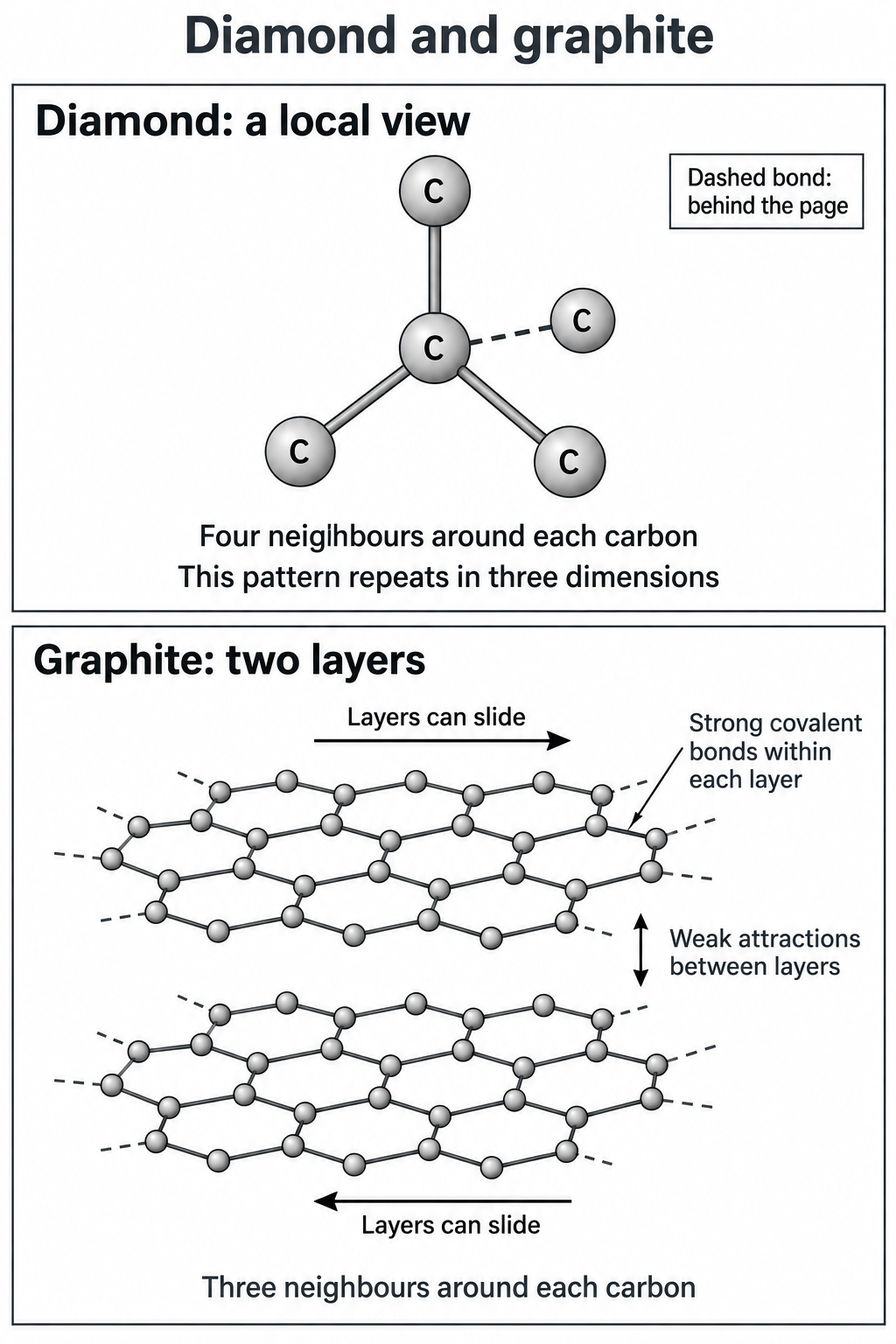
The diagram is a model. The diamond panel shows one carbon and its four neighbours, not a five-atom molecule. Its dashed bond recedes behind the page. The graphite panel shows only two sections of much larger layers; its edge continuations mean the network continues. Count neighbours at an interior atom, not at a cut edge. A flat drawing loses depth: rotate a physical tetrahedral model to see why four bonds need not lie in one plane.
Continue this lesson.
You’re previewing NovaLearn without an account. Create a free account to read the rest.
Create free account