Physics 12.4 - 12.6 - Field maps and compasses
A magnetic-field map shows direction and relative strength. Learn how to read bar-magnet and uniform-field patterns, trace directions with a plotting compass, and explain what a compass reveals about the Earth.
The field-line model
Magnetic field
The region around a magnet in which another magnet or magnetic material experiences a force.
Magnetic field lines are a model, not physical threads. At any point, the arrow gives the direction in which the north-seeking end of a small compass would point.
Around a bar magnet:
- the lines curve from one pole to the other;
- outside the magnet, arrows point from N to S;
- the lines never cross, because the field cannot have two directions at one point;
- the field is stronger where the lines are closer together, so it is strongest near the poles.
A uniform magnetic field has the same strength and direction throughout the region shown. Its field lines are straight, parallel and equally spaced, with all arrows pointing the same way.
[DIAGRAM: asset_slug: phy_g_bar_and_uniform_fields; description: External bar-magnet lines point N to S; uniform-field lines are straight, parallel and equally spaced.]
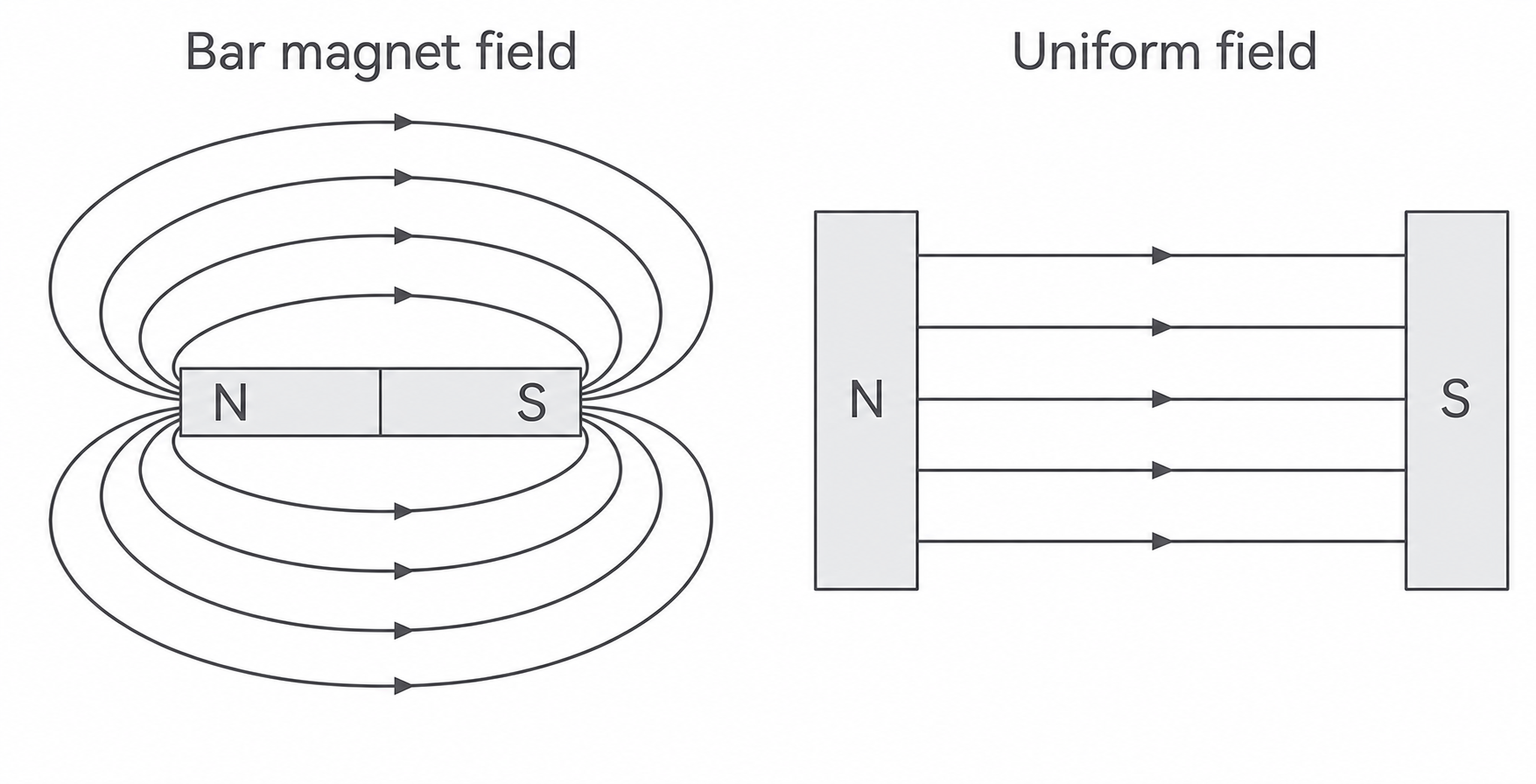
The diagram uses more lines near a bar magnet's poles to represent a stronger field. The exact number of drawn lines is not a measured quantity; compare their concentration within the same diagram.
Mapping with a plotting compass
A plotting compass is a small magnetised needle that can rotate freely. Its north-seeking end aligns with the field at its position, so several readings can reveal both the shape and direction of a field.
To trace the field around a bar magnet:
- Place the magnet under a sheet of paper, draw its outline and label N and S.
- Put the plotting compass close to N. Mark the positions of both needle ends and identify the north-seeking end from its N mark or the end that points roughly north when tested away from the magnet.
- Move the compass so its south end is on the previous mark for the north end. Mark the new needle direction.
- Repeat until the trace reaches S. Join the marks with a smooth curve and add an arrow from N to S.
- Start at several different positions near N and repeat to build up the field pattern.
Continue this lesson.
You’re previewing NovaLearn without an account. Create a free account to read the rest.
Create free account