Biology 9.14 - Water cycle and desalination
Follow water through the environment and living organisms, then compare how distillation and reverse osmosis can support water supplies during drought.
The water cycle
Water continually moves between the surface, atmosphere and organisms. Its physical state changes during part of the cycle, but it remains water.
The water route
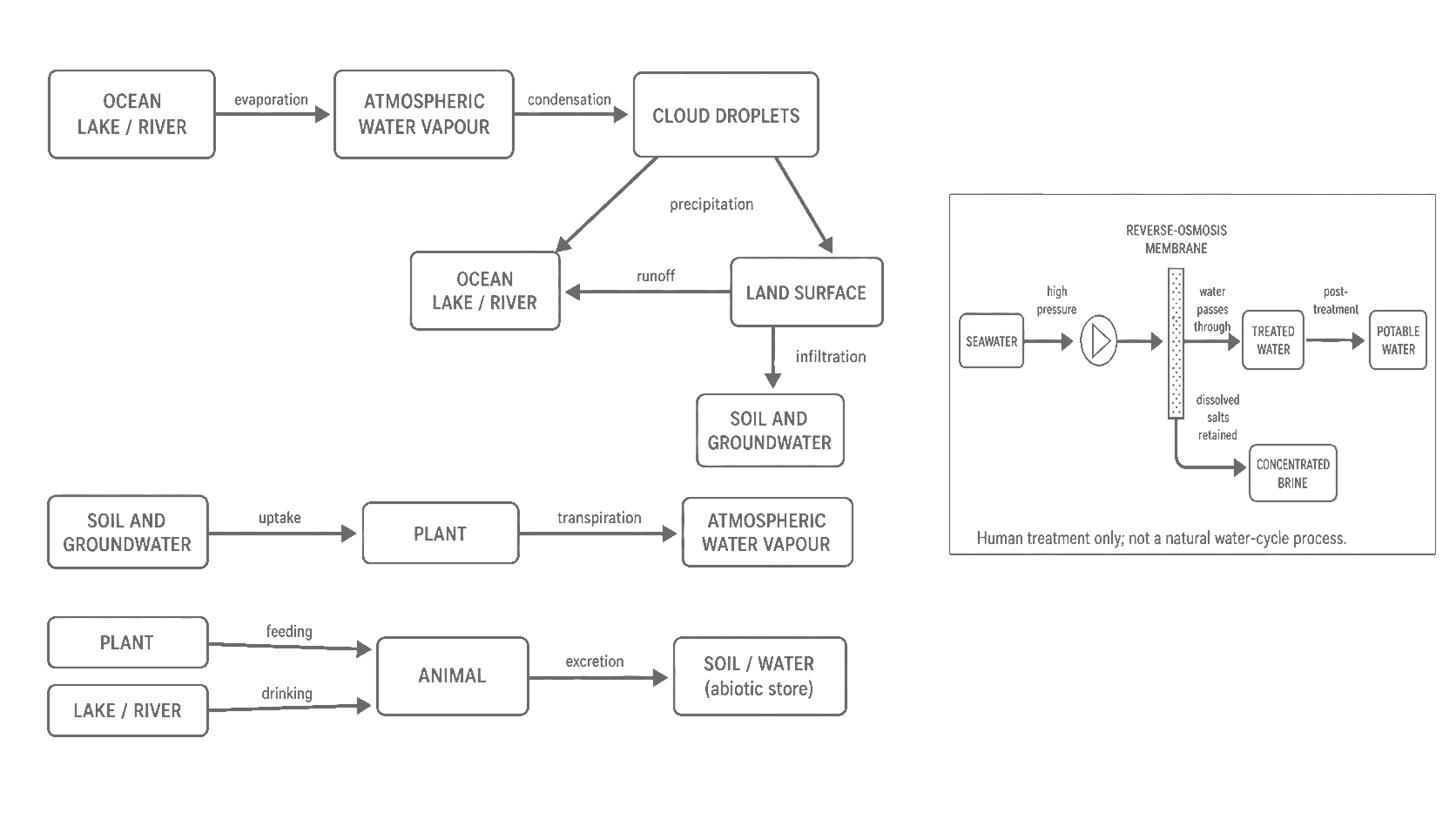
- Energy transferred from the Sun causes liquid water at oceans, lakes, rivers and wet ground to evaporate into water vapour. Evaporation is liquid to gas.
- Plants take up liquid water through their roots. Some water leaves the plant as water vapour by transpiration, moving water from a biotic component to the atmosphere.
- Moist air rises and cools. Water vapour condenses into tiny liquid droplets, which form clouds. A cloud is not a mass of invisible water vapour.
- Droplets or ice crystals grow and return water to the surface as precipitation, including rain, snow, sleet or hail.
- Water may flow over the surface as run-off, collect in rivers and oceans, soak into soil, or be taken up by organisms. These routes reconnect the cycle.
The water cycle is important because organisms need water for reactions, transport and photosynthesis. By moving and redistributing water, the cycle replenishes freshwater stores on land. It does not guarantee that every place receives enough rain at the time it is needed.
Desalination and potable water
Potable water
Water that is safe to drink. Potable water is not necessarily chemically pure; safe amounts of dissolved substances may remain.
A drought is a prolonged period of unusually low water availability, often associated with low rainfall. River flow, reservoir level and soil water can fall, so the usual local freshwater supply may not meet demand. A coastal region can use seawater, but first it must remove the high concentration of dissolved salts by desalination and make sure the final water meets drinking-water standards.
Two desalination routes are useful at this level:
- In distillation, seawater is heated so water evaporates while dissolved salts remain. The water vapour is cooled and condensed to collect fresh water.
- In reverse osmosis, pumps force seawater at high pressure against a partially permeable membrane. Water passes through; most dissolved ions do not. Further treatment and quality checks make the product suitable for supply.
Desalination can operate when rainfall is scarce because its seawater source does not depend on rain. However, pumping or heating needs substantial energy and is costly. The concentrated brine left behind must also be managed to reduce harm to marine ecosystems. A school distillation is not a drinking-water treatment system, so laboratory products must never be tasted or drunk.
[DIAGRAM: asset_slug: biof_water_cycle; description: Natural water routes with evaporation, condensation, precipitation, infiltration, uptake, transpiration and animal transfers. The separate inset shows high-pressure reverse osmosis and brine; desalination is human treatment, not a natural cycle process.]
Testing a desalination model
This is not a required core practical. Its purpose is to test whether simple distillation reduces the dissolved salt content of water, not to produce drinking water.
Continue this lesson.
You’re previewing NovaLearn without an account. Create a free account to read the rest.
Create free account