Chemistry 1.38 - 1.39 - Carbon sheets, cages and chains
Compare an extended graphene sheet with separate fullerene cages and long poly(ethene) molecules. Locate the bonds and mobile electrons before explaining the properties of each structure.
Graphene sheets and fullerene cages
Graphene and are also forms of carbon, but they must not be treated as the same kind of particle. The specification studies them together under fullerenes and graphene; structurally, graphene is an extended sheet, whereas is a separate molecule.
Graphene is one layer of graphite, only one carbon atom thick. Each carbon is covalently bonded to three others in a continuous hexagonal network. The strong covalent bonds across the sheet make graphene very strong for its tiny mass and make it difficult to break apart. Because it is a single layer, it is extremely thin, light and almost transparent; the sheet can also bend. One electron per carbon is delocalised and can move across the sheet, so graphene conducts electricity.
Fullerenes are carbon molecules with hollow shapes. , called buckminsterfullerene, is one spherical example: a cage of 60 carbon atoms arranged in pentagons and hexagons, with each carbon bonded to three others. Strong covalent bonds hold the atoms together within each molecule, but weak intermolecular forces act between molecules in a sample. These weak forces are much easier to overcome than the covalent bonds in a giant structure, so a molecular solid is relatively soft and separating its cages requires far less energy than breaking apart a giant covalent network.
also has electrons delocalised over each cage. Some -based materials can show electrical conduction, but the electrons do not have the same continuous giant sheet through which to move as they do in graphene. Pure is a poor electrical conductor compared with graphene: electrons confined mainly to individual cages do not move freely through the entire sample.
[DIAGRAM: asset_slug: che_b_graphene_cages_v2; description: A single extended hexagonal graphene sheet contrasted with three separate hollow C60 cage projections; solid bonds are within the sheet and cages, and the empty gap between cages is labelled weak attractions.]
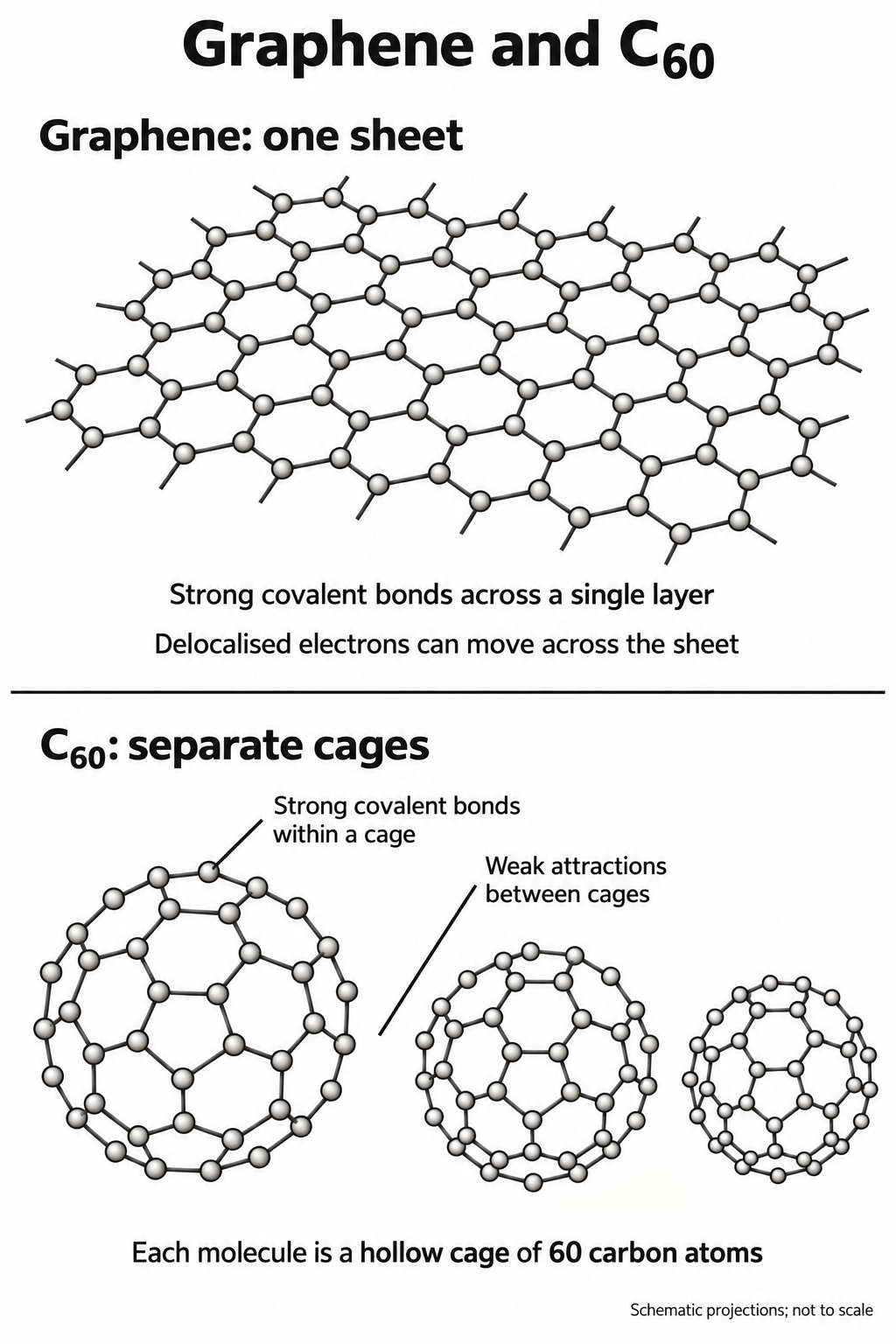
The cage is a schematic projection: the formula gives the exact count of 60 carbon atoms, while the drawing emphasises the closed cage of pentagons and hexagons rather than inviting an atom-by-atom count from one viewpoint.
| Form of carbon | Particle or network | Structural cause | Explained property |
|---|---|---|---|
| graphene | one-atom-thick giant sheet | many strong covalent bonds across the sheet | very strong; difficult to break apart |
| graphene | giant sheet with delocalised electrons | electrons can move across the sheet | conducts electricity |
| separate hollow molecules | weak intermolecular forces between cages | relatively soft; cages separate without breaking their internal bonds |
Continue this lesson.
You’re previewing NovaLearn without an account. Create a free account to read the rest.
Create free account