Physics 4.10 - 4.11 - Refraction and wave interactions
Trace a ray across a boundary using the normal as a reference. The direction change is common to both tiers; the speed explanation and wavelength-dependent absorption, transmission and reflection are Higher content.
Refraction at a boundary
A boundary is the dividing surface between two regions in which a wave can travel. It could separate air and glass for light, or deeper and shallower water for ripples. The useful system is the wave as it reaches, crosses and leaves that boundary.
We often represent the direction of travel with a ray: a straight line with an arrowhead. A ray is a model, not a physical string inside the wave. The incoming ray is the incident ray; after the boundary, the continuing ray shows the wave's new direction.
At the point where the incident ray meets the boundary, draw a normal. The normal is an imaginary construction line at to the boundary. Directions are compared with the normal, so descriptions such as towards the normal remain meaningful even if a diagram is rotated.
Refraction
Refraction is a change in the direction of a wave as it crosses a boundary.
When the ray changes direction after crossing, it is called the refracted ray. If an incident ray travels along the normal, it crosses the boundary without turning: its direction before and after the boundary is the same. Merely crossing a boundary is therefore not enough evidence that the direction has changed.
A pencil viewed through water can appear displaced because light from the pencil changes direction at the water-air boundary before reaching the eye. The pencil itself has not bent; the ray path has changed.
How speed controls the direction
Higher tier only: the speed explanation in Physics 4.10
Physics 4.10 adds the cause: a wave is refracted because its speed changes as it crosses a boundary. For a wave arriving obliquely, one part of a wavefront reaches the new region before the rest. That first part changes speed while the rest is still moving at the original speed, so the wavefront pivots and the ray direction changes.
There are two rules, both measured from the normal:
- If the wave slows down, the refracted ray bends towards the normal. Its angle to the normal becomes smaller.
- If the wave speeds up, the refracted ray bends away from the normal. Its angle to the normal becomes larger.
[DIAGRAM: asset_name: Physics 4.10-4.11 - Refraction, reflection and absorption - diagram 01; asset_slug: physics_4_10_4_11_refraction_reflection_and_absorption__diagram_01; recommended_method: image_gen; description: Two-panel monochrome ray comparison at a horizontal boundary. In both panels an incident ray travels from upper left to the same point of incidence, with an arrowhead towards the boundary, and a dashed vertical normal passes through that point. Left panel: the lower region is slower, the refracted ray continues down-right with an arrowhead away from the boundary and lies closer to the normal than the incident ray, labelled 'slows down' and 'towards the normal'. Right panel: the lower region is faster, the refracted ray continues down-right with an arrowhead away from the boundary and lies farther from the normal than the incident ray, labelled 'speeds up' and 'away from the normal'. Use white background and #6A6B6E only. Exclude reflection rays, angle values, refractive index, Snell's law, lenses and decorative marks.]
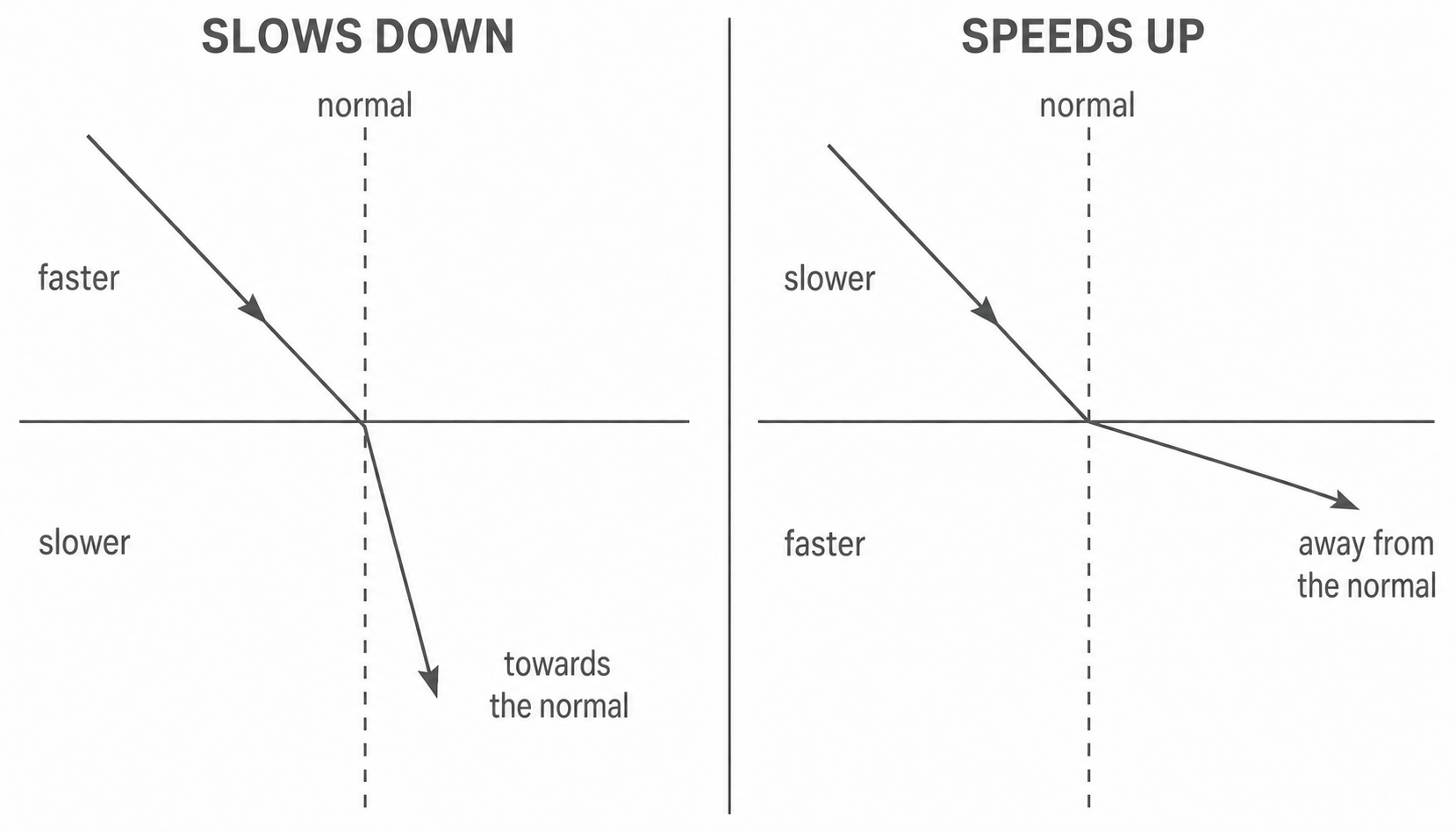
The normal-incidence case is an important limit. If every part of a wavefront reaches the boundary at the same time, no side gets ahead of the other, so the direction does not turn even though the speed can change.
Worked prediction
A wave approaches a boundary obliquely. Its speed is in region A and in region B.
- Compare speeds: , so the wave slows as it enters B.
- Track the wavefront: the part entering B first slows while the rest is still moving faster in A, so the wavefront pivots.
- State the ray direction: slowing means towards the normal, so the angle between the refracted ray and the normal is smaller than the angle between the incident ray and the normal.
- Sense-check: reversing the journey would make the wave speed up from to , so it would bend away and retrace the same path in reverse.
This reasoning is stronger than memorising whether a ray bends "up" or "down": compare the speeds first, then use the normal.
Continue this lesson.
You’re previewing NovaLearn without an account. Create a free account to read the rest.
Create free account