Chemistry 3.9 - 3.14 - Acid reactions and neutralisation
Predict salts, water and gases from the substance reacting with an acid. Use diagnostic gas tests and the hydrogen-ion/hydroxide-ion model to explain the observations.
Bases and the soluble subset
Start with a visible event: copper(II) oxide is a black solid, but when it reacts with sulfuric acid the black solid is used up and a blue copper sulfate solution forms. The acid has not simply made the solid vanish. A chemical reaction has produced a new salt and water.
Base
A base is a substance that reacts with an acid to form a salt and water only.
Metal oxides and metal hydroxides are common bases. For example:
copper(II) oxide + sulfuric acid → copper sulfate + water
The word only matters in this definition: the products in this base-acid pattern are a salt and water, with no gas product.
Alkali
An alkali is a base that is soluble in water.
This makes alkalis a subset of bases:
- sodium hydroxide dissolves in water, so it is both a base and an alkali;
- copper(II) oxide is a base but is insoluble in water, so it is not an alkali;
- every alkali is a base, but not every base is an alkali.
Solubility is the deciding property. A substance does not become an alkali merely because its name contains hydroxide; the hydroxide must dissolve in water.
A salt is an ionic compound formed when the hydrogen in an acid is replaced by a metal ion or another positive ion. In this lesson, examples include magnesium chloride, copper sulfate and sodium nitrate. Chemical salt therefore means a family of compounds, not just sodium chloride used in food.
Four acid reaction patterns
An aqueous acid contains particles dissolved in water. When it reacts, the class of the other reactant determines the product pattern. The macroscopic observation, word equation and symbolic equation should all tell the same chemical story.
| Other reactant | General word equation | Typical macroscopic evidence | Balanced example |
|---|---|---|---|
| Suitable reactive metal | metal + acid → salt + hydrogen | Bubbles as the metal is used up | |
| Metal oxide | metal oxide + acid → salt + water | Solid may be used up; no gas from the pattern | |
| Metal hydroxide | metal hydroxide + acid → salt + water | Solid may be used up, or two solutions mix; no gas from the pattern | |
| Metal carbonate | metal carbonate + acid → salt + water + carbon dioxide | Fizzing as carbon dioxide is released |
The hydrogen-producing metal examples here use dilute hydrochloric or sulfuric acid. Do not assume every acid gives hydrogen with every metal: nitric acid can follow a different reaction pathway. The metal row is a reaction pattern, not a claim that every metal reacts. Magnesium and zinc react with dilute acids; some less reactive metals do not. The reactivity order and its electron explanation belong elsewhere, so here the precise statement is: when a suitable reactive metal reacts with an acid, hydrogen is made.
Metal oxides and metal hydroxides fit the base definition because their acid reactions produce salt and water only. Keep the carbonate row as its own three-product pattern: it has carbon dioxide as an additional product.
Naming the salt
Both reactants contribute to the salt name:
- The metal gives the first part of the name.
- The acid gives the ending.
| Acid | Salt ending | Example salt |
|---|---|---|
| Hydrochloric acid | chloride | magnesium chloride |
| Sulfuric acid | sulfate | copper sulfate |
| Nitric acid | nitrate | sodium nitrate |
So zinc reacting with sulfuric acid makes zinc sulfate, not zinc chloride. Calcium carbonate reacting with nitric acid makes calcium nitrate, not calcium carbonate again.
Worked example: predict and check the products
Predict the reaction between calcium carbonate and hydrochloric acid.
Step 1: classify the other reactant. Calcium carbonate is a metal carbonate, so select:
metal carbonate + acid → salt + water + carbon dioxide
Step 2: name the salt. The metal supplies calcium; hydrochloric acid supplies chloride. The salt is calcium chloride.
Step 3: write the word equation.
calcium carbonate + hydrochloric acid → calcium chloride + water + carbon dioxide
Step 4: write and balance the symbol equation.
Step 5: check conservation. Both sides contain 1 atom, 1 C atom, 3 O atoms, 2 atoms and 2 atoms. The equation is balanced, so no atoms have been created, destroyed or hidden. The gas product also makes sense of the expected fizzing.
Gas tests turn observations into evidence
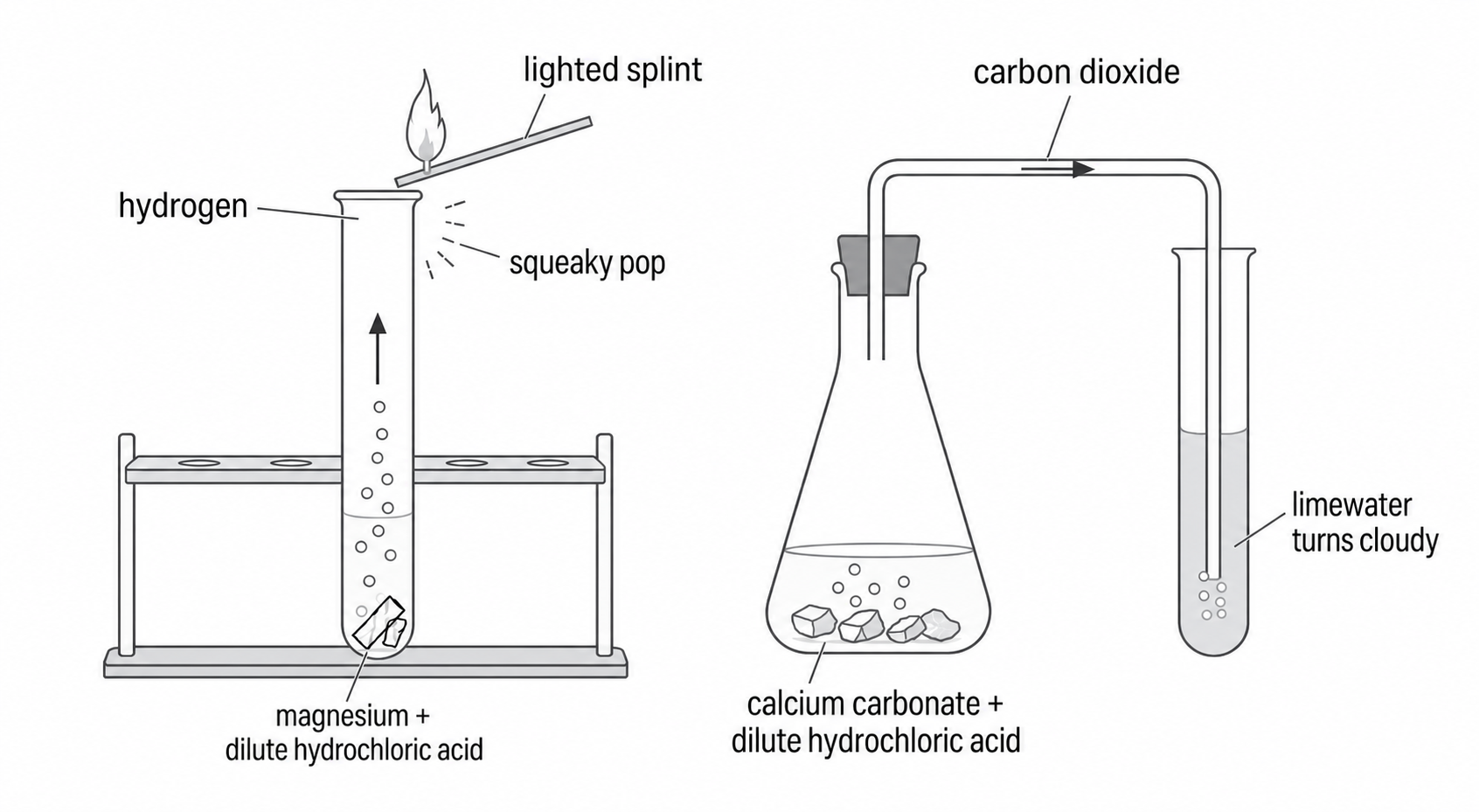
Fizzing is an observation: it shows that a gas is being released. It is not yet an identification. A chemical test gives a diagnostic positive observation that supports an inference about which gas is present.
| Gas | Test procedure | Positive observation | Supported inference |
|---|---|---|---|
| Hydrogen, | Bring a lighted wooden splint to a small sample of the gas. | The gas burns with a squeaky pop. | Hydrogen is present. |
| Carbon dioxide, | Bubble the gas through fresh limewater. | The limewater turns cloudy or milky as a fine white precipitate forms. | Carbon dioxide is present. |
A lighted splint has a flame. Do not confuse it with a glowing splint, which has no flame and is used for a different gas test outside this lesson. Carbon dioxide may put out a flame, but that observation is not the specified positive test: bubbling the gas through limewater and observing cloudiness is much more diagnostic.
[DIAGRAM: asset_name: Chemistry 3.9-3.14 - Acid reactions, tests and neutralisation - diagram 01; asset_slug: chemistry_3_9_3_14_acid_reactions_tests_and_neutralisation__diagram_01; recommended_method: image_gen; description: Two-panel monochrome scientific apparatus diagram on white. Left: magnesium in dilute hydrochloric acid producing hydrogen in a test tube; a lighted wooden splint is held at the mouth, with a small pop symbol and direct labels 'hydrogen' and 'squeaky pop'. Right: calcium carbonate in dilute hydrochloric acid inside a stoppered reaction vessel; a delivery tube carries carbon dioxide into a separate test tube of limewater below the liquid surface, with visible bubbles and the limewater region labelled 'turns cloudy'. Arrowheads must point from each reaction vessel toward the gas test. Use #6A6B6E linework and labels; exclude oxygen/chlorine tests, heating, gas syringes, rate measurements, coloured flames and decorative laboratory detail.]
A workable suggested practical
This is suggested practical work, not a specified core practical. Its purpose is to compare the four reaction classes and identify any gas produced.
Continue this lesson.
You’re previewing NovaLearn without an account. Create a free account to read the rest.
Create free account