Chemistry 1.40, 1.42 - Metals and their properties
Explain how mobile electrons let a solid metal carry charge and how ion layers can slide while the metal stays together. Compare typical metal and non-metal properties while recognising exceptions.
Patterns in metal and non-metal properties
Begin at the macroscopic level: properties that can be observed or measured for a bulk material. A clean copper wire looks shiny, can be bent and completes an electrical circuit. A sulfur sample, by contrast, does not complete the circuit.
The specification uses a deliberately cautious pattern:
| Class of element | Typical property pattern required here |
|---|---|
| Most metals | Shiny solids with high melting points and high density; good electrical conductors |
| Most non-metals | Low boiling points; poor electrical conductors |
High density means a large mass is packed into a given volume. A good electrical conductor lets charge move through it readily.
Malleable
A malleable material can be hammered or pressed into a new shape without breaking.
These are trends, not definitions. Mercury is a metal but is liquid at room temperature, while graphite is a non-metal form of carbon that conducts electricity. A tarnished metal can also look dull because its surface has reacted. Therefore, use words such as most, usually and typically; one property on its own cannot identify every material.
The metallic bonding model
To explain the bulk properties, move to the sub-microscopic level. In the GCSE model, a metal has a giant metallic structure:
- metal ions occupy a regular, repeating arrangement;
- the ions are positive because some outer-shell electrons are no longer attached to one particular atom;
- those electrons are delocalised, so they can move throughout the structure;
- strong electrostatic attraction between the positive ions and negative delocalised electrons acts throughout the lattice.
That electrostatic attraction is metallic bonding. The metal is neutral overall: the total positive charge of its ions is balanced by the total negative charge of its delocalised electrons. The structure is not made from separate metal molecules, and the electrons have not escaped from the metal.
[DIAGRAM: asset_name: Chemistry 1.40-1.42 - Metallic bonding and material models - diagram 01; asset_slug: chemistry_1_40_1_42_metallic_bonding_and_material_models__diagram_01; recommended_method: image_gen; description: A white and monochrome 2D schematic of a neutral representative section of a giant metallic lattice, with exactly 12 positive metal ions and 12 delocalised electrons, direct labels for both particle types, and a leader identifying electrostatic attraction in all directions; no element-specific symbols, negative ions, neutral atoms, covalent sticks, pairwise bond lines, current arrows or 3D claim.]
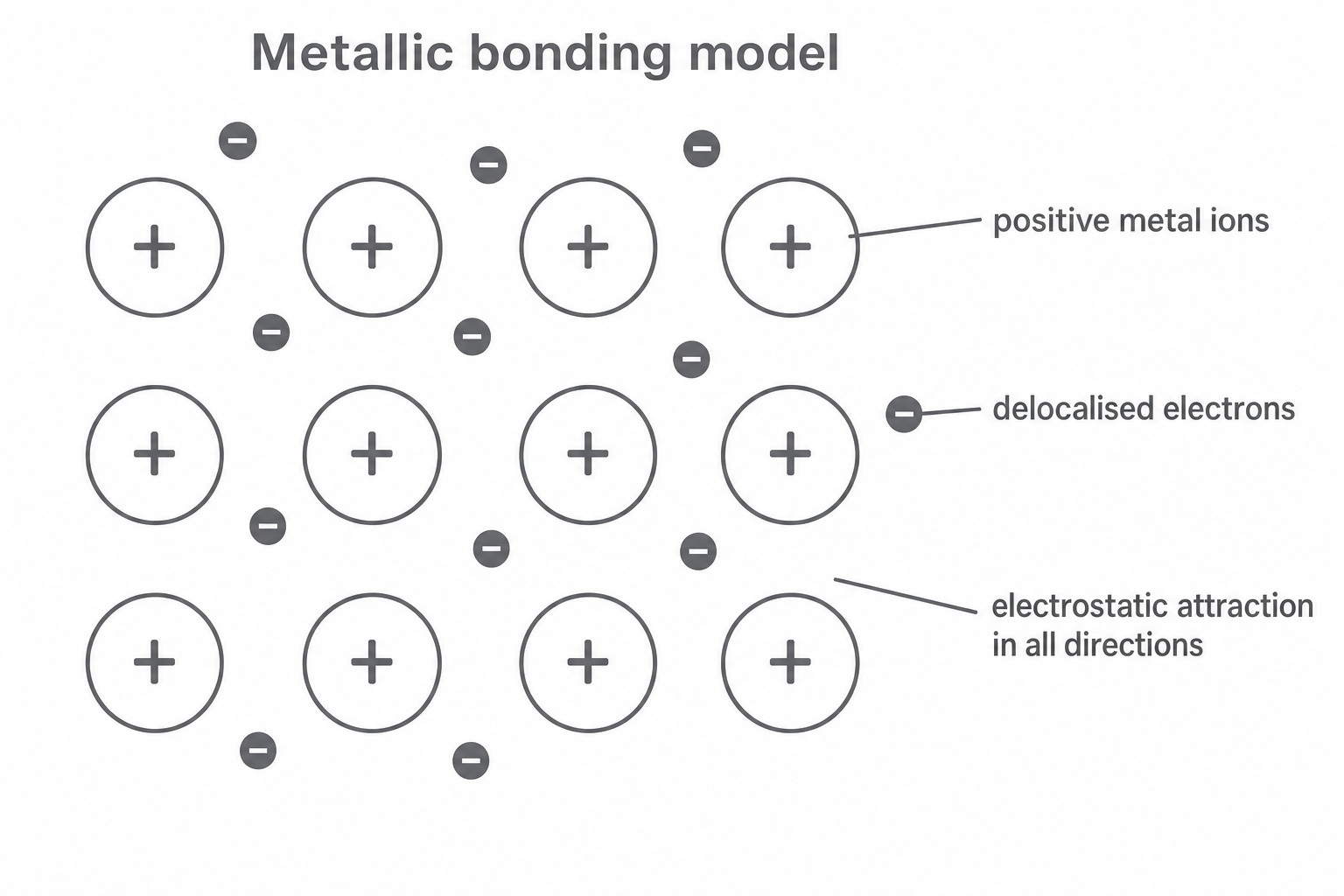
The diagram is a model. Its minus symbols mark 12 possible electron positions at one instant; they do not mean that the electrons are fixed there. Its equal counts show charge balance for this simplified section, not that every metal ion in every metal always has charge .
How structure explains metallic properties
The useful reasoning pattern is:
Structure and bonding → particle behaviour → observed property
Electrical conduction
In a solid metal, the positive ions stay near fixed lattice positions, but the delocalised electrons can move through the structure. When a potential difference is applied, these mobile electrons carry electrical charge from one part of the metal to another. The metal therefore conducts while still solid.
Do not say that the positive ions flow through the wire. They may vibrate about lattice positions, but the mobile charge carriers in this model are the delocalised electrons. Also, delocalised does not mean uncharged or completely free: the electrons remain attracted to the positive ions while being mobile within the metal.
Continue this lesson.
You’re previewing NovaLearn without an account. Create a free account to read the rest.
Create free account