3.04a, 3.04b - Moments and rigid-body equilibrium
Find a force's turning effect by measuring the right distance, then combine turning balance with force balance. You will calculate signed moments, distinguish the two equilibrium conditions and choose a point that makes unknown forces easier to find.
Moment and perpendicular distance
Can equal and opposite forces still turn an object? Imagine pushing upwards at one end of a horizontal ruler and downwards at the other. The forces cancel as a resultant, but their turning effects reinforce each other. We need to keep track of where each force acts.
Start with one force: upwards, to the right of . Its turning effect about is anticlockwise. Move that force so its line passes through , and its turning effect becomes zero, although the force is unchanged.
You already know
Forces have magnitude and direction. Resolve an inclined force into perpendicular components using sine and cosine; a rigid-body diagram also keeps the positions of the forces.
Extending a force's line of action helps you see which distance matters.
Moment of a force
The moment of a force about a point is its turning effect about an axis through that point, perpendicular to the plane of the forces. Its magnitude is force multiplied by the perpendicular distance to the force's line of action; its sense is clockwise or anticlockwise.
The distance to the arrow's starting point is useful only if it is perpendicular to the force. A horizontal force needs a vertical arm; a vertical force needs a horizontal arm.
[DIAGRAM: asset_name: Perpendicular moment distances; asset_slug: perpendicular_moment_distances; description: A horizontal rod with a vertical 10 N force 3 m from O and a rectangular lamina with a horizontal 8 N force 0.5 m above O; perpendicular distances and line-of-action extensions labelled; caption: Use perpendicular distance to the force's line of action]
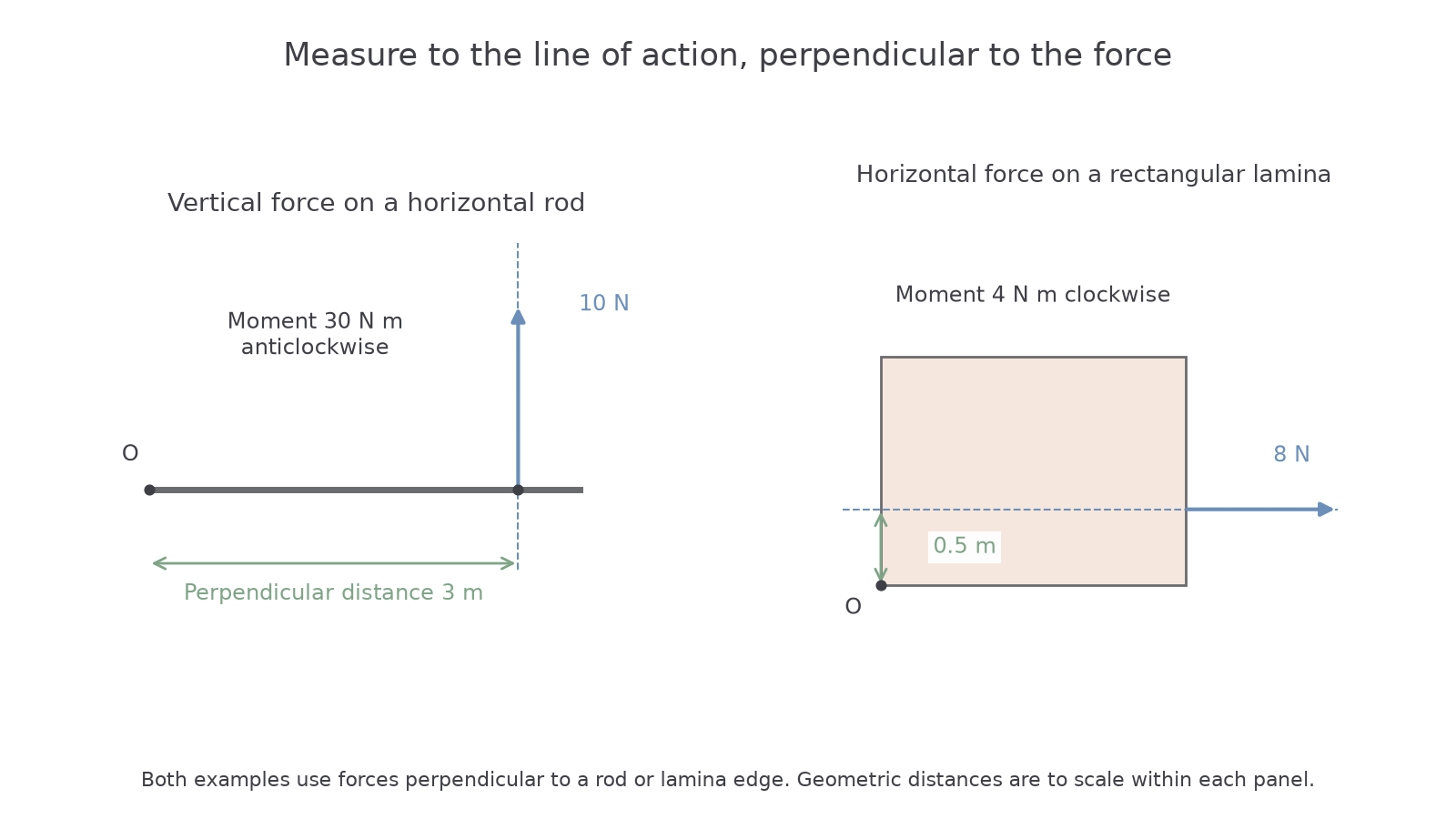
The second panel gives clockwise. Sliding an arrow along its existing line leaves its moment unchanged: the line of action determines the arm.
Moment magnitude
For force magnitude and perpendicular distance from the chosen point to its line of action,
Newtons and metres give . State the turning sense; a line through the point has .
Not in the formula sheet: learn it.
With an oblique force on a rod, either find the perpendicular arm or use the perpendicular force component.
Worked example 1: an inclined force
Question. A horizontal rod extends rightwards from . A force acts from , at above the rightward horizontal. Find its moment about , giving magnitude and sense exactly.
Plan. Find the vertical component, then multiply by its horizontal arm.
Why use the vertical component? The horizontal component's line passes through , so its moment is zero.
Answer. anticlockwise.
Check. The direct perpendicular arm is ; .
Change only the force angle. Its magnitude and point of application stay fixed.
Worked example 2: a greater angle
Question. On the same horizontal rod, a force acts from , at above the rightward horizontal. Find its moment about , giving magnitude and sense exactly.
Plan. Resolve vertically and use the same horizontal arm.
Why has the moment increased? More of the same force now acts perpendicular to the rod.
Answer. anticlockwise.
Check. This is about , below the maximum for a perpendicular force.
A signed scalar and turning sense are enough here; no vector treatment of moments is needed.
Watch out
The line ignores the angle. Use or ; do not use the sine factor twice.
An arrow pointing partly left can still turn the right-hand end upwards.
Adding clockwise and anticlockwise moments
Several forces can turn the same body in competing senses. Choose one point and one sign convention before adding their moments.
Take anticlockwise as positive. A force upwards to the right of has positive moment; the same force upwards to the left has negative moment. Force direction alone does not determine the sign.
Resultant moment
For coplanar forces, the resultant moment about a point is the algebraic sum of individual moments about that same point:
With anticlockwise positive, clockwise moments enter negatively.
Not in the formula sheet: learn it.
Ask how each force would turn the body before attaching a sign.
Worked example 3: competing turning effects
Question. A horizontal rod has forces upwards right of and downwards right of . Find the resultant moment about , stating its sense.
Plan. Add signed moments, taking anticlockwise as positive.
Why subtract? The forces turn the rod in opposite senses.
Answer. clockwise.
Check. The clockwise contribution exceeds the anticlockwise contribution .
Change only which side of carries the downward force. Its direction stays downwards, but its turning sense reverses.
Worked example 4: crossing the moment point
Question. A horizontal rod has forces upwards right of and downwards left of . Find the resultant moment about , stating its sense.
Plan. Identify both rotations and add with anticlockwise positive.
Why is the second term positive? Pushing the left side down turns the right side up.
Answer. anticlockwise.
Check. Reinforcing moments give a total greater than either individual contribution.
For rectangular laminas, vertical forces still use horizontal arms, and horizontal forces use vertical arms. Include every force once.
Continue this lesson.
You’re previewing NovaLearn without an account. Create a free account to read the rest.
Create free account