1.06c–1.06f - Logarithms, natural logs and their laws
Interpret logarithms as exponents, connect the natural logarithm with its inverse exponential, and derive the laws for combining logarithms. Learn why a shorter expression must keep the domain of the expression it came from.
From exponents to logarithms
Can simplifying an expression accidentally give it extra inputs? For example, is not real, but is. We need to know what logarithms mean before deciding when they can be combined.
You already know
A positive-base exponential has positive outputs. For a base other than 1 it is one-to-one, so each positive output comes from one exponent.
A logarithm names that exponent, rather than a new kind of multiplication.
Logarithm
For , , and ,
The base is , the argument is , and the logarithm's value is the exponent . For example, because .
Base 1 is excluded because cannot return a unique exponent. Non-positive bases do not give real exponentials on all real inputs. Arguments must be positive, but the logarithm's value may be zero or negative.
Two exact logarithm values
For every valid logarithm base , ,
These follow from and .
Not in the formula sheet: learn it.
Converting back to an exponential is the quickest check of an exact logarithm.
Worked example 1: a negative exponent
Question. Evaluate , and express the answer in index form.
Plan. Write the argument as a power of the stated base.
Why this step? The logarithm asks for the exponent, not for the reciprocal of the base.
Answer. ; the equivalent index statement is .
Check. The argument is positive, so a negative logarithm value is entirely valid.
Change only the exponent's type: the argument now corresponds to a fractional negative power.
Worked example 2: a fractional exponent
Question. Evaluate , and express the answer in index form.
Plan. Use the square-root and reciprocal index laws.
Why this step? A logarithm need not be an integer; it can be any real exponent.
Answer. , since .
Check. Squaring the positive argument gives , whose exponent is twice .
A zero answer and an undefined argument are quite different.
Watch out
, but has no real value. No real power of a valid positive base gives zero or a negative number.
Keep the base fixed when changing notation.
Inverse functions and logarithmic graphs
An inverse graph swaps each input with its output, turning an exponential's horizontal asymptote into a logarithm's vertical asymptote.
Natural logarithm
The natural logarithm is , the inverse of . It has domain , range , intercept , and vertical asymptote .
The graph increases, becoming less steep. It has no vertical-axis intercept because zero is outside its domain. As , ; as , , so it has no horizontal asymptote.
Inverse identities
In particular, , , , and .
Not in the formula sheet: learn it.
Even exactly: the logarithm reports the exponent without needing to write out the enormous input. The reflected graphs show this reversal of roles.
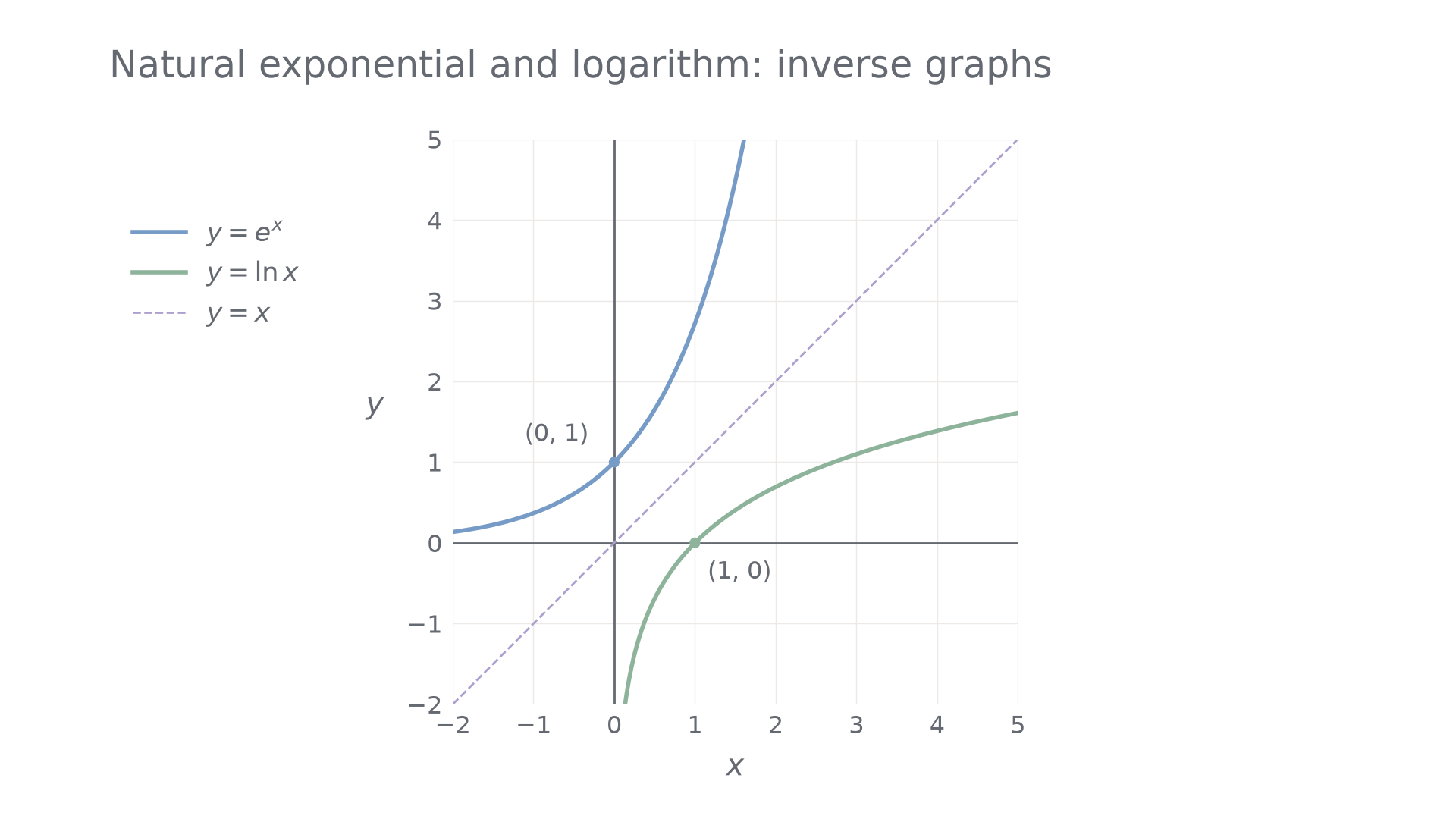
A sketch needs its domain, asymptote and a few exact points before any smooth curve is drawn.
Worked example 3: sketching the natural logarithm
Question. State three exact points and the asymptote of .
Plan. Swap coordinates of familiar exponential points.
Why this step? Reflection in exchanges the exponential's input and output, including the direction of its asymptote.
Answer. Points ; asymptote , with the curve entirely to its right.
Check. , so part of the graph has negative height despite its positive inputs.
Change only a horizontal translation by 2.
Worked example 4: shifting the logarithmic graph
Question. State the corresponding points, domain and asymptote of .
Plan. Move every point and the vertical asymptote two units right.
Why this step? The argument, rather than the whole logarithm, controls the horizontal shift and the domain.
Answer. The displayed three points, domain , range , and asymptote .
Check. At , the argument is 1, so the output is zero.
Other valid bases have the same domain and intercept, but the direction depends on the base: increasing for , decreasing for . For bases 2 and one half, the points reflect vertically to .
Continue this lesson.
You’re previewing NovaLearn without an account. Create a free account to read the rest.
Create free account