1.02g–1.02i - Inequalities, sets and graphical regions
Solve linear and quadratic inequalities in 1.02g, express complete solution sets in 1.02h, and identify graphical regions and boundaries in 1.02i. Learn why roots give boundaries rather than the whole answer, and why an allowed curve can still have excluded endpoints.
Preserving order in linear inequalities
Can a region include its curved boundary but exclude the two ends of that boundary? Consider : the point works, since , but fails because it would require . We will explain the whole region after building the one-variable tools.
You already know
Adding the same quantity to both sides preserves an inequality. A real square is non-negative. First expand brackets, just as you would in an equation.
Order behaves differently under a negative multiplier: , but . Reflecting numbers through zero reverses their order on the number line.
Preserving or reversing order
For real , if , then
The corresponding rules hold for non-strict inequalities. Division follows the same sign rules with a non-zero divisor.
Not in the formula sheet: learn it.
A constant divisor has a known sign, so its effect is easy to control.
Worked example 1: dividing by a negative number
Question. Solve .
Plan. Expand, collect the unknown terms and reverse order when dividing by a negative number.
Why this step? Dividing by a negative number reflects order; keeping the old sign would select the wrong side.
Answer. .
Check. At , the left side is ; at , it is , so the boundary and the side selected both work.
Change only the inequality from non-strict to strict. The boundary stays put but is no longer included.
Worked example 2: excluding the boundary
Question. Solve .
Plan. Use the same rearrangement and keep the strict sign.
Why this step? Equality does not satisfy a strict inequality, even though it still locates the boundary.
Answer. .
Check. works as before, but gives , which is false.
For constant fractions, multiply by a positive common denominator: becomes , hence . A compound inequality applies two conditions together: gives . Do the same operation to all three expressions; a negative multiplier reverses both signs, after which you can rewrite the chain in increasing order.
Watch out
Wrong: . The divisor is negative, so the correct result is . Multiplication by zero is not a reversible solving step either.
Change the bracket and boundary value for this matched problem.
Quadratic roots and sign intervals
Roots mark where a quadratic can change sign. The inequality then selects intervals, not just the roots themselves.
For , inspect the factor signs:
| Interval | Product | ||
|---|---|---|---|
| Negative | Negative | Positive | |
| Positive | Negative | Negative | |
| Positive | Positive | Positive |
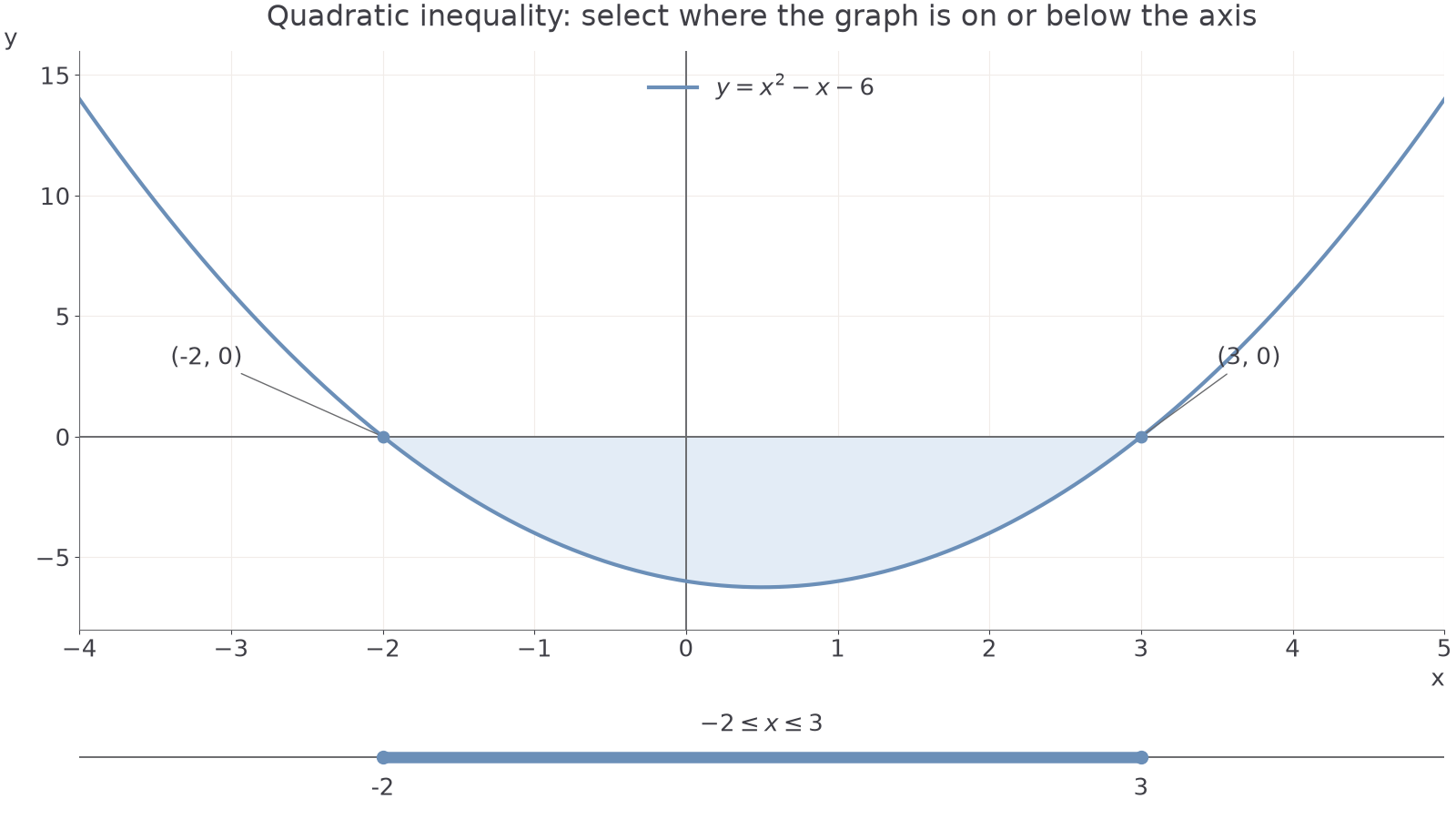
The graph gives the same information: negative outputs lie below the horizontal axis, and zero outputs occur on it.
Worked example 3: a non-positive upward quadratic
Question. Solve .
Plan. Find the roots, inspect signs and decide whether to include the boundaries.
Why this step? The product is negative when its factors have opposite signs; “less than or equal” also permits zero.
Answer. .
Check. At , the output is ; at , it is , so the outside interval is correctly excluded.
Change only the overall sign of the quadratic. Every non-zero output reverses sign.
Worked example 4: a non-positive downward quadratic
Question. Solve .
Plan. Use the same roots but reverse the sign pattern.
Why this step? “Between the roots” is not a universal rule; the leading sign and required inequality decide the intervals.
Answer. or .
Check. The given expression is at , which fails, and at , which works.
A striking boundary case: has exactly one solution, ; replacing the sign by gives none, while gives every real number. A repeated root does not change the square's sign. These conclusions use real squares, without introducing complex roots. The sign-interval method is not supplied in the formula sheet.
Exam tip
For detailed reasoning, show the boundaries and a sign chart, sketch or factor-sign argument selecting the interval. A calculator's two roots do not themselves answer an inequality.
Keep a downward quadratic but change its roots.
Fractions, signs and excluded values
A fraction's denominator must be non-zero, and its sign may change. Multiplying by a variable denominator without checking that sign can reverse an inequality in only part of the domain.
Critical values for a fractional inequality
Zeros of the numerator and denominator split the real line into sign intervals. A numerator zero may satisfy a non-strict inequality; a denominator zero is always excluded.
A quotient is positive when numerator and denominator have the same sign. A sign table avoids multiplying by an expression whose sign is not known.
Worked example 5: an included zero and an excluded denominator
Question. Solve .
Plan. Exclude the denominator zero, find the numerator zero and compare signs in the three intervals.
Why this step? Equality can include , but it cannot make an undefined denominator valid.
Answer. or .
Check. At , the fractions are : the selected intervals have the required signs.
Change only the right side from zero to . Combine into one fraction before inspecting signs.
Worked example 6: a non-zero right side
Question. Solve .
Plan. Subtract using a common denominator, retaining .
Why this step? The numerator never vanishes, so no equality case is possible, despite the non-strict sign.
Answer. .
Check. At , the given fraction is ; at , it is , which fails.
The same idea gives , with , hence . Alternatively, split into positive- and negative-denominator cases and reverse order in the negative case. This is a local extension of the linear/quadratic sign methods, not a new formula on the formula sheet.
Watch out
Wrong: multiply by and conclude . You have lost , where the denominator is negative and the inequality reverses.
Change the numerator so that the final constant has the opposite sign.
And, or and solution sets
A correct interval needs a correct connection to the next one. “And” imposes both conditions; “or” allows either condition.
Union and intersection
The union contains values in either set. The intersection contains values in both. For example, and gives ; and gives the empty set .
In set-builder notation, means real numbers satisfying the stated condition. Specify a different domain, such as integers, when needed.
Interval notation
Round brackets exclude a finite endpoint; square brackets include it. Thus means . Infinity is not an included number, so has a round bracket at infinity. The intervals , and are different sets.
Sketch intervals on a number line when helpful, using open and filled endpoints. A union joins selected pieces; an intersection keeps their overlap.
Worked example 7: taking the overlap
Question. Let and , for real . Find .
Plan. Keep only values belonging to both descriptions.
Why this step? An intersection must satisfy both conditions, not just one.
Answer. , or .
Check. belongs to both sets; fails , and fails .
Change only intersection to union, keeping the same sets. Now values need satisfy just one description.
Worked example 8: taking either set
Question. For and , find .
Plan. Join overlapping pieces and retain any gap.
Why this step? The gap belongs to neither set and cannot be filled by union notation.
Answer. or .
Check. is included through ; is in neither; is included through .
If instead reached , the intersection would be . For simultaneous inequalities, always take the intersection of their solution sets. These notations and operations are not supplied in the formula sheet.
Watch out
Wrong: and for two outside intervals. No number satisfies both. Use or, or join the sets with .
Apply the union method with new endpoints.
Regions and their boundaries
An inequality in two variables selects points, not just horizontal coordinates. Compare heights at the same : means above the line; means on or below the parabola.
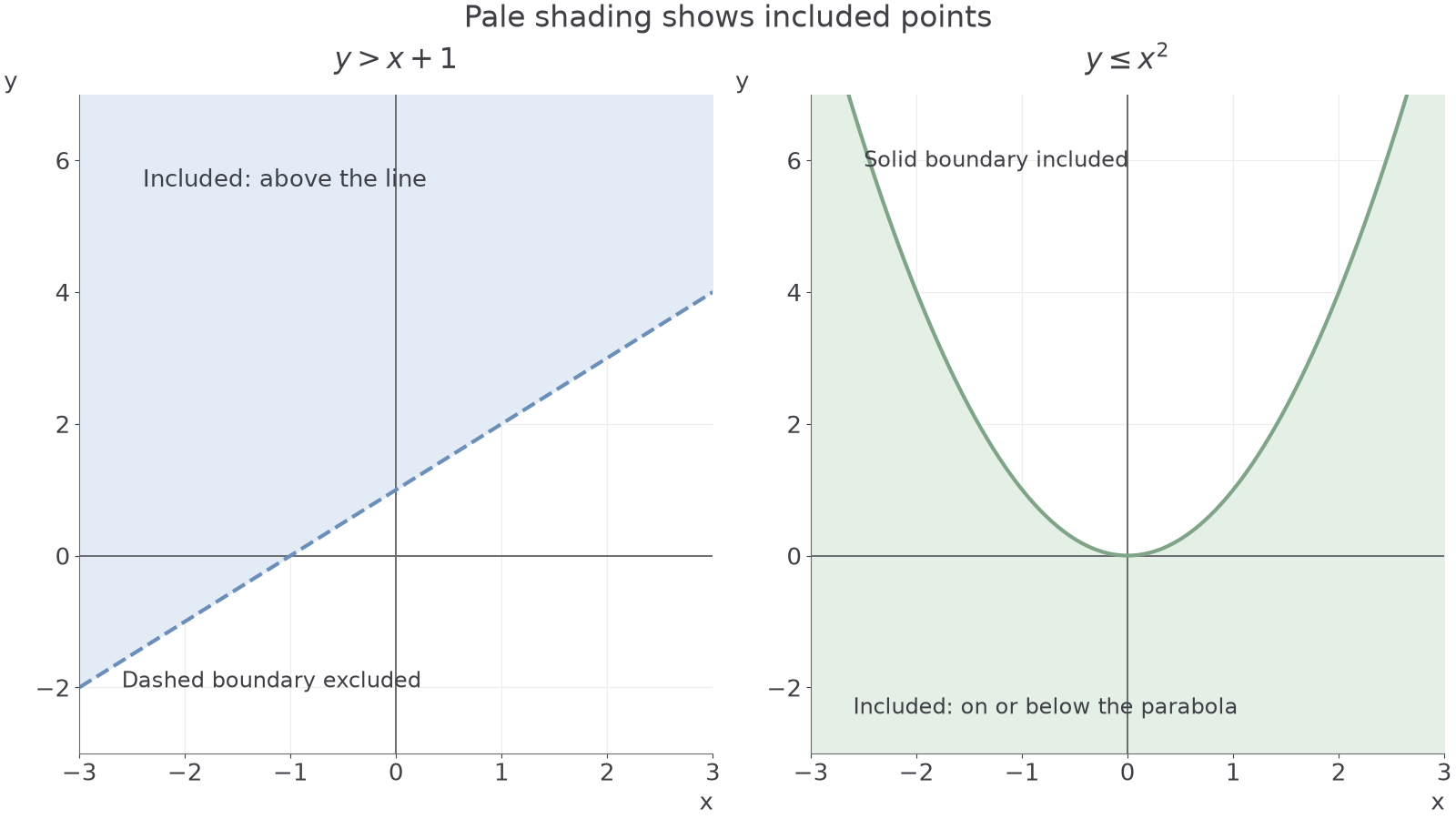
The pale shading here means included points. A solid boundary includes equality; a dashed boundary excludes it. State your convention clearly. Testing a point off the boundary helps: fails but satisfies . “Below a parabola” includes points outside its bowl, not just an enclosed interior.
Worked example 9: an included lower curve
Question. Describe the region , including its boundaries and allowed -values.
Plan. Find where the boundaries meet, then select points between them with the required inclusions.
Why this step? There is room for only where the lower bound is strictly smaller than the upper bound.
Answer. On or above the parabola and below the line, for . Include the parabola within that interval, but exclude the line and the meeting points .
Check. works; neither meeting point can satisfy a strict upper inequality.
Change only the upper inequality to non-strict. The two meeting points now become admissible.
Worked example 10: including both boundaries
Question. Describe .
Plan. Keep the same boundary intersections and include equality to both graphs.
Why this step? At an intersection there is one possible height, and both non-strict inequalities permit it.
Answer. Between and on both graphs, for , including .
Check. At , gives ; at , gives .
The opening region therefore includes its curved boundary for interior -values but excludes its ends: a boundary point must satisfy every inequality. Graphical region and boundary conventions are not supplied on the formula sheet.
Watch out
Wrong: include an intersection because it lies on an allowed curve. If another inequality excludes that point, the combined region excludes it too.
Use a horizontal upper boundary and a shifted parabola in your turn.
Quick Recap
- Negative multiplication or division reverses order; constant positive denominators do not.
- Roots split a quadratic into sign intervals; check the leading sign and endpoint inclusion.
- Denominator zeros are excluded, even under a non-strict inequality.
- “And” means intersection; “or” means union. Write included and excluded endpoints accurately.
- A graphical region contains only points satisfying all its inequalities.
Yes, includes the curved boundary for , while its endpoints are excluded by the strict upper inequality.