3.03e, 3.03l, 3.03p - Resolving forces and dynamics in a plane
Resolve angled forces into useful perpendicular directions, add their components and apply Newton's second law in a plane. You will calculate resultants, distinguish force from motion direction, and handle horizontal surfaces, inclines and resolved third-law pairs.
Resolving a force along chosen axes
Can pulling upwards on a box make it press less hard on the floor without lifting off? A pull at above horizontal supplies upwards as well as a forward component. The upward part reduces the floor force; we will calculate both effects.
You already know
For a right-angled triangle, cosine uses the adjacent side and sine the opposite side. Components have signs; magnitudes do not. Choose positive directions before calculating.
Resolving replaces one vector by components whose vector sum equals it. It does not create extra physical forces.
Perpendicular force components
For magnitude at angle anticlockwise from positive horizontal,
These are signed projections on perpendicular axes. Not in the formula sheet: learn it.
If the angle is measured from vertical, the vertical component is adjacent to it. Redraw the small right-angled triangle rather than learning a second rule.
Worked example 1: angle from horizontal
Question. A force points up and right at above horizontal. Find its signed horizontal and vertical components exactly, with right and up positive.
Plan. Use the angle's adjacent and opposite projections.
Why cosine horizontally? The stated angle touches the horizontal component.
Answer. .
Check. ; the components recover the force's magnitude.
Change only the reference direction: the same numerical angle is now measured from upward vertical. Both component tasks remain exact.
Worked example 2: angle from vertical
Question. A force points up and right at to upward vertical. Find its signed horizontal and vertical components exactly, with right and up positive.
Plan. Put cosine beside the new reference angle.
Why do sine and cosine switch places? The reference line changed, so the adjacent side changed.
Answer. .
Check. The vertical component is now larger, matching a force nearer the vertical; its magnitude is still .
For up-left, the horizontal component becomes negative. Axis choice can also rotate: on an incline, parallel and perpendicular directions often make the equations shorter.
Watch out
Adding , and counts one force twice. Use either the force or its two components in an equation.
Keep the vertical reference angle but change the direction and magnitude.
Resultants, magnitude and direction
Two forces at a point combine by vector addition, not by adding their magnitudes.
Resultant of concurrent forces
The resultant is the single force having the same vector effect as all the given forces acting at a point. Concurrent forces have lines of action meeting at that point.
Two perpendicular forces have resultant , not . More surprisingly, two equal forces separated by have resultant just : their sideways components cancel and their components along the bisector are each.
Resultant from components
For coplanar forces resolved along the same perpendicular axes,
Use the component signs to determine direction. Not in the formula sheet: learn it.
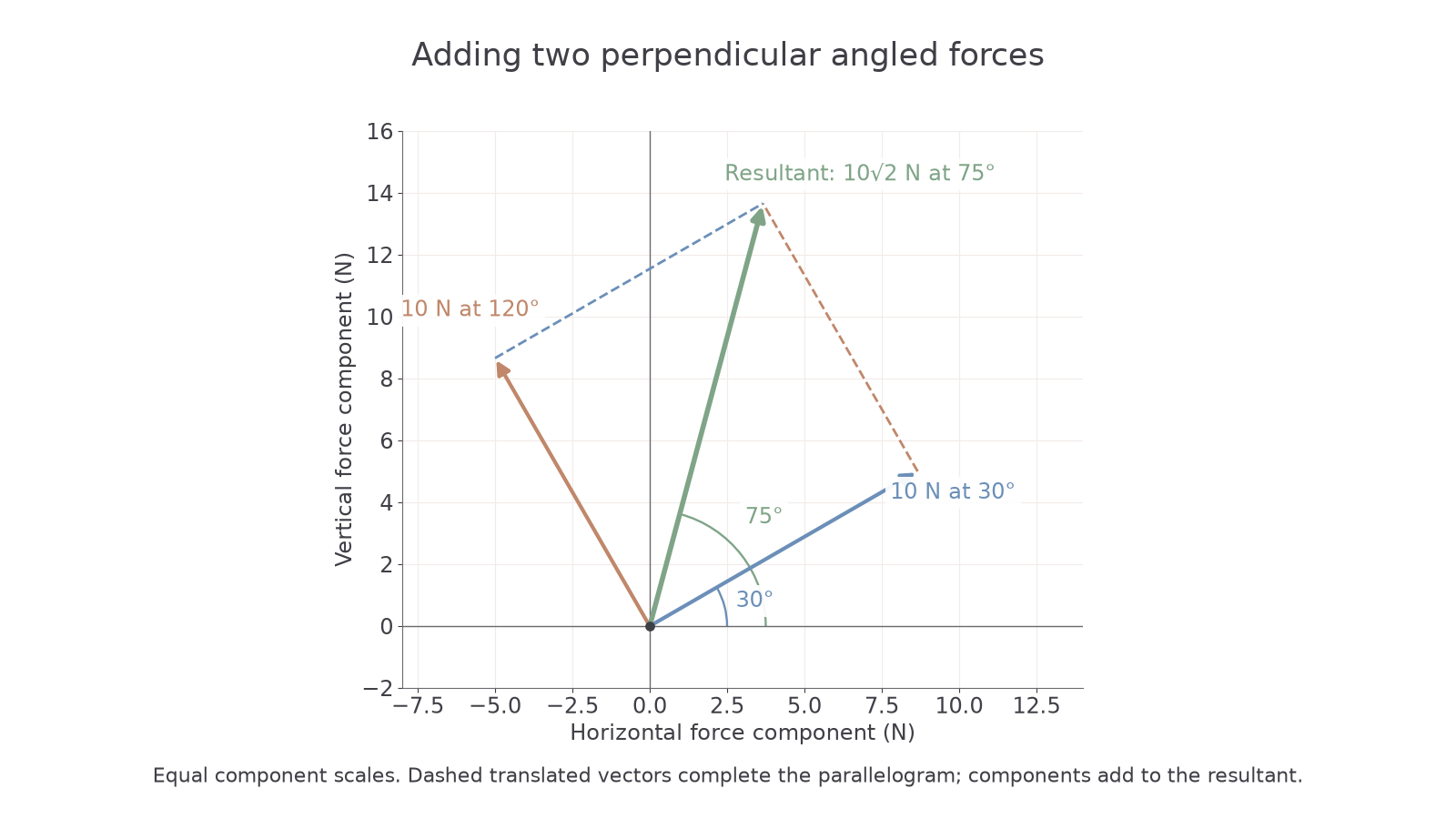
The diagram translates one force head to tail without changing its direction. We calculate the result rather than reading it from a scale drawing.
[DIAGRAM: asset_name: Adding perpendicular angled forces; asset_slug: angled_force_resultant; description: Equal-scale force-component axes show 10 N at 30 degrees and 10 N at 120 degrees, their head-to-tail parallelogram and the resultant at 75 degrees; caption: Two perpendicular 10 N forces give a resultant at 75 degrees]
Worked example 3: summing two angled forces
Question. Two forces act at and anticlockwise from positive horizontal. Find their resultant vector and magnitude exactly, and its direction to one decimal place if a direction exists.
Plan. Resolve, sum each coordinate, then find length and quadrant.
Why check the quadrant? The ratio alone cannot distinguish opposite directions.
Answer. , magnitude , direction anticlockwise from positive horizontal.
Check. Equal forces give a resultant along their angular bisector; .
Change only the second force's direction to . The forces now oppose exactly.
Worked example 4: a zero resultant
Question. Two forces act at and anticlockwise from positive horizontal. Find their resultant vector and magnitude exactly, and its direction to one decimal place if a direction exists.
Plan. Sum the components before trying any inverse tangent.
Why stop before finding an angle? A zero vector has no direction; an inverse-tangent ratio would be .
Answer. Resultant , magnitude ; its direction is undefined.
Check. The two equal forces differ in direction by , so they cancel.
For a non-zero resultant on mass , acceleration is . Positive mass preserves direction. Velocity points along the motion; acceleration points along the resultant. For example, on gives , even if the initial velocity is rightwards.
Watch out
A negative horizontal and positive vertical resultant points up-left. Giving only an acute inverse-tangent answer without saying “above left” loses the direction information.
Try a non-zero resultant in that quadrant.
Angled forces on a horizontal surface
The opening pull changes two things: horizontal acceleration and the reaction required to maintain contact.
A smooth horizontal surface supplies normal reaction but no friction. For a particle staying on it, vertical acceleration is zero. Weight acts downwards, reaction upwards, and the applied force has its own two components.
Continue this lesson.
You’re previewing NovaLearn without an account. Create a free account to read the rest.
Create free account