1.05q - Trigonometric models in context
Use sine and cosine to describe repeating changes, predict when a condition is met, and resolve directed quantities into components. Turn observations into parameters, then interpret the answers in hours, metres or newtons. A model's neat arithmetic is useful only while its assumptions remain sensible.
Building a periodic model from observations
When does a harbour model predict enough depth for a boat needing more than ? Suppose the depth varies between and , repeats every hours and first reaches a maximum at 02:00. Build the cycle first; then we can answer the boat's question precisely.
You already know
Sine and cosine take values from to and repeat after radians. Cosine starts at a maximum when its input is zero. A horizontal shift changes when a feature occurs, without changing its height.
The trigonometric input here is a phase measuring progress through a cycle. Time is not itself a geometrical angle: multiplying hours by radians per hour gives the radian input the function needs.
Parameters of a periodic model
The midline is the centre value; the amplitude is the maximum departure from it. The period is the time for one complete repetition. A phase shift fixes the timing of a reference event, such as a maximum.
A cosine model is convenient when you know a maximum. A sine model with the appropriate shift can describe exactly the same function.
Cosine model with a reference maximum
For , ,
The maximum is , the minimum is , and maxima occur at , , within the chosen time domain. The angular frequency is .
Not in the formula sheet: learn it.
Check that the chosen domain contains both a maximum and a minimum before reporting the full range of the cosine model.
Worked example 1: fitting the harbour cycle
Question. Construct the stated harbour-depth model for , where is hours since midnight and depth is in metres. State its range.
Plan. Average the extreme depths, halve their difference, then put the observed maximum at the zero of a cosine phase.
Why this step? Cosine equals when , so the phase directly matches the observed high water.
Answer. The displayed model has domain hours and range metres.
Check. It gives high water at and low water at , with the required heights and -hour separation.
The graph shows the whole day, including its endpoints; those endpoints will matter in the threshold problem.
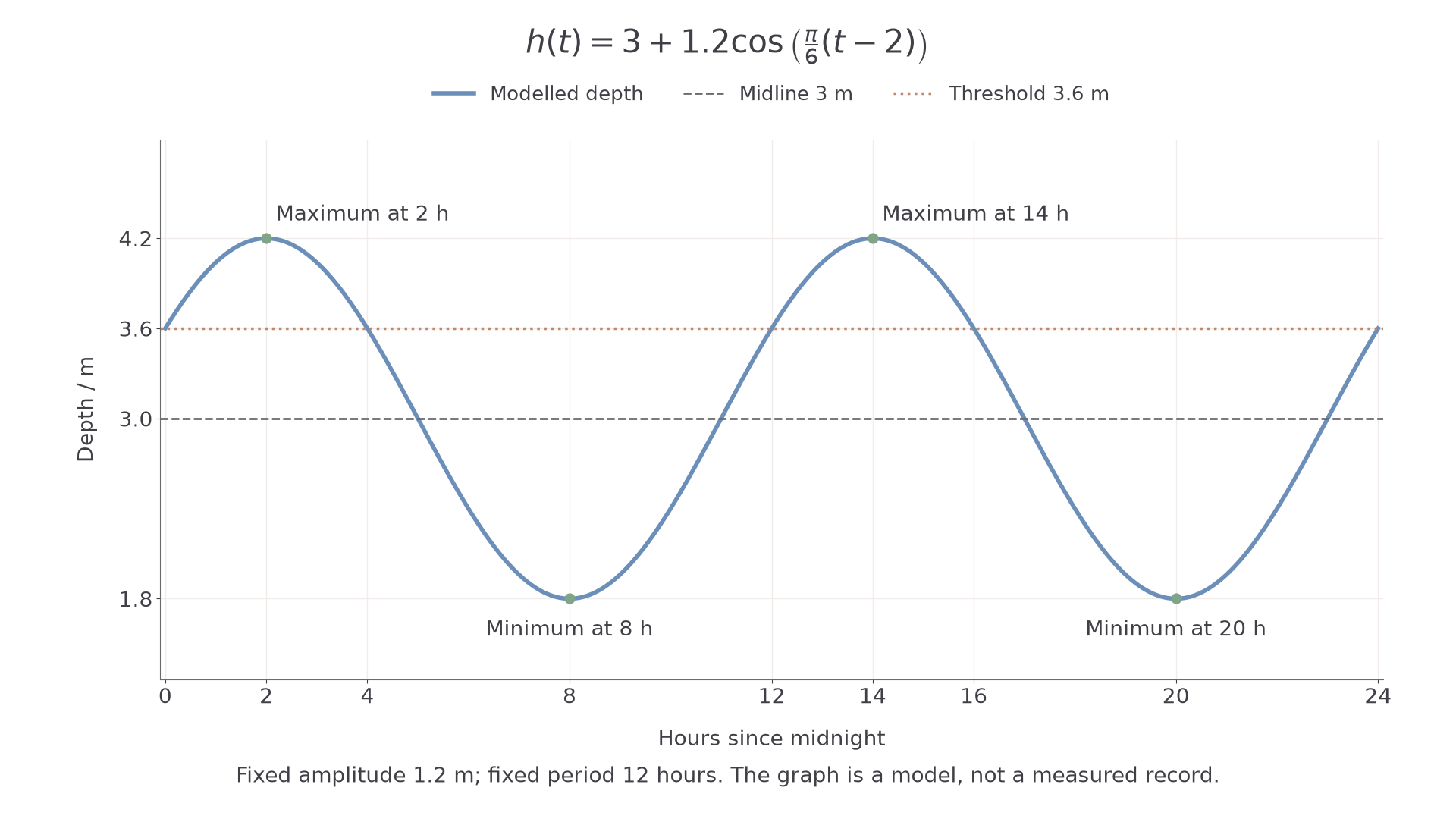
Change only the time of the first maximum. The centre, amplitude and period stay fixed.
Worked example 2: changing the timing
Question. A second harbour has the same extreme depths and period, but its first maximum is at 05:00. Construct its model on .
Plan. Keep the first model's vertical parameters and replace its reference time.
Why this step? The whole phase must be zero at the reference time; subtracting outside the cosine would change depth instead.
Answer. The model is , for .
Check. Maxima occur at hours and minima at hours; the range is still metres.
The angle setting is part of using the model correctly.
Watch out
Wrong: enter in degree mode. Right: use radians for this phase. Its frequency is radians per hour, not hours.
Keep the second harbour's timing but change its cycle length.
Times and intervals that satisfy a condition
A threshold asks you to solve over the model's actual time domain, rather than return one inverse-cosine value.
Use the first harbour's model , . Its phase runs from to . Listing all boundary crossings and checking between them is safer than guessing a time window from one root.
Worked example 3: a strict depth requirement
Question. Find every time in the stated day when .
Plan. Solve the threshold equality, then use a maximum to select the correct sides of its crossings.
Why this step? The inverse-cosine output gives only one boundary phase; periodicity and the second branch give all crossings.
Answer. The predicted times are or hours since midnight.
Check. At , depth is , so the selected intervals are above threshold. Each listed boundary has depth exactly and is excluded.
Change only “more than” to “at least”. The equality cases now belong in the answer.
Worked example 4: an included endpoint
Question. Find all times in the same day when .
Plan. Include every threshold boundary as well as the above-threshold intervals.
Why this step? At equality holds, although the following above-threshold interval lies outside the day. A single point can belong to an inequality solution.
Answer. From midnight to 04:00 inclusive, from 12:00 to 16:00 inclusive, and at 24:00.
Check. The next maximum would be at , outside the domain; no interval beyond is included.
That isolated endpoint is a useful surprise: an inequality need not produce intervals alone when you restrict the domain. Also check the range first. Since is the maximum, holds only at ; has no solutions.
Exam tip
Report the full time intervals, their endpoint inclusions and their units. A list of equality times alone does not answer a “greater than” condition.
Lower the threshold to the midline, keeping the non-strict relation.
Combining effects with one frequency
Contributions with the same frequency can combine into one wave, but their amplitudes do not usually add.
Combining cosine and sine contributions
For ,
Here . Expand the cosine to derive and check the coefficient matching; handle other signs with a suitable phase.
Not in the formula sheet: learn it.
The compound-angle identity is supplied, but this harmonic-form result is derived from it. A phase in radians becomes a time only after division by angular frequency.
Worked example 5: two positive contributions
Question. A depth is modelled by , where radians per hour and . Find its range and first maximum time.
Plan. Combine the equal-frequency terms and set the new cosine phase to zero.
Why this step? The two contributions reach their own maxima at different times, so is not the combined amplitude.
Answer. The range is metres; the first maximum is about hours after , to significant figures.
Check. At that time, cosine and sine of are and ; the depth is .
Change only the sign of the sine contribution. The amplitude is unchanged, but the first non-negative maximum moves.
Worked example 6: a reversed sine contribution
Question. Find the range and first maximum time for , with the same and .
Plan. Use and choose the first admissible maximum phase.
Why this step? Setting the phase to zero gives a negative time; the next cosine maximum is one full turn later.
Answer. Range metres; first maximum at approximately hours.
Check. At the exact time, and , giving depth . Maxima repeat every hours.
A single-wave combination requires the same frequency. Different-frequency contributions can make a more complicated pattern; coefficient matching into one cosine would be unjustified.
Watch out
Wrong: the phase means a delay of hours. Right: divide the phase by , with units, to get the corresponding time shift.
Change the ratio of the two contributions while retaining their signs and frequency.
Continue this lesson.
You’re previewing NovaLearn without an account. Create a free account to read the rest.
Create free account